We asked leaders at Davos 2026, how can we build prosperity within planetary boundaries? Here's what they said
Deep dive
One of the key questions that the Forum framed for its annual meeting is: “How can we build prosperity within planetary boundaries? Image: World Economic Forum
- Growth of renewable energy is now irreversible, according to delegates at Davos, driven by plummeting prices and wide-scale affordability compared to fossil alternatives.
- Food systems need urgent transformation to meet the projected 50% increase in demand by 2050 – greater support for farmers and fishers is critical.
- Global heating risks tipping the planet into runaway climate change – the race is on for positive tipping points in green technologies to get there first.
Davos in 2026 will be remembered as a week when geopolitics owned the stage – yet the climate and nature crisis persisted in the wings.
Business leaders in the real economy – from agriculture and biotech to energy and mining – announced unequivocally that “business-smart is climate-smart”. In doing so, they buried the myth that prosperity and sustainability are opposing forces.
“The bell has tolled,” declared Andrew Forrest – whose mining company Fortescue estimates it can save one billion dollars a year by switching to renewable energy. “We are not woke, we are not senseless greenies,” said Forrest: “We are hard-edged business people with an understanding of the planet.”
Have you read?
We asked leaders at Davos 2026, how can we cooperate in a more contested geopolitical world? Here's what they said
We asked leaders at Davos 2026, how can we unlock new sources of economic growth? Here's what they said
We asked leaders at Davos 2026, how can we build prosperity within planetary boundaries? Here's what they said
We asked leaders at Davos 2026, how can we better invest in people? Here's what they said
Double crisis: critical Earth systems risk tipping from sinks into sources of heat
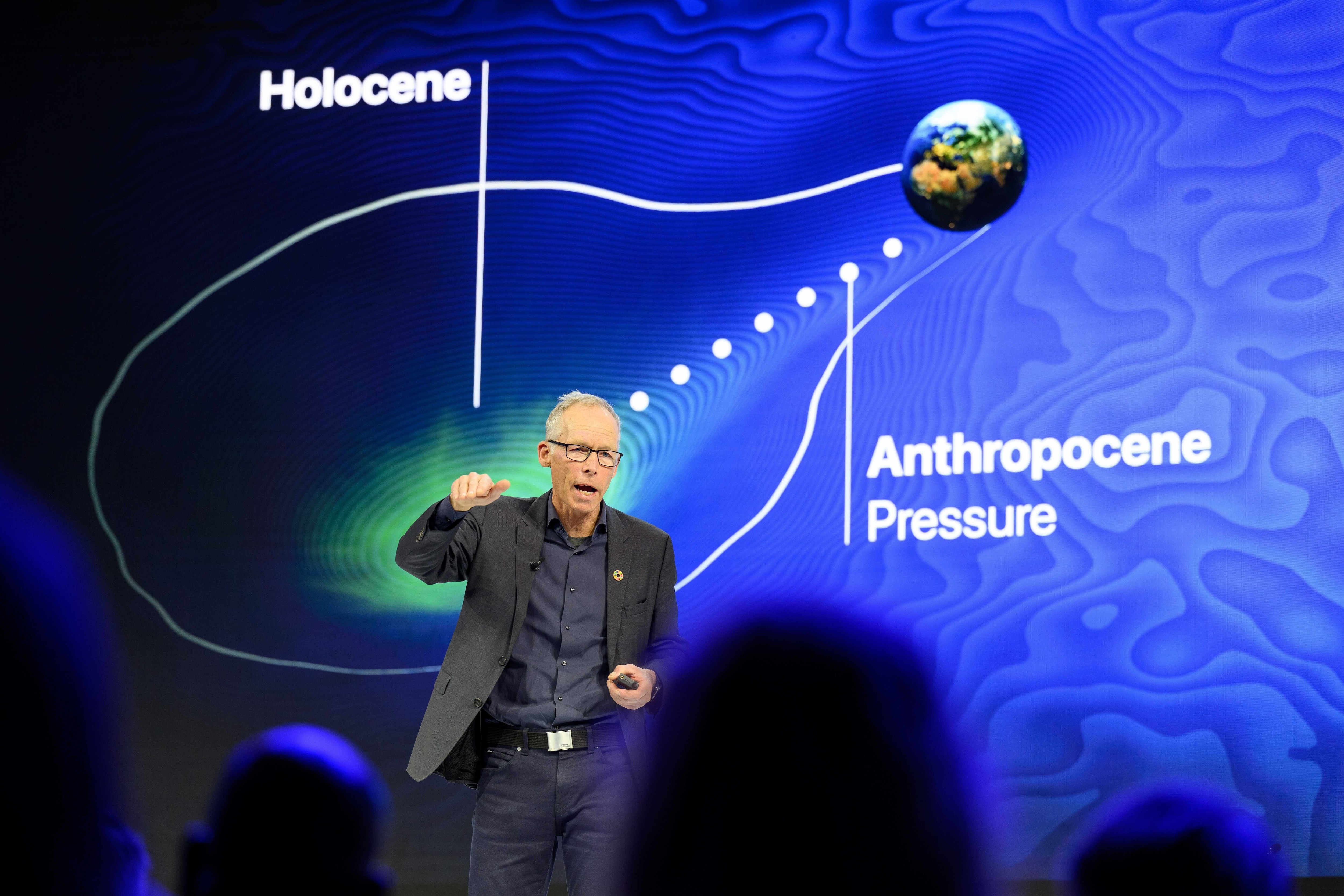
“We are at a really, really decisive juncture,” announced Johan Rockström, Director of the Potsdam Institute for Climate Impact Research and one of the world’s most highly regarded climate scientists. “Time is running out,” he told Davos delegates – “but it’s not too late.”
For the past 12,000 years, the planet has enjoyed an extraordinarily stable climate, averaging 14°C mean surface temperature – plus or minus half a degree – giving human life a safe space within which to thrive. Yet within the next three to five years, scientists expect the planet to conclusively breach the 1.5°C barrier – driven by concentrations of CO2 that are now 52% above pre-industrial levels. “We are heading towards a disastrous, unmanageable in terms of scientific evidence, 3°C world in the next 75 years,” warned Rockström.
Greenhouse gas emissions are driving a double crisis. As temperature records tumble year-on-year, climate-driven disasters – wildfires, windstorms, floods and droughts – are becoming more frequent and intense. In turn, the heat already absorbed by the planet’s oceans and atmosphere threatens to push 16 critical biophysical systems beyond tipping points of no return.
When healthy, these systems – including the Greenland ice sheet, Amazon rainforest and Atlantic meridional overturning current (AMOC) – cool our planet and dampen the effects of extreme heat. But, says Rockström, “push them across thresholds, and they will change feedbacks, self-amplify warming and undermine the basis for stable economies.”
New research shows these critical systems are closer to tipping points than previously thought. For example, scientists have long warned the Amazon rainforest could turn into dry savannah. The threshold was once estimated at 3-5°C of warming. Now, in combination with the feedback effects of ecological risks such as forest loss – the trigger point is 1.5°C with 20-25% deforestation. Already, the destruction of tree cover across the Amazon has reached 17-18%.
The question now is a stark one: can the global economy – which drives climate change – hit positive tipping points in large-scale adoption of low-carbon technologies before Earth’s own critical systems pass tipping points of no return?
Combating climate change is also a battle for the narrative – sustainability makes economic sense
Despite this glimpse into an apocalyptic future, leading figures in the climate movement point to positive news. Christiana Figueres, an architect of 2015’s Paris Agreement and co-host of the Outrage + Optimism podcast, points out that, a decade ago, carbon emissions were climbing by 2%. Today, the figure is down to 0.3%. Nothing like enough – but at least it’s the right direction of travel.


Countries from Latin America to Australia, Africa and Asia are embracing renewable energy, prompting the birth of “a new industrial sunbelt” across the Global South. Sounding a note of defiance that decouples climate action from COP and US Congress machinations, Figueres maintains: “Even as the politics have stalled, it is the economy and the hope of people everywhere that keep pulling change forward.”
Meanwhile, in Davos, despite the headlines, that spirit of hope in the future green economy felt alive. Ester Baiget, President and CEO of Novonesis, a Danish biotech company, put it this way: “Business-smart is climate-smart – they are two sides of the same coin.” She warned the climate crisis is compounded by a “narrative crisis” – a failure to explain that the transition to a more sustainable economy is “not only about the climate, it’s about growth, it’s about prosperity, and it’s about resilience – because those solutions are already competitive”.

Baiget is Co-Chair of the Forum’s Alliance of CEO Climate Leaders – whose 100+ members demonstrate the truth of her words. These major global companies have cut their CO2 emissions by 12% while at the same time increasing revenues by 20%. In December, the Alliance announced in its annual report that the world’s green economy is now valued at $5 trillion.

Analysis by the Forum and Boston Consulting Group shows that across the market, green revenues have grown twice as fast as conventional revenues on average, and companies operating in these markets typically access cheaper capital, build future competitiveness and often gain premium valuations on capital markets. In fact, from 2016-2024, companies with over 50% green revenues attracted valuations 12-15% higher than non-green competitors, on average.
The result of this acceleration in the green economy is that, today, solutions to decarbonize more than 50% of total emissions – such as solar, wind, hydro, energy efficiency and EVs – are already cost-competitive, while a further 20% of emissions are addressable through solutions at only a minor cost disadvantage.
The spectacular fall in the price of solar photovoltaic panels is well-documented, enabling China, for example, to expand its installed solar capacity from tens of gigawatts (GW) in 2015 to over 1 terawatt (1,000 GW) by mid-2025. Global investment in clean energy reached more than $2 trillion in 2025 – with 600 GW of renewables installed across the globe in 2024 – underlining the fact that this industry is already well past the tipping point of commercial viability.
The story is similar for electric vehicle (EV) sales, which are accelerating at pace. Stella Li, Executive Vice-President of leading Chinese carmaker BYD, told Davos that EV penetration in China had reached 52% by the end of 2025. This was an industry kick-started by the Chinese government’s decision to provide a decade of purchase subsidies for “new energy vehicles”. Those incentives ended in December 2022 – and since then, EVs have competed on a level playing field with fossil-fuelled alternatives. According to Li: “Once penetration is more than 30%, then it’s driven by the consumer.”
Sustainability doesn’t just make smart business sense for tech start-ups – it also applies to incumbent heavy industries. Fortescue – one of the 10 largest mining companies in the world – recently announced it would switch from diesel-powered trucks and trains to alternative transportation powered by renewables and batteries. “When we prove that we can save up to a billion dollars in operating costs through removing diesel from our supply chains, and not just maintain but grow our competitive position and continue to outperform our peers," added its founder, Forrest, “then the bell has tolled”.

Ensuring prosperous and sustainable food and water systems
Energy systems – powering industry, transport and buildings – are the largest source of planet-warming greenhouse gases, accounting for the majority of all emissions. Food systems are the other major contributor, accounting for up to one-third of all greenhouse gas emissions, when agriculture, land-use change and the food supply chain (e.g. processing, transport, retail, waste) are taken into account. So any discussion of building prosperity within planetary boundaries has to embrace how we grow, trade and consume food.
Food security is increasingly becoming national security. Major staple crops in Africa face declines in yield of ~33% at 2°C of global warming, without interventions to boost adaptation. Rice-growing areas in Southern India are facing declines in productivity of 35% by 2040.
Meanwhile, the global population is projected to reach almost 10 billion people by 2050, driving up food demand by ~50% compared to 2013. This means food systems must deliver half as much output again within one generation, against a backdrop of falling yields due to global heating, degraded soils and depleted freshwater sources.
Addressing delegates at Davos, Kashim Shettima, Vice-President of Nigeria, declared: “We don’t look at food security purely as an agricultural issue – it is a macroeconomic, security and governance issue.” He identified Nigeria’s three pillars of food security as improving food yields and production, improving environmental performance and enhancing integration of the food supply chain within West Africa.
The solutions to restoring food systems are complex and location-specific. They include developing more climate-resilient crops, replenishing soils with the right nutrients, increasing yields, reducing waste and boosting market connectivity – enhanced by the data aggregation and analysis power offered by AI.
However complex the solutions, they all revolve around one simple insight: farmers need far more support and investment. “How are we supposed to take care of food security if we don’t take care of farmers first?” asked Ana Carolina Zimmermann, an industrial engineer and farmer based in Goiás, Brazil, where she manages beef cattle operations at Fazenda Ribeirão.

Jai Shroff, Chairman and Group CEO of UPL and a well-recognized global leader in sustainable agricultural development, argued that farmers deserve greater incentives to reward them for the risks they take to ensure they feed the world in a sustainable way.
Nigeria’s Vice-President proposed a systemic farmer-focused approach. Smallholders and fishers in particular need access to affordable credit to invest in the improved seeds and fertilizers they need. In turn, to become eligible for loans, they require titles to land and waterways.
Once the crops are grown and harvested, farmers need supply chains and markets to trade their goods – from cooperatives to aggregate their produce through to regional trading opportunities. The vice-president pointed out that intra-African trade in food products is roughly 15% compared to 70% in Europe.

One idea to address this, aired at Davos, is to designate “food basket” regions of Africa – such as West Africa for rice and Southern Africa for grains – then open up a free-trade area across the continent to boost regional trade and reduce the continent’s dependence on food imports.
The role of blue foods – including both freshwater aquaculture and marine-based fisheries – is critical, especially in Africa. According to a recent report by the Forum, blue foods already supply about 18% of Africa’s total animal protein, often at a lower cost than meat or poultry. Doubling this production could unlock an additional $17 billion in GDP, reduce Africa’s protein gap by 25% compared to the global average, and generate millions of sustainable livelihoods.
The emphasis on blue foods is part of a wider Blue Davos initiative that highlights the vital role of water ecosystems – from ocean to freshwater – in global stability, trade, livelihoods, food systems and climate resilience.

Meanwhile, there is an important role for corporate food procurement that maintains the economic priorities of quality, availability and cost, but also prioritizes the safeguarding of nature to ensure continuity of supply. A report published by the Forum’s First Movers Coalition for Food presents proven solutions, from regenerative farming practices in row crops, to water management and lower-methane approaches in rice. To move these initiatives beyond pilot stage requires bold demand-side leadership: strong, credible market signals that unlock finance, align value chain partners and give farmers the confidence to invest.
Prosperity within planetary boundaries – but for whom?
One of the key questions that the Forum framed for its annual meeting is: “How can we build prosperity within planetary boundaries?” Few would question the sense of this goal – but prosperity for whom? Shortly before Davos, Oxfam launched its Global Inequality Report, which reported that just 12 billionaires have amassed greater wealth than half of humanity – more than 4 billion people. Meanwhile, the World Bank estimates that 831 million people are trying to survive on less than $3 a day.
In a matter of decades, a minority of humanity – and not just billionaires – has benefitted at the expense of both the planet and the majority of those living on it. But – apart from the ethical limits tested by this inconvenient truth – there are now planetary limits to contend with. Given the explosion in demand that a soaring global population will drive for food and energy by mid-century, the low-carbon transition will fail if it cannot carry everyone on the planet with it. And that failure would threaten to sweep us all – wealthy and poor alike – off the map of the known world.
So this agenda – to build prosperity within planetary boundaries – offers hope, an opportunity for a rebalancing of our relationship with nature, but also with each other. Given the dominance of economic logic over most political and corporate decision-making, the critical tipping point for the wide-scale adoption of low-carbon, green technologies – whether by multinational companies or ordinary people – is affordability.
Until 2024, Pralhad Venkatesh Joshi was India’s Minister of Coal. But over the past year, he has become convinced of the potency of his new portfolio – as Minister of New and Renewable Energy, in what is now the world’s most populous nation. Over the past decade, India has multiplied its solar capacity 45-fold, from just 3 GW to 136 GW today. During the same period, the purchase price for solar power has fallen almost 80%, making it cheaper than coal and oil.
Importantly, the Indian government has launched an ambitious programme to install rooftop solar power for 10 million households, giving ordinary people not only cheap energy but also the capacity to sell excess power back to the grid. The programme has already reached 2.7 million homes. “There is no question on the affordability of solar,” Joshi declared to the Davos audience: “The future is renewables – the discussion is over.”
The renewable energy transition is irreversible – adds Elizabeth Thurbon, Professor of International Political Economy at the University of New South Wales, Australia. This is because two-thirds of global energy investment is now going into clean energy, and renewables are the cheapest form of electricity in almost every location. It is also irreversible because the energy transition boosts economic security, energy security, environmental security and social security, generating three times more jobs for every dollar spent than the fossil fuel economy. Addressing delegates – and political leaders – at Davos, Thurbon said: “This is an enormous good-news story – about the energy transition as a massive national security multiplier – that's a message that conservative governments can get behind.”


License and Republishing
World Economic Forum articles may be republished in accordance with the Creative Commons Attribution-NonCommercial-NoDerivatives 4.0 International Public License, and in accordance with our Terms of Use.
The views expressed in this article are those of the author alone and not the World Economic Forum.

Forum Stories newsletter
Bringing you weekly curated insights and analysis on the global issues that matter.