How India proves health and digital health are the world’s best investments
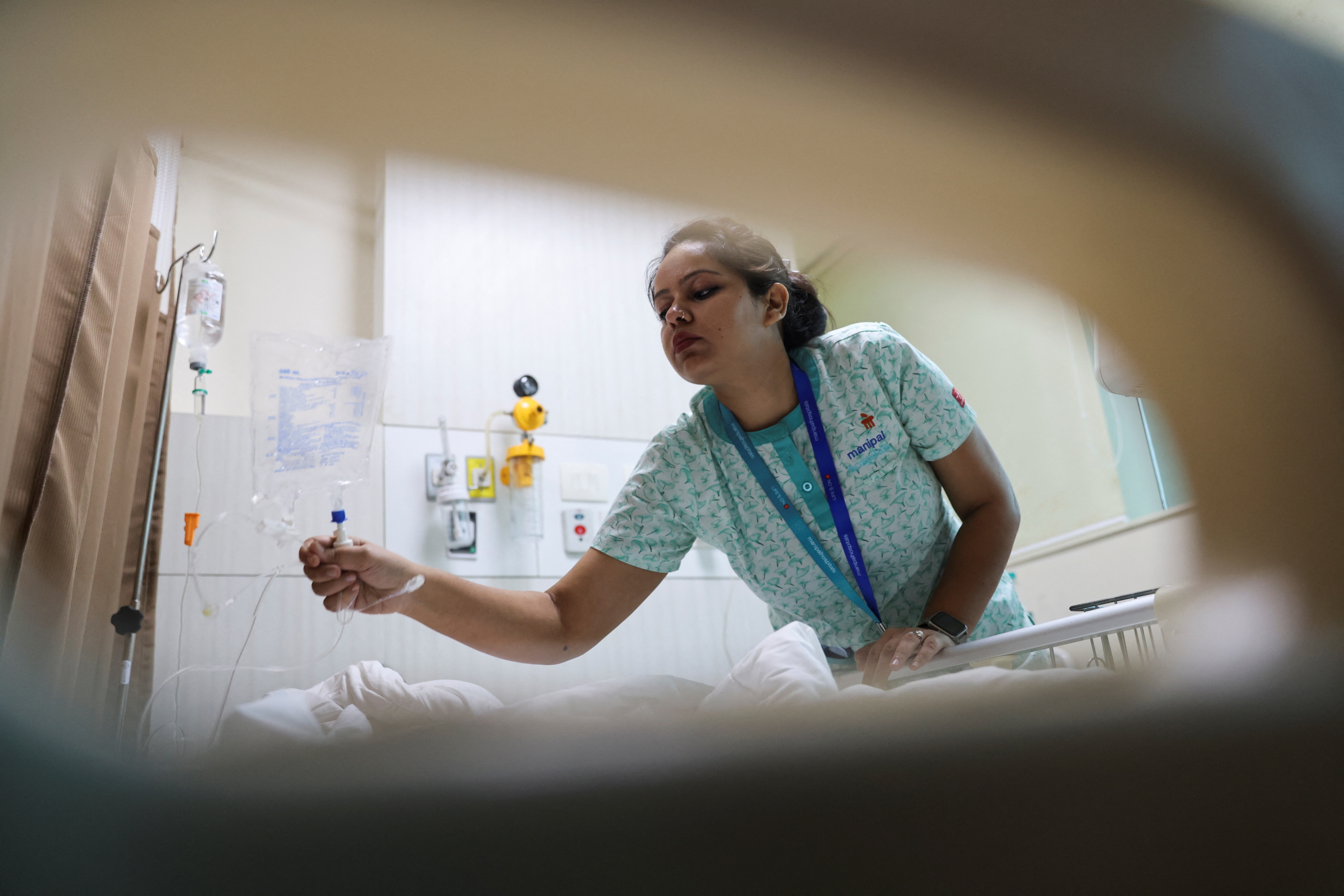
Investment in health – especially innovation-led digital health – is proving to be growth capital, not a cost Image: REUTERS/Anushree Fadnavis
Shyam Bishen
Head, Centre for Health and Healthcare; Member of the Executive Committee, World Economic Forum- Health is one of the world’s highest-return investments, with strong evidence that preventive care and digital systems deliver major economic and social gains.
- Digital health infrastructure, such as interoperable data systems and AI-enabled care, reduces system waste, expands access and strengthens productivity.
- Outcome-oriented, public–private collaboration can unlock a compounding health dividend, with India offering early evidence of scalable, innovation-led transformation.
Health is the world’s best investment. It drives productivity, strengthens economies, and anchors social stability. As the world faces demographic shifts, rising chronic disease and tighter budgets, investment in health – especially innovation-led digital health – is proving to be growth capital, not a cost.
Recent analyses prove that returns on health investment are significant. Investing just $0.24 per person per year in selected digital tools for non-communicable diseases, for example, could save more than 2 million lives and generate nearly $200 billion in economic gains by 2033 – evidence that digital health is itself a high-return investment.
The McKinsey Global Institute similarly finds that better health could add US $12 trillion (~8% of global GDP) by 2040 through fewer early deaths, fewer health conditions and higher labour-force participation of healthier people; and through the productivity gains achievable by workers who are physically and cognitively healthier.
The returns on health are essentially the compounding benefits that flow from stronger human capital, reduced system waste and greater innovation. Unlocking them requires sustained commitment from governments, business and civil society, as well as a mindset shift to view health as a strategic investment.
Investment is already being made
India’s Ayushman Bharat Digital Mission (ABDM) shows how such investment begins to take shape. As of late 2025, more than 834 million citizens hold ABHA digital IDs, with approximately 438,000 health facilities and 738,000 professionals registered. More than 787 million digital records have been linked.
ABDM’s sandbox model enables any health facility, insurer, laboratory or digital provider to integrate once and seamlessly connect with every other ABDM-enabled entity. Custom API integrations in India typically cost at least $2,500 each when including vendor fees, manpower time, testing effort and leadership oversight. With ABDM’s design, one certified integration replaces multiple bespoke interfaces and the system-wide savings can instead strengthen clinical care, cybersecurity, and citizen engagement.
This same logic applies inside large public or private hospital networks, diagnostic chains and integrated care systems, which often operate multiple IT platforms internally. Unifying these via ABDM’s common rails can significantly reduce IT duplication and long-term maintenance costs.
Leading hospital networks in India – including Apollo Hospitals – are beginning to show returns. In 2024, Apollo delivered 1.2 million teleconsultations and deployed 20 industry-certified clinical AI tools in acute care, diagnostics and public health use cases, expanding specialist access to tier-2 cities (mid-sized urban centres outside India’s largest metropolitan areas, typically with developing healthcare infrastructure and more limited access to specialist services) and improving clinician productivity. These tools have already been used for more than 3.5 million individuals across Apollo facilities in India, with adoption growing at other global sites.
Apollo’s early GenAI investments have also improved hospital efficiency, reducing discharge times by 39% and increasing throughput by 7.4%. Longer-term follow-up from Apollo’s AICVD cohort suggests better outcomes for high-risk cardiac patients, including shorter hospital stays, lower mortality and fewer ventilation days. Their primary care models also show a similar impact. The Apollo–ATC Digital Dispensary programme in Madhya Pradesh, recognized by UHC2030, has demonstrated significantly lower per-visit costs and improved access for women and underserved communities.
Together, these examples illustrate a growing body of evidence: that investing in interoperable systems, preventive care, and digital capacity yields real – and rising – returns.
This reflects a mindset shift that leaders across Apollo Hospitals and the World Economic Forum have consistently emphasized – moving beyond a purely public health lens toward a whole-of-economy approach where all actors share accountability for outcomes.
Bridging the global investment and outcome gaps
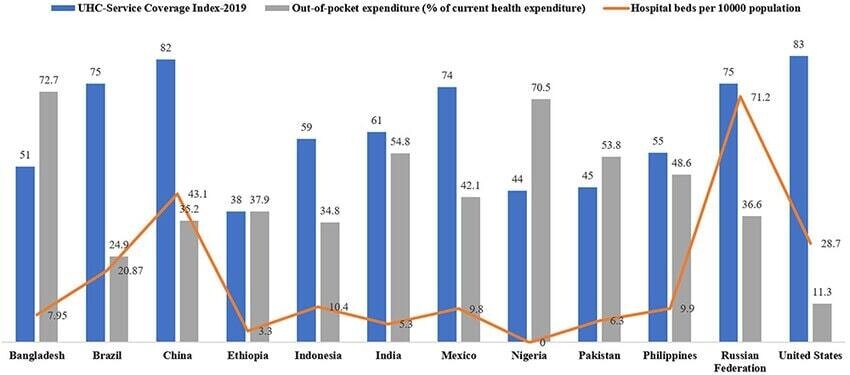
Despite progress, major disparities persist. In 2023, around 4.6 billion people still lacked full essential-service coverage; in 2022, about 2.1 billion faced financial hardship, including 1.6 billion pushed deeper into poverty.
The World Bank reports a $176 billion annual financing gap for essential services, such as primary care, maternal health and non-communicable disease prevention, in the poorest countries. In addition, 20–40% of health spending is lost to inefficiencies and over $500 billion in out-of-pocket payments, pushing 100 million people into extreme poverty.
Together, coverage gaps, financing pressures and system inefficiencies highlight the need to redirect resources toward high-return investments – particularly digital infrastructure, prevention, and interoperable systems. This context provides the framework for the recommendations that follow.
What is needed – and what the returns could be
We need to:
1. Reframe health as a crucial driver of economic prosperity and national stability
Recognizing health as growth capital enables governments and investors to justify larger, long-term allocations, given its clear effect on productivity, educational attainment and workforce participation. Moreover, investing in health security is fundamental to national security: resilient systems limit destabilizing shocks, protect economic continuity and strengthen social and fiscal stability in the face of biological threats.
2. Invest in digital foundations
Interoperable digital systems help reduce duplication, maintenance burden and operating costs. Every rupee spent on digital health foundations today prevents recurring duplication and waste tomorrow.
3. Channel philanthropic health funding toward measurable outcomes
Redirecting philanthropic funding to long-term, outcome-linked digital-health programmes will be critical.
4. Strengthen neutral collaboration platforms
Neutral convening platforms, such as the forum’s Digital Healthcare Transformation (DHT) Initiative and its India Digital Health Pathfinder, can play an important role by generating evidence, harmonizing standards and enabling states, companies and knowledge partners to build solutions collaboratively.
5. Experiment and learn through district-level pilots
The upcoming Future Health Districts project under the India Pathfinder initiative aims to test ABDM-aligned, outcome-linked models in collaboration with state governments and partners. The ambition over three-to-five years is to improve indicators such as screening rates, maternal-health follow-ups and claims-processing times. Each district that succeeds becomes proof of what investable digital health can deliver.
6. Make public–private collaboration a global engine for transformation
Achieving better health outcomes at sustainable cost requires partnerships that align public stewardship with private-sector innovation. Governments provide standards and equity frameworks, businesses bring technology and delivery capacity, and civil society strengthens accountability. When focused on measurable results, such collaboration reduces friction, expedites digital adoption, and turns health spending into long-term value.
7. Build integrated data systems to hasten innovation and research
Digital health enables earlier detection, more precise treatment and longer, better-quality lives. As health systems become more connected, cross-cutting research and data-driven innovation become the engine of progress. Integrated data systems allow insights in one domain to unlock advances in another, linking diseases, populations and technologies.
Taken together, these steps can raise workforce productivity, reduce inefficiency, and unlock a recurring “digital health dividend” – fiscal and social returns that compound like interest.
India as a pathfinder for the Global South
India stands at a rare intersection of opportunity and responsibility. By aligning public innovation with private capacity and international collaboration, it can prove that digital health investment is a model for sustainable growth. The lessons emerging from ABDM, Apollo and Future Health Districts experiments can guide low and middle-income countries seeking scalable, interoperable and affordable solutions.
In doing so, India can help not only itself but also serve as a trailblazer for the Global South, demonstrating how to unlock the world’s best investment: the health of its people.
Don't miss any update on this topic
Create a free account and access your personalized content collection with our latest publications and analyses.
License and Republishing
World Economic Forum articles may be republished in accordance with the Creative Commons Attribution-NonCommercial-NoDerivatives 4.0 International Public License, and in accordance with our Terms of Use.
The views expressed in this article are those of the author alone and not the World Economic Forum.
Stay up to date:
SDG 03: Good Health and Well-Being
Related topics:


Forum Stories newsletter
Bringing you weekly curated insights and analysis on the global issues that matter.
More on Health and Healthcare SystemsSee all

Shyam Bishen
March 3, 2026