Here’s how AI is reshaping drug discovery
AI is reshaping three critical steps in drug discovery. Image: Unplash/Louis Reed
- Human biology is extraordinarily complex, making drug discovery exceptionally challenging – yet AI is now reshaping the process end to end.
- AI could help make some of the most difficult steps in drug discovery faster and smarter, including identifying disease targets, generating new compounds and predicting safety.
- Leaders are gathering at the World Economic Forum Annual Meeting 2026 to explore how the ethical use of AI and other emerging technologies will translate into solutions for real-world challenges.
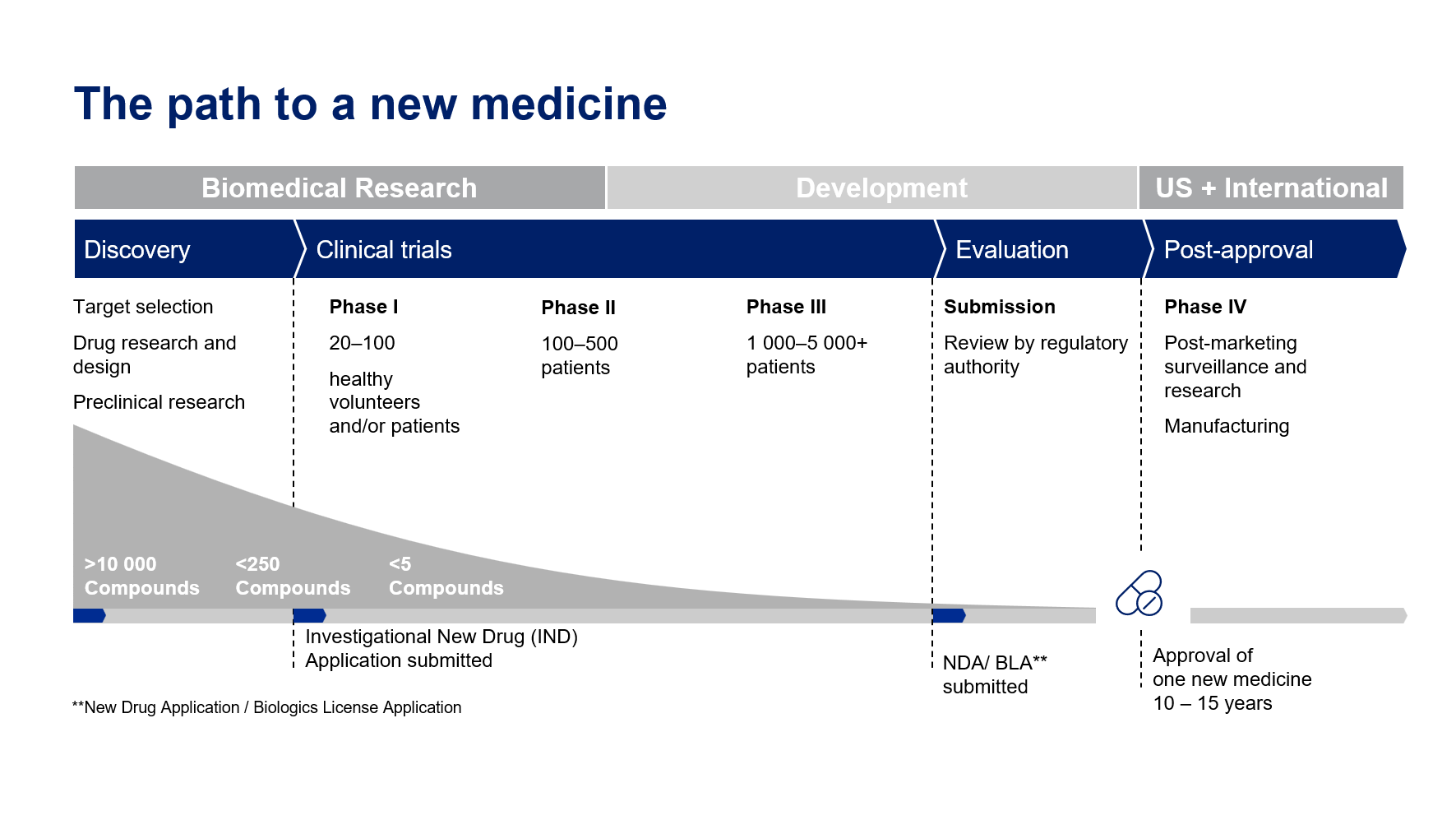
If you’ve ever taken a medicine and felt better, you’ve experienced something truly remarkable. Human biology is extraordinarily complex. Discovering drugs that can safely correct biological problems is extremely challenging. In biopharma research and development, a single programme can span years or even decades. We design and test thousands of compounds and feel fortunate if even a few advance to clinical testing.
Artificial intelligence‑based approaches are redefining these odds, not by digitally conjuring drugs overnight, but by making some of the most difficult parts of this process faster, smarter and less prone to failure.
Drawing on our work at Novartis, I’d like to share how AI is reshaping three critical steps in drug discovery: identifying disease targets, generating compounds and predicting safety. By taking an end-to-end view of the process, we gain a deeper understanding of the challenges and where AI can have the most impact.
Breaking away from the herd
Drug discovery typically starts with a protein in a disease that’s doing something you want to change. Maybe it’s overactive in a cancer cell or misfiring in the heart. The goal is to create a compound that binds to the protein in just the right way to modify its activity. This first step, protein target identification, is ripe for AI transformation. Biopharma often “herds” around the same targets, clustering in areas such as drivers of cancer cells or appetite regulators in obesity, but creating real breakthroughs requires new targets.
For example, autosomal dominant polycystic kidney disease (ADPKD) is the most common inherited form of kidney disease, marked by cyst growth that eventually causes kidney failure. Recently, using large‑scale, AI-driven simulations, our team systematically turned thousands of genes on and off in digital models of ADPKD cells to look for involvement in the disease. In parallel, we used AI to mine vast amounts of scientific literature, human genetics data and results from millions of single‑cell experiments.
This could have been prohibitively slow without AI, but with it, we rapidly identified several dozen gene candidates. We then tested these in wet‑lab experiments using kidney organoids – “mini‑kidneys” grown in a dish that mimics the disease. In under a year, we honed in on five promising targets that we are now advancing for further study. The combination of AI and lab experimentation helped us quite literally break through a challenge that had resisted more traditional approaches.
Generative discovery
The next step is designing molecules to act on our target. This requires finding a molecule that binds to specific pockets on the protein that can change its function. Traditionally, drug hunters used brute force, screening thousands to millions of molecules in hopes of finding a few active ones that we then spend enormous effort to optimize. Improve potency and you might ruin stability; fix metabolism and you might introduce toxicity. We juggle 20 or 30 properties at once – binding, solubility, off‑target effects, how long the compound lasts in the body and more.
This is why it can take several years to go from a promising hit to a true drug candidate, and why generative AI is potentially game-changing. With generative chemistry, new molecules can be designed rationally based on protein structure, chemical libraries can be screened at massive scales using digital approaches, and multiple properties can be optimized simultaneously.
Take neurodegenerative diseases like Huntington’s Disease. In one project, we identified a protein that we wanted to remove through a biological mechanism known as intracellular degradation. Such molecules are called molecular glue degraders, as they stick the protein target to the cell’s waste system. This is a new approach to target otherwise undruggable proteins in this devastating condition. But creating degraders that are orally available and reach the brain has been difficult.
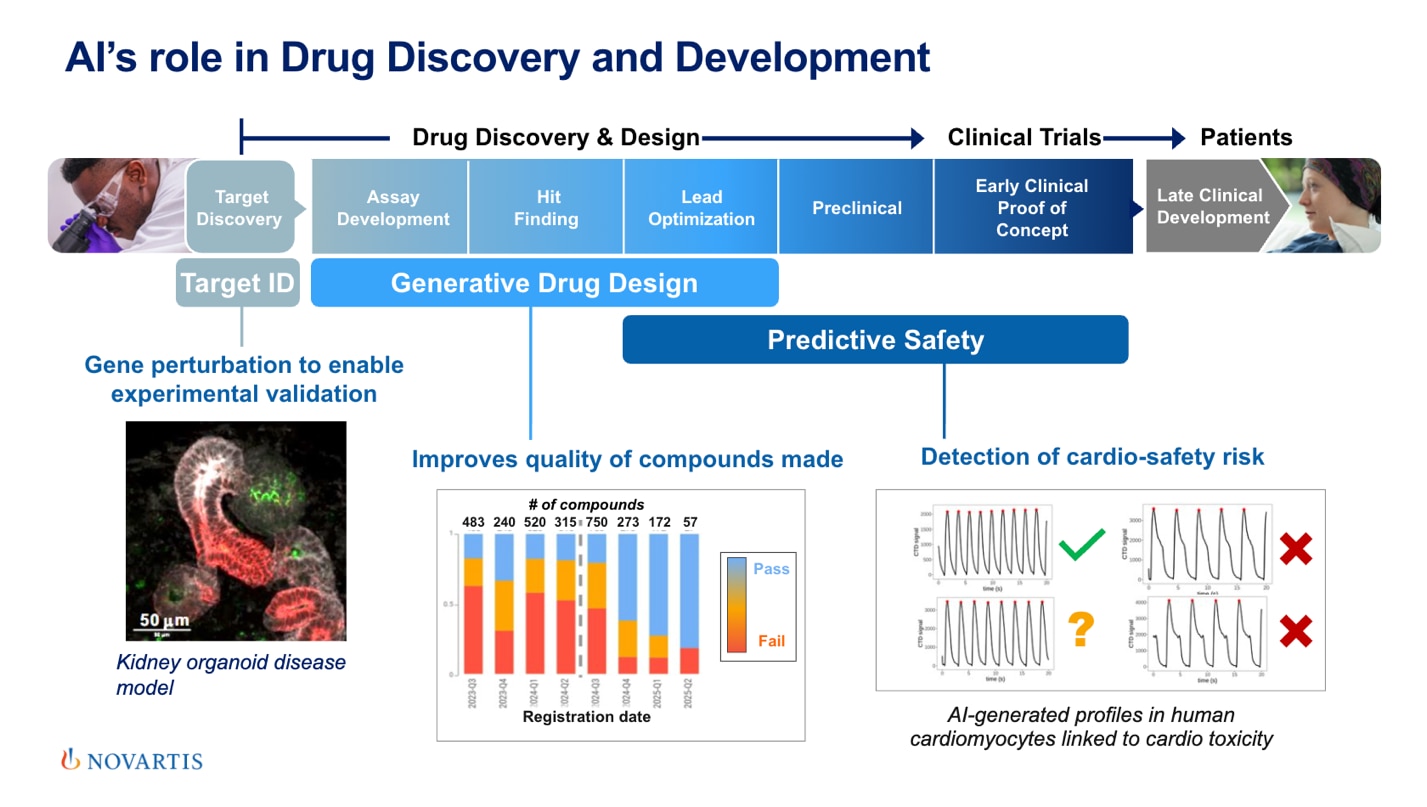
Using generative AI, we computationally designed 15 million potential compounds and created predictive models to assess key properties like brain penetration. Instead of synthesizing thousands of molecules, we worked with around 60 in the lab, ultimately arriving at a potent, brain-penetrant molecular scaffold now moving forward for further optimization.
Like many companies, we’re finding that this approach can dramatically reduce the time needed to narrow in on a candidate. This is just one example of a wide range of similar AI‑enabled programmes we’re advancing, both internally and with collaborators such as Isomorphic Labs.
Smart about safety
With candidate compounds in hand, we next evaluate safety. One of the foundational resources for our AI efforts at Novartis is Data42, our in-house data lake containing 30+ years of our clinical and preclinical studies. We’ve invested heavily in cleaning and standardizing our historical data, and for all the focus on algorithms, the work of data curation is one of the biggest unlocks for AI.
Using Data42, we can quickly query thousands of toxicology and clinical studies. For example, some classes of compounds are associated with cardiac safety signals like arrhythmias. We used AI to generate activity profiles for heart muscle cells, which predict potential clinical cardiac toxicity based on Data42 insights. We then used these profiles to computationally analyse candidate compounds from a preclinical programme. We found that for some otherwise promising molecules, our models predicted a strong cardiosafety risk signal. We validated this prediction in the lab and can now avoid compounds like this in the future.
Deciding when to stop can be a major challenge in biopharma, making AI-assisted predictive safety models invaluable. They can accelerate timelines, reduce failure rates and decrease reliance on animal studies – a shared priority for regulators and the scientific community. With AI and high-quality data, we can help ensure we only advance candidates with the greatest chances of being safe and effective.
Reality check
These are just three steps in the much longer journey every new medicine must take. Companies like ours are deploying AI broadly across research and development to accelerate and improve not just discovery, but also clinical trial design, patient recruitment, regulatory documentation and more.
AI is not a magic wand. But at Novartis, we can clearly see the benefits, and molecules are advancing at pace with the help of AI. At the same time, the fundamental challenges haven’t gone away: human biology remains deeply complex; translating research into carefully designed clinical studies takes time; and for many diseases, we still need long, rigorous trials to truly understand safety and efficacy.
What AI offers is not a way to circumvent the complexities of human biology, but to navigate them more intelligently. By enhancing how we choose targets, design molecules and avoid safety risks, AI is helping us make better decisions, faster, so that we can deliver for patients waiting for the next breakthrough.
Don't miss any update on this topic
Create a free account and access your personalized content collection with our latest publications and analyses.
License and Republishing
World Economic Forum articles may be republished in accordance with the Creative Commons Attribution-NonCommercial-NoDerivatives 4.0 International Public License, and in accordance with our Terms of Use.
The views expressed in this article are those of the author alone and not the World Economic Forum.
Stay up to date:
Artificial Intelligence


Forum Stories newsletter
Bringing you weekly curated insights and analysis on the global issues that matter.