Why human behaviour and workforce adoption will determine the value we derive from AI
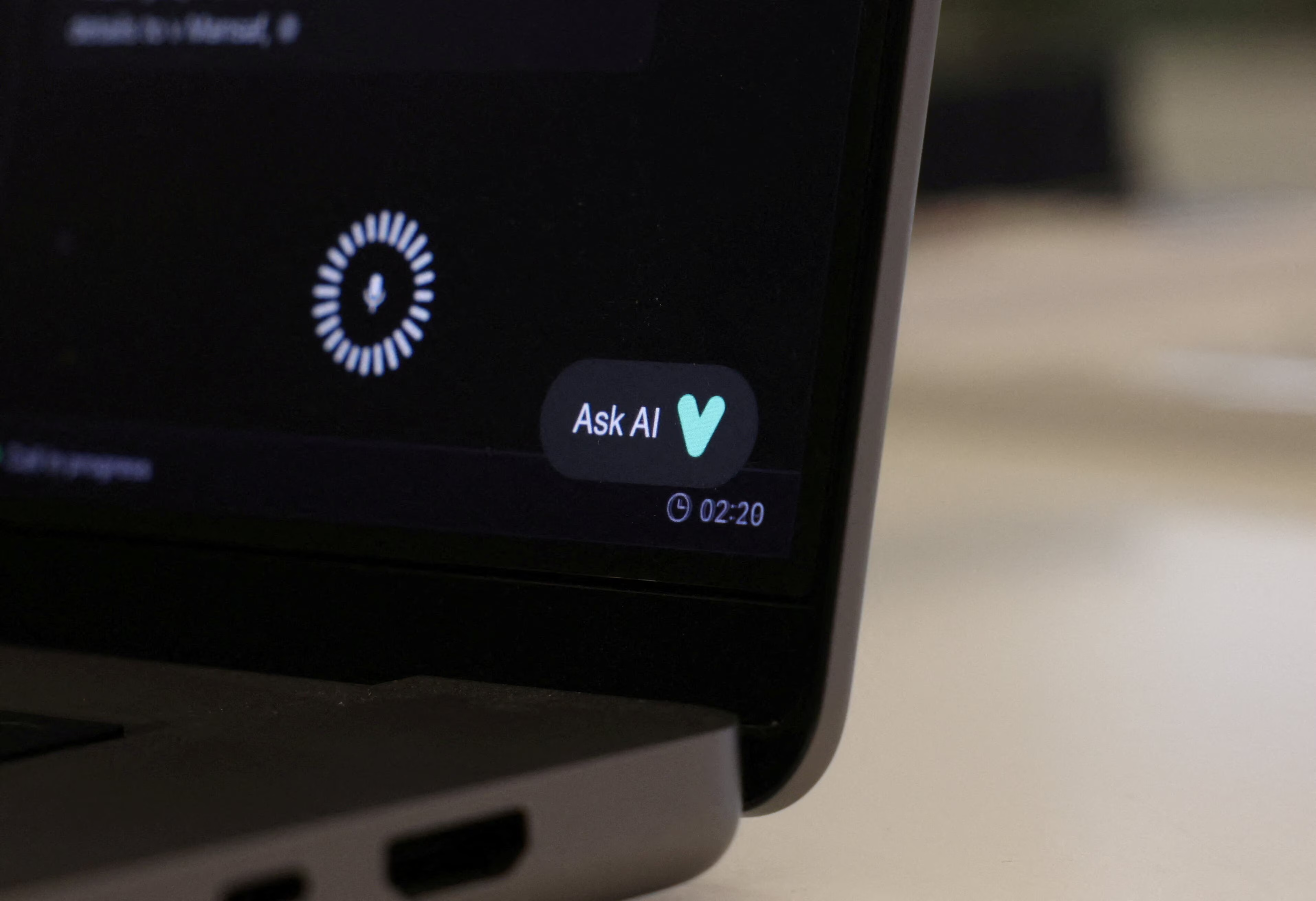
The true value of AI depends on human adoption and workforce readiness. Image: REUTERS/Priyanshu Singh
- The true value of AI depends on human adoption and workforce readiness rather than just technical capabilities.
- Organizations must transition towards modular, skills-based structures and continuous learning to successfully drive long-term productivity gains.
- Leaders are gathering at the World Economic Forum Annual Meeting 2026 to explore how the ethical use of AI and other emerging technologies will translate into solutions for real-world challenges.
The past five years have tested organizations in ways few leadership teams could have anticipated. A global pandemic, war on the European continent, supply chains fractured and re-imagined, geopolitical shifts, trade barriers, and digital transformation accelerated at unprecedented speed.
The acceleration of artificial intelligence (AI) and the emergence of Gen and Agentic AI is generating a significant economic impact for all the constituents at the core of the technology: chips, energy and software companies are all investing at unprecedented levels in a short time. There is no doubt that AI presents a significant disruption and opportunity at the level of industrialization; we are still at the stage of anticipating its potential versus tracking its impact – particularly when it comes to productivity.
Organizations can deploy advanced AI systems, but without a workforce able to adapt at speed, value creation slows, or worse, stalls.
”Like other technology revolutions before it, realizing this potential at scale will be determined by the humans who use it, rather than by technical capability alone. Today, organizations are investing heavily in technology infrastructure, financial resilience and operational continuity. Yet one critical factor remains underdeveloped: workforce adoption and readiness for rapid change in operating models that require new skills. Organizations can deploy advanced AI systems, but without a workforce able to adapt at speed, value creation slows, or worse, stalls.
Productivity pressure and demographic reality
This challenge is unfolding against a clear demographic backdrop. Population growth is slowing or reversing across much of the world. Ageing workforces are placing structural pressure on productivity, growth and public finances, making productivity the principal driver of economic expansion. The emergence of Gen AI is a welcome solution to help maintain and improve productivity against this backdrop.
Technology has historically played this role when demographic tailwinds fade. In Japan and China, technology adoption is driven by demographic necessity rather than choice, accelerating automation to sustain productivity and economic participation. AI and demographics are now intertwined drivers of significant productivity opportunity. However, productivity gains depend on how effectively technology is embedded into how work gets done, rather than on technical capability alone.
A structural shift in how work is organized
ManpowerGroup’s Global Future of Work Trends: The Human Edge identifies an important shift in labour markets. The traditional employment model, organized around fixed roles, standardized time and long-term predictability, is evolving. In our most recent ManpowerGroup Employment Outlook Survey, we found that among organizations that are expanding, the top motivators are organizational growth (37%) and investment in new business areas (26%). Just 19% of new hires are backfilling recent departures, signaling that employers are evolving roles to respond to changing needs.
Work is increasingly organized around skills and capabilities that can be deployed across dynamic demands. Internal mobility, project-based work and continuous reskilling are becoming more common across sectors and regions. Workforce design, learning systems and talent deployment are now central to enterprise performance and competitiveness.
The unbundling of work
Work is becoming more modular. Tasks are increasingly separable, recombinable and scalable. Automation has accelerated this process by fragmenting work into components that technology can perform, while humans integrate those components into outcomes.
Employee expectations are shifting in parallel. Our 2026 Global Talent Barometer shows rising demand for flexibility, role mobility and skills development, yet organizations continue to struggle to deliver. Work-life balance support now stands at 70% globally, up from 65% in 2024. However, nearly half of workers (49%) experience high daily stress, and two in three report recent burnout, citing stress (28%) and large workloads (24%) as leading contributors.
Organizations structured around rigid role definitions must evolve to design for flexibility and better reallocate capacity as conditions change. Experience shows that culture, incentives and ways of working shape outcomes as much as technology choices.
Workforce readiness, adoption and AI outcomes
AI adoption is often evaluated through a technical lens: deployment speed, model performance or tool selection.
These are the wrong questions.
Evidence increasingly shows that business outcomes from rapid technological change are shaped by workforce readiness.
Our Talent Barometer data validates this precisely: AI adoption has jumped 13%, with 45% of workers now regularly using AI at work. Yet confidence in using the tech fell 18%. This shows that the limiting factor isn’t the technology itself — it’s organizational readiness and learning capacity. Technical implementation frequently meets expectations, while productivity and performance gains lag.
Value creation depends on end-to-end process redesign, learning capacity and organizational culture. Incremental or point-based applications rarely deliver material productivity improvement at scale. As with earlier waves of automation, meaningful gains emerge when work itself is redesigned and new skills evolve alongside technology. Workforce strategy and technology strategy are increasingly inseparable, and organizational learning capacity is becoming a decisive source of advantage.
From recovery to continuous retooling
Traditional approaches to resilience emphasize recovery following disruption. In an environment of persistent volatility, resilience increasingly depends on continuous adaptation. Organizations designed for ongoing retooling refresh capabilities more rapidly and adjust direction with less friction. They view transformation not as a periodic initiative, but as a continuous cultural expectation.
We are already moving in this direction — 55% of companies now use skills-based systems instead of role-based structures, and project-based work among permanent employees has grown by 40%.
But significant gaps remain. Over half of workers report no recent training (56%) or mentorship (57%) opportunities — a concerning finding given the pace of change. This underscores the urgency of embedding continuous learning into workforce design, particularly for experienced workers whose institutional knowledge is invaluable, but whose tech fluency will need support.
The human edge in the workforce
Rapid technological advances succeed only when humans adopt them. Rather than replacement, the future of work is the interaction between human capability and intelligent systems. Technology expands what is possible, but outcomes depend on how people learn, adapt and apply that knowledge.
Leadership in this environment requires continuous learning, curiosity and resilience. As change accelerates, the ability to maintain organizational coherence while continuously evolving becomes a defining leadership and organizational capability.
Workforce adoption, organizational agility and resilience in the face of continuous change is no longer a supporting function. It is a core determinant of whether economies and organizations convert technological progress into prosperity for individuals, companies and nations.
Don't miss any update on this topic
Create a free account and access your personalized content collection with our latest publications and analyses.
License and Republishing
World Economic Forum articles may be republished in accordance with the Creative Commons Attribution-NonCommercial-NoDerivatives 4.0 International Public License, and in accordance with our Terms of Use.
The views expressed in this article are those of the author alone and not the World Economic Forum.
Stay up to date:
Artificial Intelligence
Related topics:


Forum Stories newsletter
Bringing you weekly curated insights and analysis on the global issues that matter.
More on Artificial IntelligenceSee all

Jeremy Jurgens
February 27, 2026