India at Davos 2026: Growth is no longer the question
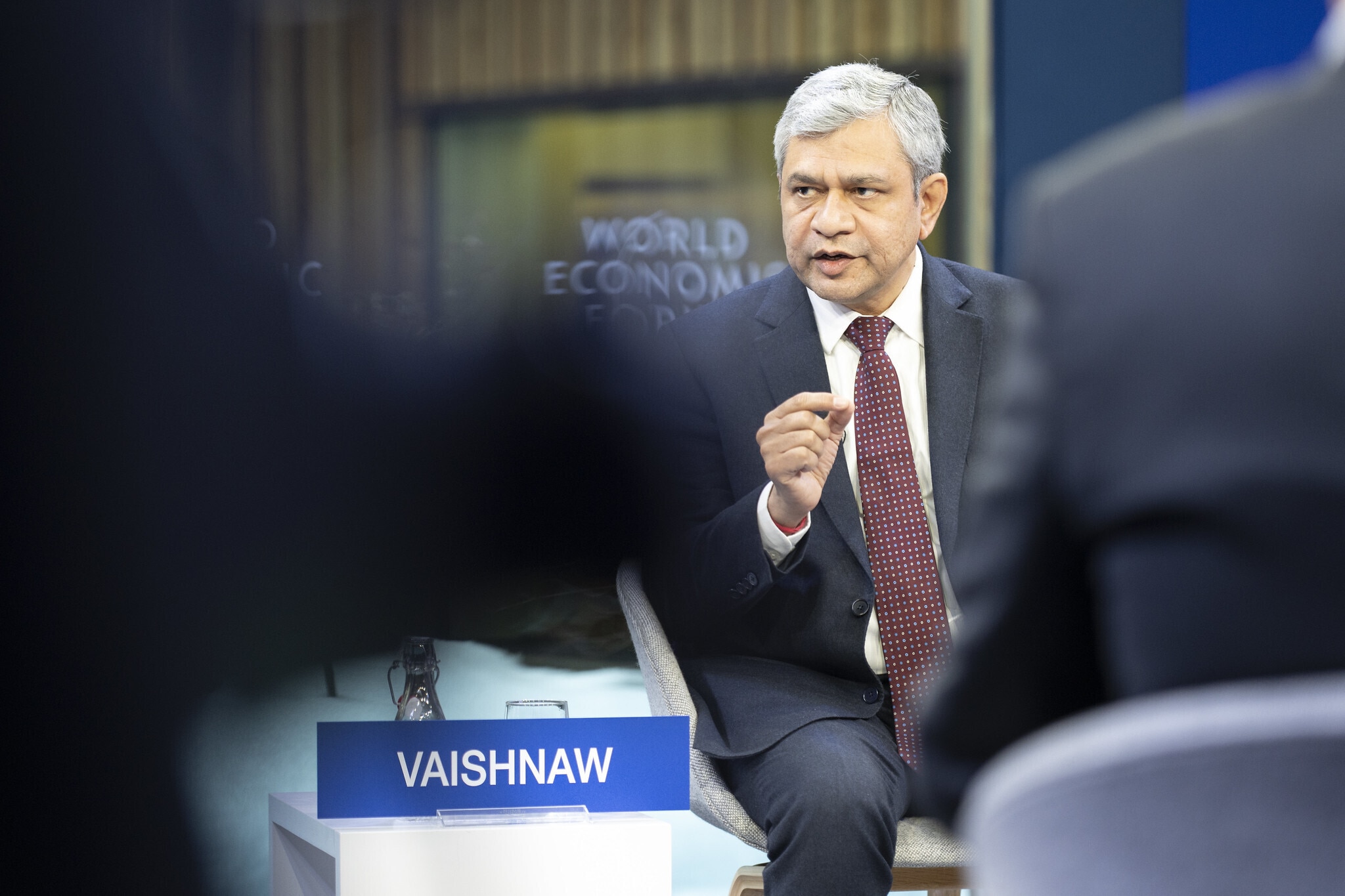
“India will become the third largest economy in the coming few years,” said India’s Union Minister Ashwini Vaishnaw. Image: World Economic Forum
- With India widely expected to become the world’s third-largest economy, the focus at Davos 2026 shifted to how growth can translate into higher incomes and productivity.
- Policymakers emphasized execution over ambition, pointing to reform, simplification and centre–state coordination as priorities for the next phase of growth.
- Alongside reforms, leaders pointed to healthcare, livability and trade resilience as areas where further investment will shape long-term growth.
India arrived in Davos this year with a familiar question on the table: can it become the world’s third-largest economy?
The question came against a backdrop of renewed optimism. In the days leading up to the Annual Meeting, the International Monetary Fund raised its forecast for India’s growth in the next fiscal year to over 7%, citing strong momentum and positioning the country as one of the world’s key growth engines - even as global growth slows and uncertainty around trade and geopolitics persists.
Back on stage in Davos, the consensus was delivered within minutes.
“India will become the third largest economy in the coming few years itself,” said India’s Union Minister Ashwini Vaishnaw, calling it “a certainty.”
Gita Gopinath agreed. “Without a doubt, India will become the third-largest economy of the world,” she said, pointing to current projections that place the milestone around 2028.
What followed across the week was a deeper conversation: what determines whether that growth translates into jobs, rising incomes and long-term resilience?
The ranking is not the challenge
Gita Gopinath, Gregory & Ania Coffey Professor of Economics, was quick to shift the focus in the session examining India’s growth. “The challenge for India is not about becoming the third largest economy in the world,” she said.
“The challenge for India is about raising per capita incomes to higher levels.”
From the policy side, Ashwini Vaishnaw framed the past decade as one defined by execution. He currently serves as India’s Minister of Electronics and Information Technology, Minister of Railways, and Minister of Information and Broadcasting. He pointed to four pillars underpinning the country’s growth: public investment in physical, digital, and social infrastructure; inclusive growth; manufacturing and innovation; and simplification.
“We have removed 1,600 old laws and over 35,000 compliances,” he said, describing a broad effort to modernise legal and procedural frameworks. “Practically every sector, we are trying to bring in a totally new legal framework or a totally new procedural framework built on the technology stack that we have.”
Gopinath, while acknowledging the reforms and infrastructure buildout, pointed to deeper structural constraints that remain. “It is a tremendous challenge in India to acquire land,” she said, pointing to land titling and judicial reform as persistent bottlenecks.
Sustaining growth, she argued, will depend on whether reforms translate into higher productivity and rising incomes, particularly as India seeks to make fuller use of its demographic potential.
Jobs (and the kind of jobs) remain crucial
Across sessions, the conversation repeatedly returned to employment. It wasn’t simply seen as a volume challenge, but as a question of job quality and income growth.
For Salil S. Parekh, CEO and Managing Director at Infosys Limited, the significance of employment lies in what certain kinds of jobs make possible.
“Just the technology industry in India employs about six million or so people,” he said during a session titled Can We Save the Middle Class?. “When you add everything associated with it, it’s maybe five to eight times more — somewhere between 30 to 40 million people who benefit from the sort of wages that a technology job allows, which is essentially the definition of middle class in India.”
Those wages, Parekh argued, have effects that extend well beyond the workplace and link to “education, consumption and healthcare.” And the lesson, he suggested, is about creating more jobs like those that generate middle-class wages across industries such as pharmaceuticals, electronics exports and consumer businesses.
From a macroeconomic perspective, Gita Gopinath framed the challenge in more stark terms. “There is a mismatch between what jobs can be created and the skills of the labour force in India.”
“Only about 30% of India’s growth has come from labour,” she noted, describing an economy that remains relatively capital-intensive. She pointed to the need for labour market flexibility and sustained investment in human capital.
Ashwini Vaishnaw, in response, framed job creation as a shared exercise between the centre and the states, pointing to reforms underway at the state level. “The central government and the state governments, we work together to bring out many of the reforms,” he said, citing examples from Maharashtra, Andhra Pradesh and Odisha. “Many of these reforms are now becoming the template for the states to follow.”
He highlighted labour reforms in particular as “a major step,” alongside GST (Goods and Services Tax) simplification and procedural and legal reforms across sectors. “Practically every sector,” he said, is undergoing change, from labour regulations to opening up areas such as nuclear energy to private participation.
Diffusion of technology
As the conversation turned to technology, speakers consistently framed infrastructure as the critical enabler in a large, fragmented economy. “How do you create a structured opportunity for a billion people?" asked Nandan Nilekani during a session on jobs in emerging markets.
The chairman and co-founder of Infosys pointed to the digital public infrastructure India has built over the past decade, linking identity, banking and payments in practice. “Somebody gets an ID. With that ID, they get a bank account. They get a mobile connection,” he said. “They can start taking digital payments for what they sell using UPI (an Indian instant payment system).”
That digital trail, Nilekani argued, becomes economic leverage because “that data can now be used to get a loan to grow their business”. He described it as an “escalator of opportunity” that allows informal livelihoods to formalise and scale.
The emphasis on diffusion carried into the discussion on artificial intelligence. For Ashwini Vaishnaw, the value of AI lies less in building the largest models than in deploying cost-effective tools where returns are clearest. “ROI doesn’t come from creating a very large model,” he said. “Ninety-five per cent of the work can happen with models that have 20 billion or 50 billion parameters.”
India’s focus, he argued, is on ensuring AI deployment happens “in a very big way” across sectors and enterprises rather than concentrating capability in a few frontier systems.
Gita Gopinath offered a note of caution. While AI can raise productivity, she warned it will also reshape labour markets, including in services where India has traditionally been strong. “Business process outsourcing is going to be impacted by AI,” she said, adding that coders and call centres will be affected. “If services also become capital-intensive in India, then there is going to be a problem with enough job creation.”
People capacity as growth infrastructure
In the discussions around India’s growth story, another constraint surfaced repeatedly: whether the systems supporting people, from health to livability, can keep pace with economic ambition.
In the India session, Gita Gopinath placed environmental and human factors alongside deregulation and labour reforms as determinants of long-term growth.
“Pollution is a challenge in India,” she said, arguing that its economic cost is “far more consequential than any impact of any tariffs.” Citing World Bank estimates, she noted that “about 1.7 million lives are lost every year in India because of pollution,” with implications for productivity, public health and investor confidence.
That emphasis on people capacity surfaced again in a separate session, Healthcare: Cost or Investment?, where Suneeta Reddy of Apollo Hospitals Enterprise framed healthcare infrastructure as an economic input rather than a social add-on. “Eighty per cent of the Indians used to go abroad for treatment,” she said, recalling a period when India was also losing skilled professionals.
The dynamic has begun to shift, she argued, as private-sector investment expands capacity and helps retain talent. “Now we have the ability to retake them… and bring them back.”
But the scale of need remains significant. “India needs it very badly,” Reddy said. “We do need investments in healthcare.” Framed as an investment case as much as a social one, she pointed to returns not only in health outcomes, but also in economic value, enabled by volume and the ability to deliver “clinical outcomes at scale.”
Resilience in a fragmented global economy
On geopolitics and trade, the conversation was framed in more pragmatic terms: a global economy fragmenting and the need to build resilience within it.
Vaishnaw described a strategy of diversification and deeper participation in global value chains. “Our exports have actually increased despite the tariffs,” he said, citing electronics exports as a rapidly growing category and pointing to multiple trade agreements and negotiations. He argued that India has emerged as “a trusted value chain partner”, not only manufacturing to another country’s designs, but participating in the “journey of design” and understanding customer needs.
Gopinath set the broader context: regardless of where tariff levels land, “we have permanently moved away from the previous… global economic order.“
We’re not going back,” she said, describing a world where national and economic security considerations shape trade and industrial strategy.
Sunil Bharti Mittal, Chairman of Bharti Enterprises, argued that India’s leverage rests on scale: “a market for everybody in the world… 1.5 billion consuming hungry young Indians”, alongside a long-term buildout of physical infrastructure, with digital systems providing a cushion as manufacturing capacity deepens.
Watch a replay of the full session on ‘Can India Become the Third Largest Economy in the World?’:
License and Republishing
World Economic Forum articles may be republished in accordance with the Creative Commons Attribution-NonCommercial-NoDerivatives 4.0 International Public License, and in accordance with our Terms of Use.
The views expressed in this article are those of the author alone and not the World Economic Forum.

Forum Stories newsletter
Bringing you weekly curated insights and analysis on the global issues that matter.
More on Geographies in DepthSee all

Abdulla bin Ahmed Al Khalifa
February 25, 2026


