From short-term wins to systemic transformation: How India can thrive in the Intelligent Age

For the Intelligence Age, India is applying tech and governance models that combine scale, sustainability and equity. Image: REUTERS/Mansi Thapliyal
- The “Intelligent Age” is changing how decisions are made and how value is created. At its core is agentic AI and a leap from automation to autonomy.
- Equitable progress depends not on the tools themselves, including how we deploy agentic AI, but on how we reimagine the systems, skills and values that govern their use.
- India's work in this area and its digital public infrastructure, known as India Stack, ambitiously reimagines technology as a public good and deploys models that combine scale, sustainability and equity.
Human and machine intelligence are intertwining to redefine how industries operate. From autonomous systems and robotics to breakthroughs in clean energy and quantum computing, the transformation is irreversible and happening in real time.
For all its promise, technology is not a silver bullet. Despite the rise of generative tools and unprecedented investments in AI and automation, productivity and efficiency gains from these investments remain stubbornly flat.
This paradox reveals something deeper: progress depends not on the tools themselves, but on how we reimagine the systems, skills and values that govern their use. Without that reinvention, intelligence risks becoming an illusion that is powerful in theory, but hollow in practice.
The shift from automation to autonomy
The “Intelligent Age” is changing how decisions are made and how value is created. At its core is agentic AI, marking a leap from automation to autonomy. These agents plan, act and learn across workflows, moving businesses' use of AI from isolated tasks to orchestrated journeys. By 2029, 45% of routine enterprise tasks are expected to be handled by AI agents, while early adopters report productivity gains of 40-60%. Scaling this demands new architecture and bold leadership as agentic AI fast becomes the backbone of enterprise operations.
Alongside autonomy, multimodal AI is reshaping how machines understand the world, as it integrates text, images, audio and sensor data for richer insights. From precision manufacturing to immersive media, this capability is driving breakthroughs in robotics and advanced simulations. Quantum computing is moving toward real-world impact, tackling challenges that classical systems can’t, such as drug discovery, development of new cryptographic techniques and complex supply chains. Meanwhile, edge AI, paired with 6G, brings intelligence closer to where data is generated, powering industrial automation, autonomous mobility and smart cities.
Navigating the now and next
In this scenario, balancing short-term goals with long-term imperatives means adopting a dual lens of delivering immediate value while laying the groundwork for transformation. Quick wins matter: automating repetitive tasks, improving customer experience with AI chatbots, or using predictive analytics for inventory management can boost efficiency today. These should, however, be paired with investments in AI governance, data interoperability and workforce reskilling that enable future-ready systems.
Consider how industries are approaching this balance. Banks deploy AI for fraud detection now, while preparing for agentic systems that orchestrate end-to-end customer journeys. Manufacturers use edge AI for predictive maintenance, while investing in quantum computing for supply chain optimization. Healthcare providers apply Gen AI for clinical documentation, while building ethical frameworks for autonomous diagnostic systems. These steps ensure that short-term actions aren’t isolated; rather, they become stepping stones toward long-term resilience.
Cracking the productivity paradox
Technologies may advance, but the bigger question is whether they deliver real impact. Gen AI pilots often remain stuck in “pilot wonderland” with more than 80% of companies reporting no meaningful gains in earnings. Only one in three employees says approved AI tools meet their work needs. Adoption frequently follows a J-curve: an initial dip in performance before long-term benefits appear. To unlock AI’s potential, organizations must redesign processes, retrain teams and align incentives. Those willing to make that leap will capture real value; those who hesitate will risk being left behind.
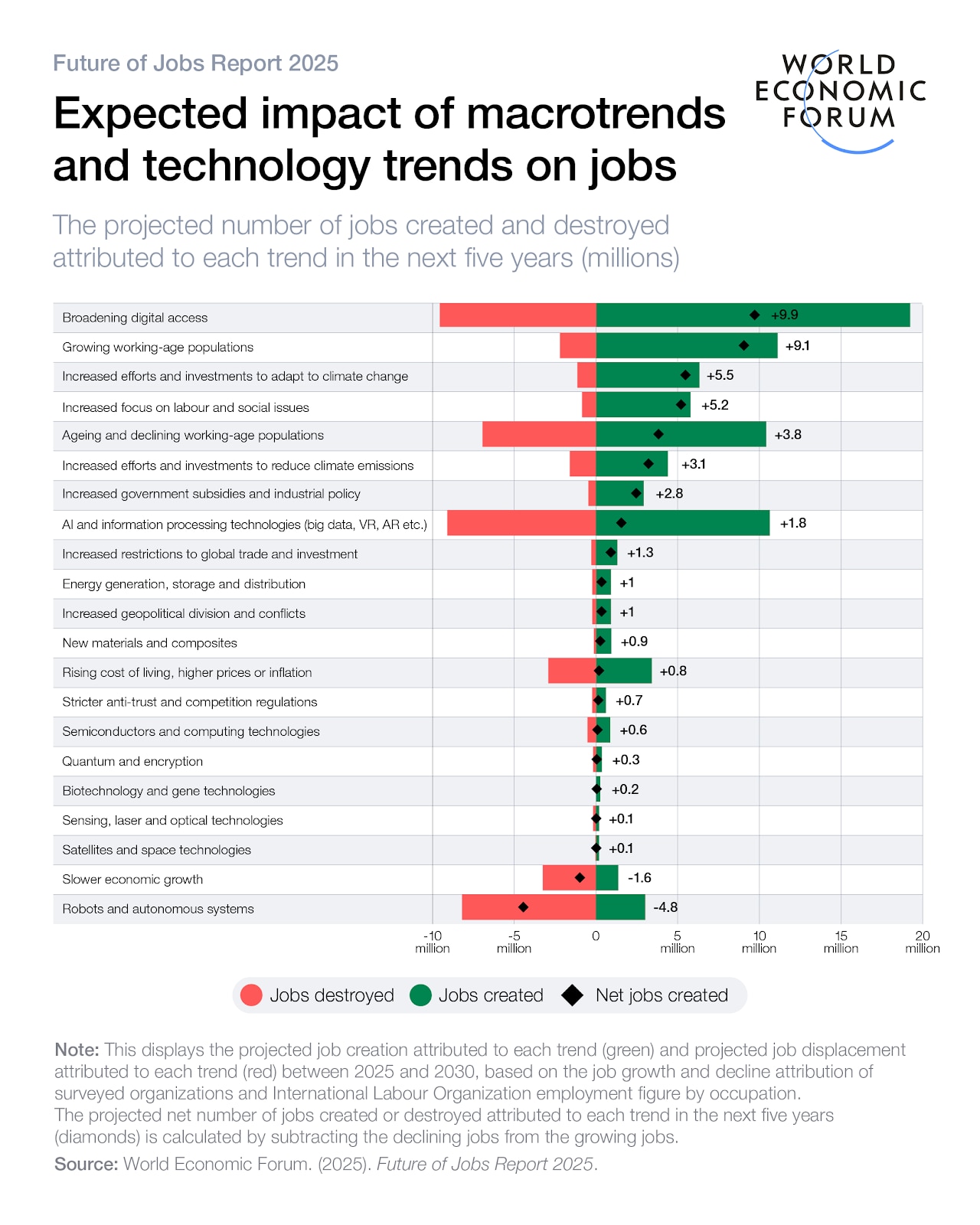
Reinvention doesn’t stop at processes; it extends to people. AI, robotics, energy systems and sensor networks are expected to affect 80% of global jobs. By 2030, 170 million new roles will emerge while 92 million will be displaced. This churn is a human story of adaptation, resilience and opportunity. Businesses have a responsibility to make this transition inclusive, to invest in skills, design ethical systems and ensure progress doesn’t come at the cost of equity.
To build a strong, future-ready organization, companies should focus on four strategic pillars that integrate intelligence, ethics and collaboration:
- AI for strategic insights: go beyond dashboards. Use AI to analyse markets, simulate complex scenarios and anticipate trends that shape long-term strategy.
- Human-centric priorities: treat learning as a continuous cycle. Reskill and upskill employees so they flourish alongside technology rather than competing with it.
- Ethical AI governance: establish systems that are transparent, fair and accountable. Governance is the foundation of trust.
- Outcome-oriented teams: build cross-functional teams that combine diverse expertise to solve complex problems. Durable teams, not siloed functions, will deliver strategic capabilities.
India’s role in the Intelligent Age
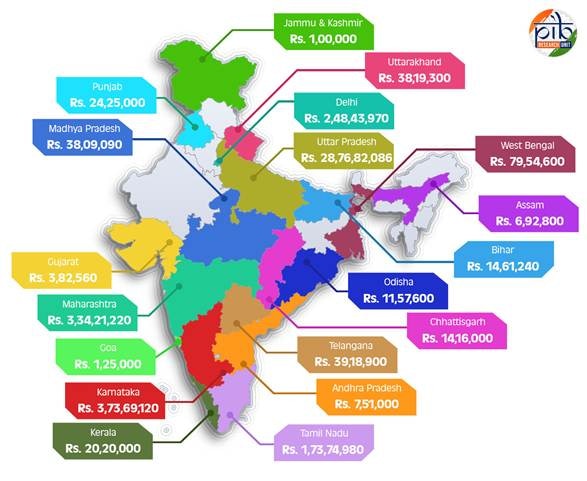
The story of this age goes beyond algorithms and machines to systems that make technology meaningful. India’s version of this is one of the most ambitious in the world. Its digital public infrastructure, known as India Stack, has changed how people live and transact. The Aadhaar programme gives every citizen a digital identity, its Unified Payments Interface (UPI) processes more than 18 billion transactions every month and its platforms, such as DigiLocker and Account Aggregator, enable secure data sharing. These are the foundation for services that reach millions, proving that scale and inclusion can go hand in hand.
This foundation matters because technologies such as agentic AI thrive on trusted data and integrated workflows. India’s digital rails make that possible – and its ambition doesn’t stop there. The government's National Quantum Mission aims to build 1,000-qubit quantum computers by 2031, unlocking computational power for breakthroughs in science and security. AI capacity is growing too, with 18,693 GPUs (graphic processing units) driving research and innovation, supported by initiatives to make advanced computing accessible across sectors.
What makes India’s approach distinctive is its philosophy of technology as a public good. With a $4 trillion economy, a young, tech-savvy population, and policies that prioritize openness, India is positioned to shape the age through models that combine scale, sustainability and equity.
Progress in this age is about deciding what kind of future we want to create. That means looking past short-term wins and imagining systems that are fair, skills that keep pace with change and values that put people at the centre of innovation.
This work is demanding. It calls for courage to challenge what feels safe, commitment to invest when results aren’t immediate and collaboration across boundaries that once seemed fixed. Those who take this path will shape a future where technology strengthens human potential instead of overshadowing it.
Don't miss any update on this topic
Create a free account and access your personalized content collection with our latest publications and analyses.
License and Republishing
World Economic Forum articles may be republished in accordance with the Creative Commons Attribution-NonCommercial-NoDerivatives 4.0 International Public License, and in accordance with our Terms of Use.
The views expressed in this article are those of the author alone and not the World Economic Forum.
Stay up to date:
The Digital Economy
Related topics:


Forum Stories newsletter
Bringing you weekly curated insights and analysis on the global issues that matter.
More on Artificial IntelligenceSee all

Jeremy Jurgens
February 27, 2026