The new requirements for leaders: How next-generation leadership can help move the world forward together
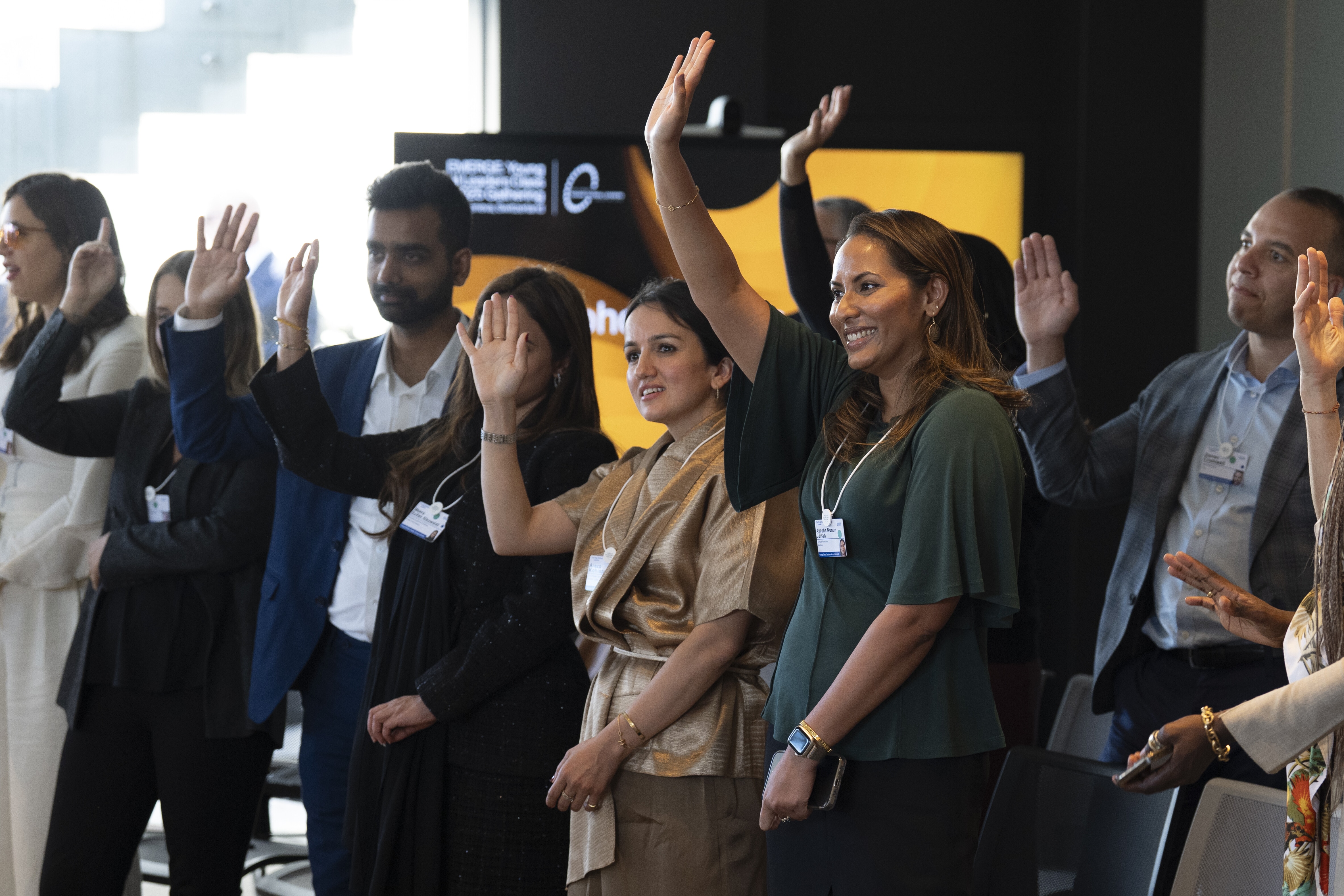
Through accelerating practical experimentation, the lab would help to turn the theory of next-generation leadership into systemic change. Image: ©World Economic Forum/Pascal Bitz
- Traditional leadership models are failing in a world defined by constant transformation and disruption.
- The Global Future Council on Leadership identifies four areas of change to rewire leadership and improve trust.
- A new report advocates for the creation of a collaborative
platform to discuss, co-design and test next-generation leadership
models across sectors, generations and geographies.
Worldwide trust in leadership is at an all-time low. Yet rather than wringing their hands in despair, a new generation of young leaders is treating the trust deficit as a design challenge and rewiring the very foundations of leadership.
The scale of the problem is daunting. Nearly 70% of people believe that government and business leaders purposely mislead them, according to the 2025 Edelman Trust Barometer. In addition, a zero-sum mindset is proliferating across groups of society, the same survey shows.
The scale of the problem is daunting. While, according to the 2026 Edelman Trust Barometer, public trust in governments, businesses and media slightly increased over the past year, 70% of people surveyed report that they were unwilling or hesitant to trust someone who is different from them, be it because of different core values, culture, background or lifestyle, different sources or facts believed, or because of different views how societal problems should be solved. This mindset makes action for leaders, let alone collective progress, incredibly hard. These findings are also mirrored by a recent survey among 130 young leaders from around the global and different sectors: 82% agree that trust towards political, corporate, academic and non-profit leaders has eroded over the last decade, with political polarization and the erosion of fact-based public discourse and decision-making (24% and 20% respectively) cited as the leading factors making the exercise of leadership more difficult. For younger generations, however, this lack of trust is also a symptom of a deeper crisis: The failure of leadership models to evolve at the speed of modern-world challenges.
The Young Global Leaders (YGL) community and its Global Future Council on Leadership have spent the past year examining this issue through a global dialogue series on leadership, including at the YGL Summit 2025, and by asking more than 130 young leaders about the new requirements for emerging leaders in the above-mentioned survey.
In the new report Next Generation Leadership for a World in Transformation: Driving Dialogue and Action, the Council summarizes the striking findings and proposes a new way forward. At the root of the crisis is the fact that leadership today is not future-proof. Indeed, in many cases, it appears not even fit to meet the demands of the present day. Traditional leadership models, shaped for an earlier age of stability and predictability, are simply inadequate in an era of rapid technological breakthroughs, geopolitical fragmentation, ecological stress and deepening inequality.
In essence, the world is suffering from a leadership design problem, coupled with a leadership talent shortage. It is thus not only a question of finding “better” leaders – it is about reimagining the system that shapes leadership itself.
Changing leadership to rebuild trust
Current leadership structures and selection processes tend to reward past success over future readiness and prioritize institutional authority over the ability to adapt. Given these systemic issues, it is not surprising that 81% of the young leaders surveyed believed that today's leaders were not incentivized to put long-term results ahead of short-term gains.
The limitations of such a misaligned reward system do not have to be inevitable. Rather, the report diagnoses them as flaws that can be resolved. From rethinking selection pipelines to reinventing leadership training that shapes decision-making, action and thus leadership legacy, members of the YGL community stand ready to build a new model that treats trust not as a uniquely personal trait, but also as a systemic outcome.
1. Rethinking how leaders are selected
Better selection is the first step, with a rethink needed on who becomes a leader and how. Conventional pipelines often reproduce existing networks and structures, reinforcing homogeneity and privileging continuity over innovation. Today’s realities demand broader pathways that intentionally cultivate diverse talent, especially from underrepresented communities.
Brazil’s largest political training school, RenovaBR, formerly led by YGL Irina Bullara, shows how this can be done. By scouting, encouraging and preparing future talent, the non-profit school is discovering the political and public leaders of tomorrow.
2. Redefining how leaders are trained and continually developed
Preparing leaders properly for current and future realities also requires updating their training. Many leadership programmes prioritise technical skills but underinvest in qualities such as ethical reasoning, resilience, empathy, self-awareness and the capacity to enhance one’s future-preparedness with foresight and anticipation.
As artificial intelligence, neurotech and other technologies reshape decision-making, communication and – ultimately – what it means to be human, leaders need not only a basic grasp of science and technology breakthroughs to come, but also a deep understanding of the societal implications of their application. The Geneva Science and Diplomacy Anticipator works on equipping leaders with exactly such future-readiness and tech-savviness through its Global Curriculum for Anticipatory Leadership, headed by YGL Marga Gual Soler.
3. Rewiring leaders’ decision-making for complex systems
When it comes to decision-making and action by leaders, traditional models assume stable evidence and clear authority. But today’s leaders face uncertainty, ambiguous data and evolving social expectations. This demands a new approach that balances analytical reasoning with ethical clarity, intuition and lived experience. Dialogue and mindful listening are key here, enabling leaders to navigate conflict and co-create meaningful solutions. Listening is no longer a soft skill – it becomes a core competency for building trust.
Especially in the context of decision-making, the survey ranked the possession of a moral compass as the most crucial leadership skill of our time. In addition, 64% of respondents agreed that faith and spirituality can provide important guiding principles for leaders.
While values or ethical principles can be used as something divisive, digging deeper reveals that there are some innate human values with the ability to build bridges across differences and lead to better leadership outcomes.
New books, written by authors and thought leaders on leadership, highlight opportunities and challenges. For example, YGL and author of the book A Different Kind of Power Jacinda Ardern, former Prime Minister of New Zealand, summarises it y in a New York Times interview: "If you ask a room of parents, 'What are the values that you think are really important for your kids?’ you’ll hear the same things: People want their kids to share, they want them to be generous, they want them to be kind and empathetic, they want them to be brave, courageous. Those values that we teach our kids, we then see somehow as weaknesses in leaders?”
Beyond that, mental well-being plays a crucial role for organizational, team and individual performance, and decision-making, too, as the co-chair of the Global Future Council on Leadership, YGL Thomas Roulet together with Kiran Bhatti explains in their book Well-Being Intelligence: Building Better Mental Health at Work.
4. Reinforcing leadership decisions that leave a long-term legacy
Finally, leadership must be understood as an intergenerational responsibility, making legacy and long-term thinking a key leverage point to rewiring leadership. Instead of defining legacy through short-term achievements or individual acclaim, the focus should be on stewardship: building systems that endure and empowering those who follow.
This approach to legacy is starting to gain traction and the idea of being a good ancestor has been taken up by thinkers such as YGL Shoukei Matsumoto, who examines how people can see past daily challenges and embrace what they are really trying to achieve.
Towards a global next-generation leadership lab
To bring all these ideas to life, the report recommends establishing a global leadership lab – a platform for exchange, innovation and cross-sector collaboration. Such a lab would:
- Convene dialogue across generations, sectors and regions.
- Curate a repository of case studies and practical insights.
- Cultivate a next generation of leaders through training frameworks and practical tools.
- Catalyse projects to test next-generation leadership models in real-world contexts.
Through accelerating practical experimentation, the lab would help to turn the theory of next-generation leadership into systemic change.
By redesigning how leaders are selected, developed and supported, we can rebuild trust and strengthen our collective capacity to navigate this world in transformation leaving a lasting legacy that benefits people and the planet.
Don't miss any update on this topic
Create a free account and access your personalized content collection with our latest publications and analyses.
License and Republishing
World Economic Forum articles may be republished in accordance with the Creative Commons Attribution-NonCommercial-NoDerivatives 4.0 International Public License, and in accordance with our Terms of Use.
The views expressed in this article are those of the author alone and not the World Economic Forum.

Forum Stories newsletter
Bringing you weekly curated insights and analysis on the global issues that matter.