Nvidia CEO Jensen Huang on how AI is becoming the next great infrastructure build
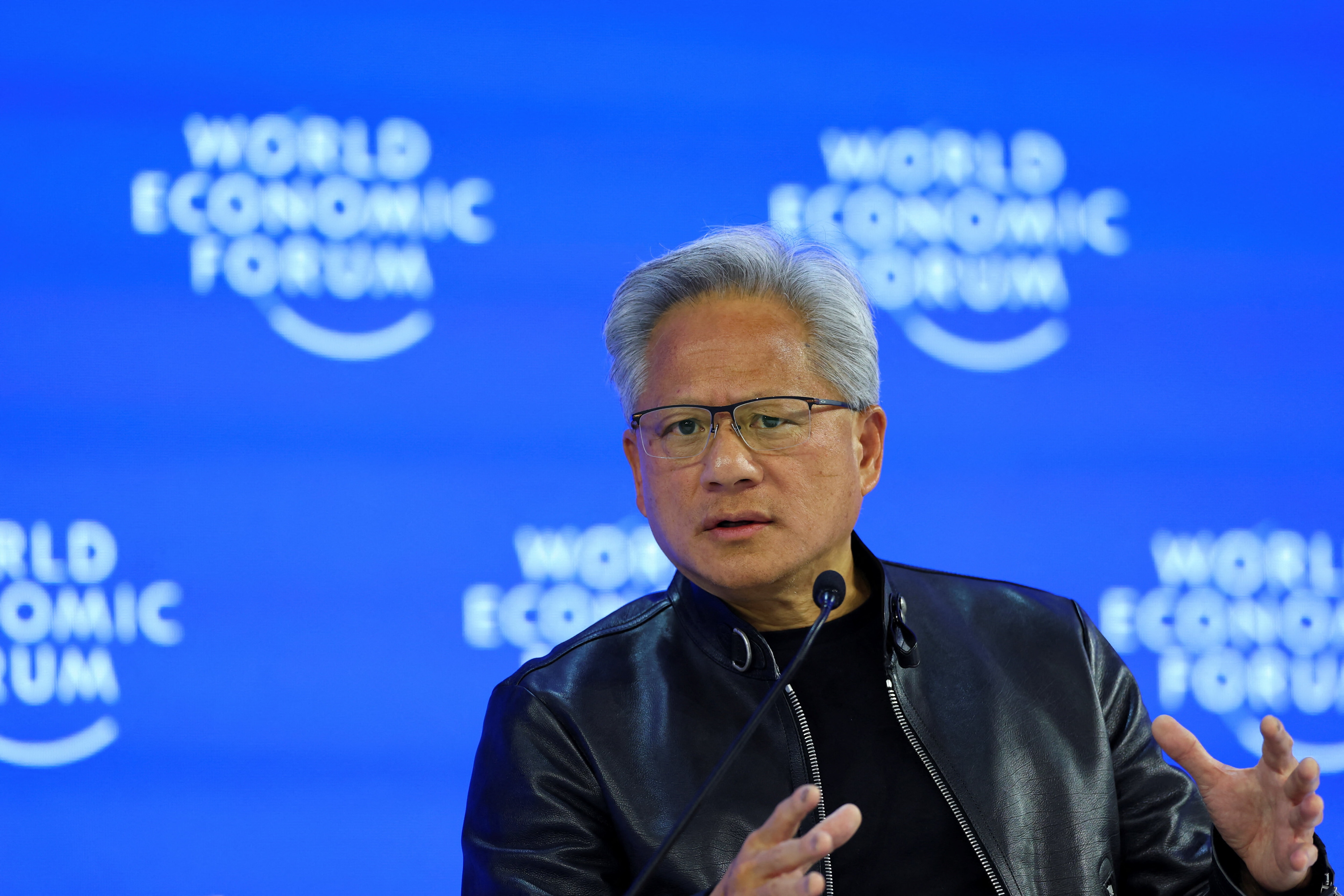
NVIDIA's CEO said AI's main strength is in its ease of use. Image: REUTERS/Denis Balibouse
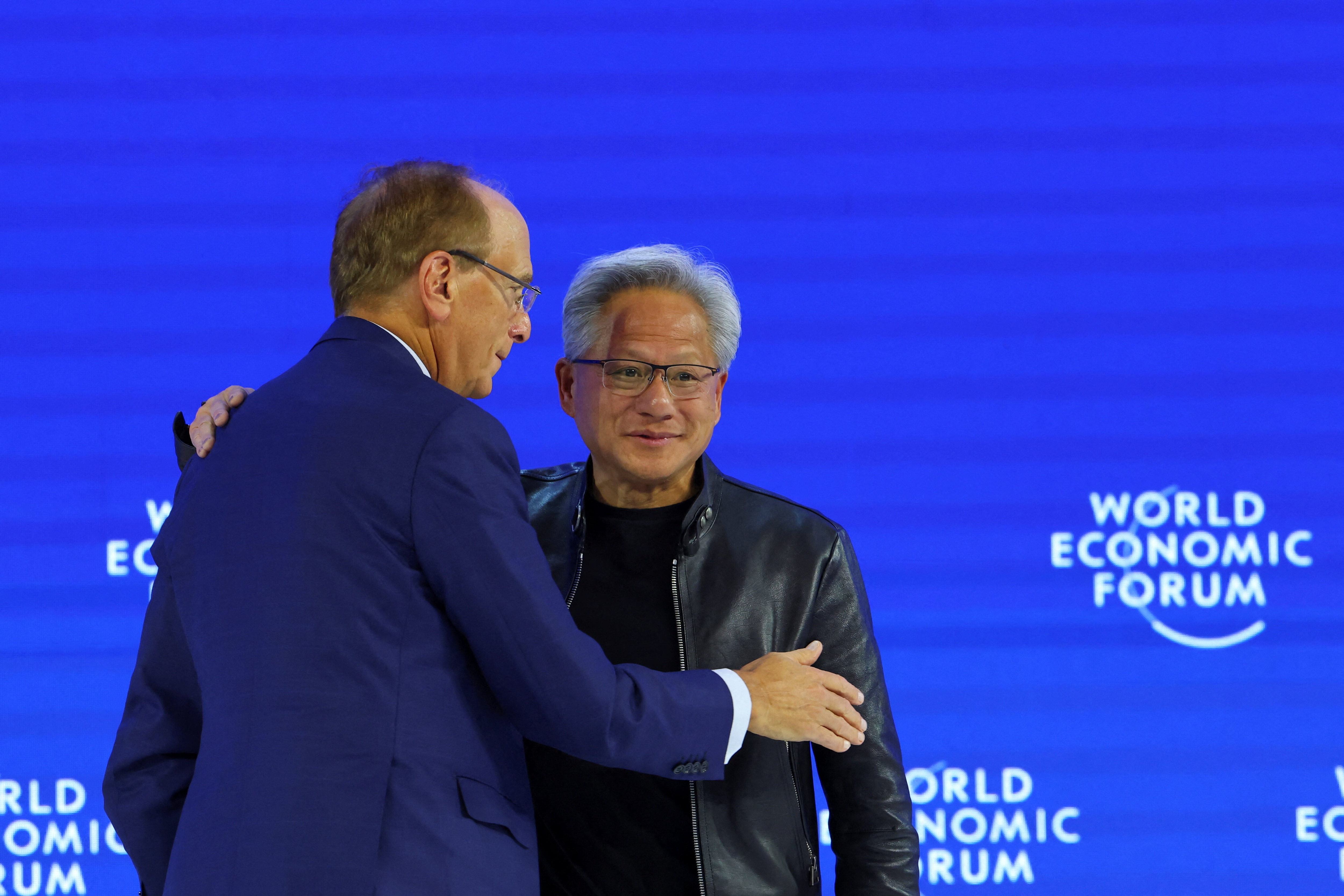
- During the World Economic Forum Annual Meeting 2026 in Davos, Switzerland, Forum interim co-chair Larry Fink sat down with NVIDIA CEO Jensen Huang to discuss the future of artificial intelligence (AI).
- Huang emphasised that AI's real impact will come from how widely it is built, adopted and used.
- The Annual Meeting underscores the growing importance of open, impartial dialogue under the theme, "The Spirit of Dialogue."
As artificial intelligence (AI) continues to grow as one of the most widely used technology applications, lingering questions remain about how more people can benefit from it and just how it will shape jobs and infrastructure.
At the World Economic Forum Annual Meeting 2026 in Davos, Switzerland, Larry Fink, the Forum's interim co-chair, sat down with Jensen Huang, president and CEO of NVIDIA, to explore the future of AI.
AI as a platform shift
Huang framed this moment as a platform shift, just as was seen with other emerging technologies such as the internet and mobile cloud. What makes AI different, Huang said, is that it could understand and act on unstructured information.
“For the first time, we now have a computer that is not pre-recorded but it's processing in real time,” he explained.
While many people think of AI as the model layer alone, Huang emphasized that it is better understood as a multi-layer system. Five layers, including energy, chips, cloud, the AI model itself and then the application, must scale together and have already triggered “the largest infrastructure build-out in human history.”
Build your own AI, take advantage of your fundamental natural resource, which is your language and culture...
—Jensen Huang, President and CEO, NVIDIA
”A trillion-dollar build-out with real-world impact
In response to the challenge often cited around job losses, Huang pointed to massive investments underway across the global economy, including expanding semiconductor manufacturing, growing demand for computing infrastructure, and record levels of venture capital flowing into AI-native companies across healthcare, manufacturing, finance and science.
All of these, he says, would create high-quality jobs.
Citing real-world anecdotes, he noted the increasing use of AI in radiology and nursing, which has automated tasks such as charting, scans, and note transcription, making radiologists and nurses more productive and giving them more time to focus on patients.
“The question is, what is the purpose of your job? In the case of radiologists and nurses, it is to care for people. And that purpose is enhanced and made more productive because the task has been automated,” he clarified.
Broadening access to AI worldwide
In response to Fink's question about AI reaching people beyond developed economies and the educated class, Huang said that all countries should include AI in their infrastructure.
By combining AI models and local expertise, they could tailor AI to the context.
Because AI is easier to use than any previous generation of software, Huang argued it could help close technology gaps, particularly in emerging economies.
Learning to work with AI, he added, will soon be as fundamental as learning to manage people. Prompting, supervising and evaluating AI systems will become core skills across industries.
“Build your own AI, take advantage of your fundamental natural resource, which is your language and culture; develop your AI, continue to refine it, and have your national intelligence part of your ecosystem,” he said.
We need to make sure that the average pensioner, the average saver, is a part of [AI’s] growth. If they're just watching it from the sidelines, they're going to feel left out.
—Jensen Huang, President and CEO, NVIDIA
”Europe’s opportunity
As Fink and Huang sat in Europe, the continent's strengths were deliberated. Huang believed Europe had an incredibly strong industrial base, which was its strategic advantage. AI, particularly robotics and physical intelligence, offers Europe a chance to leap forward by combining manufacturing expertise with advanced AI systems.
Its success depends on investment, however, especially in energy and infrastructure, in order to support a thriving AI ecosystem.
“Get in early now so that you can now fuse your industrial capability – your manufacturing capability – with artificial intelligence and that brings you into the world of physical AI or robotics.
“Robotics is a once-in-a-generation opportunity for the European nations.”
Participation matters
As debate continues over whether AI represents a bubble, Huang offered that the answer was evident in the current demand, with computing capacity remaining scarce, rental prices rising and companies rapidly shifting research and development budgets toward AI-driven discovery and development.
The opportunity, he concluded, is extraordinary but participation matters. For AI-driven growth to be sustainable, it must be accessible to everyone.
Huang said: “We need to make sure that the average pensioner, the average saver, is a part of [AI’s] growth. If they're just watching it from the sidelines, they're going to feel left out.”
Watch the full session here:
Don't miss any update on this topic
Create a free account and access your personalized content collection with our latest publications and analyses.
License and Republishing
World Economic Forum articles may be republished in accordance with the Creative Commons Attribution-NonCommercial-NoDerivatives 4.0 International Public License, and in accordance with our Terms of Use.
The views expressed in this article are those of the author alone and not the World Economic Forum.
Stay up to date:
Artificial Intelligence
Related topics:


Forum Stories newsletter
Bringing you weekly curated insights and analysis on the global issues that matter.
More on Artificial IntelligenceSee all

David Haber
March 6, 2026


