The top 5 urban transformation stories of 2025
Here are the year’s most critical developments in urban transformation. Image: ZQ Lee/Unsplash
Jeff Merritt
Head of Centre for Urban Transformation; Member of the Executive Committee, World Economic Forum- From innovation ecosystems to managing sinking cities, 2025 has been another year of transformation across the world's urban areas.
- Here are some of the top stories and themes covered this year.
If 2024 was the year cities began to ask "what if?", 2025 was when they were ready to answer "how".
From the tech hubs of San Francisco to the flood defences of Durban, the emphasis has shifted markedly from aspiration to action.
At the Urban Transformation Summit in San Francisco this October, the mood was one of pragmatic urgency. Leaders gathered not just to discuss the challenges of climate change, inequality and economic instability – but to showcase the toolkits and alliances now being used to solve them.
The stories that defined 2025 reveal a new urban paradigm: cities are no longer just economic engines, but 'innovation ecosystems' that must be 24-hour, nature-positive and radically resilient. Here are the year’s most critical developments in urban transformation.
1. The rise of innovation ecosystems
For decades, cities chased growth by offering tax breaks to attract big tech. In 2025, that playbook was rewritten, instead looking to innovation districts to help solve one of the biggest challenges today: achieving sustainable growth.
At the San Francisco summit, the Forum launched Innovation Ecosystems: A Toolkit of Principles and Best Practice, shifting the focus from purely attracting companies and talent, to building vibrant, sustainable ecosystems.
Drawing on lessons from 10 global innovation districts – including Detroit’s Michigan Central and Monterrey’s DistritoTec – the new framework identifies three critical challenges (pictured below) and eight guiding principles for responsible innovation: collaborative, sustainable, resilient, human-centric, efficient, transparent, accessible and scalable.
The toolkit then translates these principles into practice across three areas:
- Collaborative governance and stakeholder engagement
- Human-centric design and sustainable places
- Efficient and scalable digital infrastructure.
"Innovation districts represent one of the most significant opportunities to reshape urban prosperity in the 21st century," says the report. While modelling sustainable development and inclusive technological transformation, they can demonstrate that "innovation serves everyone, not just elites".
How the Forum helps leaders harness the power of cities for resilient growth
2. Debunking 24-hour economy myths
This year, the "night-time economy" finally shed its reputation as a euphemism for clubbing. With the global night-time tourism market projected to triple by 2035, and cities like New York generating over $35 billion annually after dark, 2025 saw a serious re-evaluation of the city at night.
Our myth-busting article on the 24-hour economy also shed light on the idea that the night is "for play, not work", highlighting the millions of logistics, healthcare and service workers who power the urban engine while others sleep.
Safety is a design challenge, not just a policing one, with cities like Amsterdam proving that "night mayors" and community mediators are often more effective than increased patrols.
The Forum's 24-Hour Economy initiative aims to reimagine life after dark – not as an afterthought but as a frontier for inclusive growth, innovation and community wellbeing.
3. Leading the way on nature-positive
The release of a series of reports – Nature Positive: Cities' Efforts to Advance the Transition – cemented the idea that cities can be at the forefront of advancing the Global Biodiversity Framework and fostering a nature-positive future.
With San Francisco, Durban and Barranquilla among the case studies, the reports detail how cities are pivoting from "grey" infrastructure to more sustainable "green" and "blue" solutions.
Adding urban trees to 10 megacities globally could save $482 million a year in health costs from their ability to absorb pollutants, Nature Positive: Financing the Transition in Cities found in January.
From Barranquilla’s urban greening strategy, which has recovered over 1.8 million square metres of green spaces, to Durban's Transformative River Management Programme, cities are deploying nature as their first line of defence against climate shocks.
The launch of the Nature-Positive Cities initiative highlighted that integrating biodiversity into urban planning is now a fiscal imperative, offering a dual return of climate resilience and improved public health.
4. Sinking cities and the $8 trillion risk
While some cities looked up to the sky, others were forced to look down at the ground beneath them.
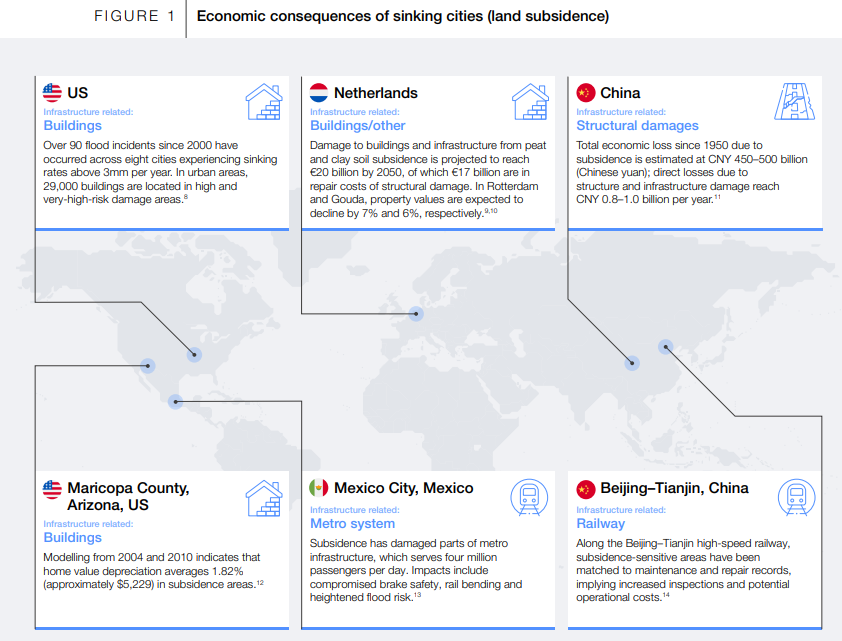
The release of Resilient Economies: Strategies for Sinking Cities and Flood Risks in November delivered a sobering statistic: land subsidence now threatens $8.17 trillion – or 12% – of global GDP.
The report, a collaboration with Deloitte, warned that "sinking cities" can no longer rely on reactive crisis management. Instead, they must treat land and water as strategic assets.
Case studies include Jakarta and parts of Tokyo, which have been stabilized.
5. Baukultur: Quality over quantity
Finally, 2025 marked a renaissance for Baukultur, or the 'culture of building'. The Davos Baukultur Alliance announced its first cohort of 'Pioneering Places', including Medellín, Nairobi and Utrecht.
These cities have committed to a bold premise: that the quality of our built environment directly dictates the quality of our lives.
This renewed focus on design excellence coincided with the year’s push for adaptive reuse. With the construction sector responsible for nearly 40% of global carbon emissions, the Forum’s Model Policy on Adaptive Reuse offers a roadmap for retrofitting the old to serve the new.
By repurposing existing assets, cities found they could cut emissions and construction costs, proving that the most sustainable building is often the one that already exists.
License and Republishing
World Economic Forum articles may be republished in accordance with the Creative Commons Attribution-NonCommercial-NoDerivatives 4.0 International Public License, and in accordance with our Terms of Use.
The views expressed in this article are those of the author alone and not the World Economic Forum.

Forum Stories newsletter
Bringing you weekly curated insights and analysis on the global issues that matter.
More on Built Environment and InfrastructureSee all

Lin O’Grady and Alice Charles
April 7, 2026


