What next for Venezuela? What leaders and experts said at Davos
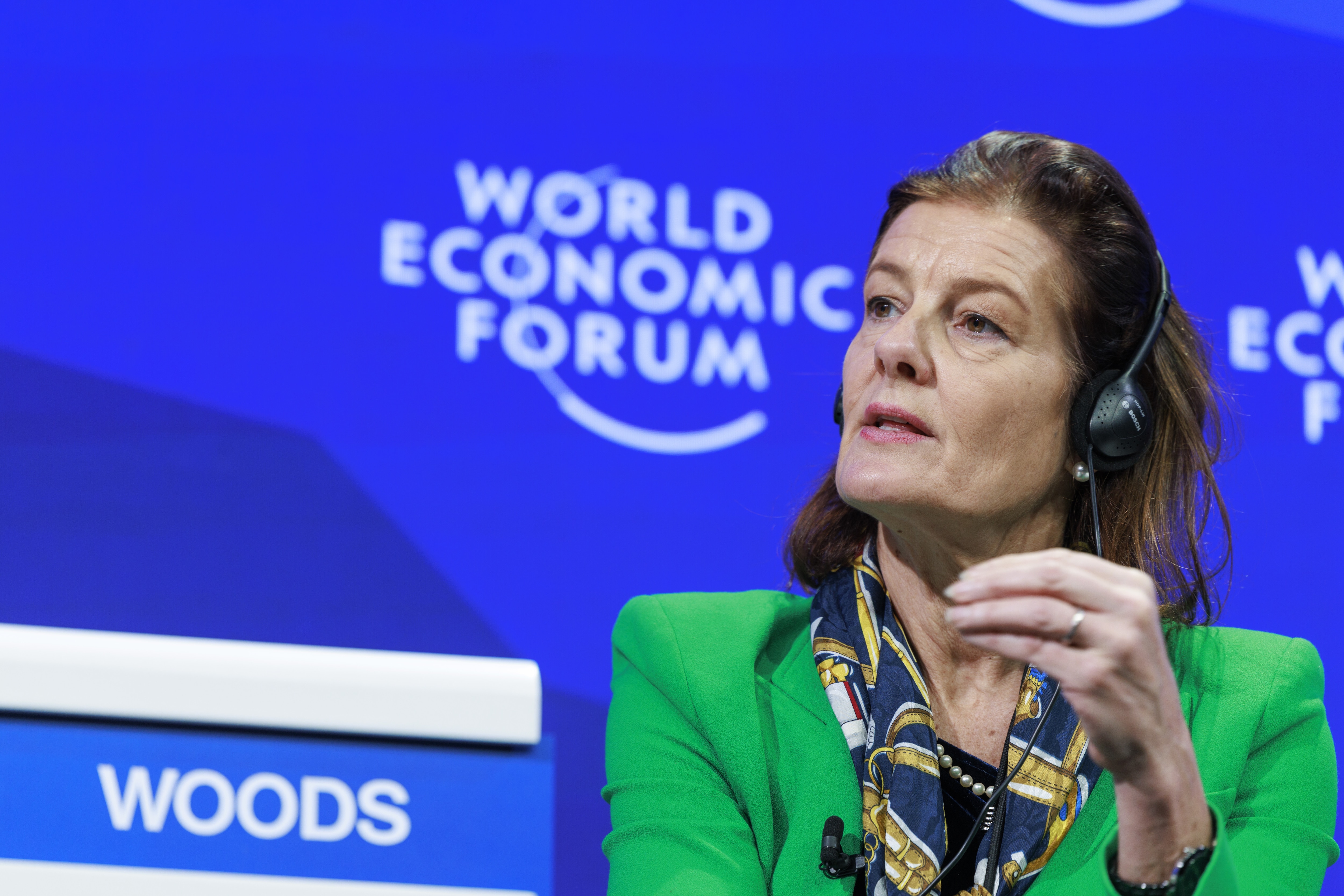
Ngaire Woods: The international community has to 'create the conditions for national consensus to take place.' Image: World Economic Forum
- Venezuela faces profound political and economic uncertainty in the wake of the US military intervention that captured Nicolás Maduro on 3 January.
- Core questions remain unanswered, including the feasibility of Washington’s "stabilisation–recovery–transition" plan.
- Venezuela’s political future and economic recovery have been debated across Davos this week, from Latin American leaders to geopolitical and energy experts.
Venezuela is facing huge uncertainties — both political and economic — following the US military intervention that ousted and captured Nicolás Maduro on 3 January. And in Davos this week, the country's future was part of the conversations among Latin American leaders and geopolitical and energy experts across several panels during the Annual Meeting.
In a session titled Venezuela: What Next?, a group of experts converged on a sobering assessment that Washington's plans are yet to present a credible pathway to legitimate governance or a durable recovery in Venezuela.
Ricardo Hausmann, Founder and Director of Harvard University’s Growth Lab — and a former Venezuelan Minister of Planning — argued that what is being framed as "stability" today is, in fact, repression: the continued detention of political prisoners and severe curtailment on basic freedoms. In his view, a climate of coercion will deter Venezuela's roughly eight-million-strong diaspora from returning to help drive the country’s economic reconstruction.
No election has been announced, despite constitutional provisions requiring interim authorities to call a vote within 30 days. For Hausmann, this has produced a constitutional vacuum that undermines the legitimacy of both the government and the National Assembly to rewrite a credible framework for companies to invest. "I would argue that there cannot be recovery without rights," Hausmann said. "Venezuela can recover very dramatically if you send a signal to Venezuelans that it's time to go back home. Right now, it's not time to go back home."
Oil and economic recovery
Venezuela currently produces around 800,000 barrels of oil per day, down from a late-1990s peak of nearly 3.5 million barrels. Output held just under 3 million barrels per day through much of the 2000s, before sliding under Maduro —a decline that accelerated sharply after US unilateral sanctions targeting the oil sector.
Experts have dampened expectations about a return to the heyday of oil production in Venezuela. Jason Bordoff, founding director of Columbia University’s Center on Global Energy Policy, said international oil companies that remained in the country could deliver relatively near-term gains if their assets were repaired and upgraded, potentially increasing production by a third. But rebuilding Venezuela's oil industry would require tens of billions of dollars and years of sustained investment.
"Companies are not going to do that," Bordoff said, "even with the strong encouragement, to put it modestly, of the US President. Unless they have confidence that there is an investable framework, because these are investments that are going to have to pay back long after President Trump has left office.
"They want to see a transition to a stable government, hopefully with the support of the Venezuelan people, a stable investment regime, rule of law, and a transparency policy for how that will work."
The evidence from post-conflict societies, as well as democratic transitions in Latin America, suggests that recovery after such processes require broad support from a country's elites to be successful. Ngaire Woods, dean of the Blavatnik School of Government, University of Oxford, pointed out that this is not a given when powerful actors have learned to survive and profit under the status quo.
"If we think about the politicians, the military, the business leaders, the power brokers in Venezuela…each of them has found a way to keep profiting from the status quo," Woods said. "The task of bringing them together and having them believe that if they work together and share one vision, they will all benefit because the pie will get bigger is actually a more difficult one than it looks."
She framed the challenge as a collective gamble: asking elites to give up the immediate fruits under the existing system in exchange for a longer-term path. But it is possible, as other countries have shown. The international community and regional actors need political coordination to create the conditions for a "national consensus" to take place.
What next for Venezuela?
Venezuela's prospects were a theme that ran through regional conversations in Davos. Presidents Daniel Noboa of Ecuador and José Raúl Mulino of Panama offered their perspectives during a session titled Rebuilding Trust in Latin America. The Ecuadorean leader framed the issue in terms of popular autonomy, and said many Venezuelans in Ecuador were relieved by the removal of Maduro because it restored "hope" and the prospect of a democratic future. Mulino took a more cautious approach, drawing a direct parallel to Panama's 1989 invasion to capture Manuel Noriega. He emphasised regional spillovers, noting that Venezuelans account for a large part of migration through the Darién crossing.
During that panel, Ilan Goldfajn, president of the Inter-American Development Bank (IDB), was asked about how the institution could support Venezuela's economic recovery: where resources would flow — and under what conditions. Goldfajn emphasized the IDB's mission to improve lives in the region, but cautioned it can only step in when there are credible conditions for sustainable recovery. In Venezuela’s case, the IDB would need authorisation from its 48-member board and the ability to operate within a normal economic relationship, constraints that do not currently hold. "We have been following Venezuela in the best way we can, and we're preparing ourselves for when and if the conditions arise," Goldfajn said.
Speaking during the Venezuela: What Next? panel, Jeffry Frieden, Professor of International and Public Affairs and Political Science at Columbia University, emphasised that investment follows stability. "I think there are three prerequisites for a recovery of foreign investment in Venezuela," he said, "political stability, political stability, and political stability."
Frieden reminded the audience that History offers plenty of cases where authoritarian rule provided a predictable environment that foreign investors can accept, although he was skeptical that this would be sufficient in Venezuela. The real question, he said, is whether Venezuela can achieve stability without the kind of democratic transition and restoration of rights that Ricardo Hausmann argued is essential.
Washington, Frieden added, has leverage in this situation: it can provide sanctions relief, access to markets, and support for a transition — but whether the current US administration is prepared to prioritise a democratic transition is uncertain.
Panelists in these Davos sessions highlighted that Venezuela's future depends on decisions made in Caracas and Washington. However, the emphasis on "stability" may prove illusory for the country's long-term prospects. Given the deep structural constraints that complicate any political settlement, the challenge of rebuilding trust in Venezuela’s recovery remains unresolved.
Don't miss any update on this topic
Create a free account and access your personalized content collection with our latest publications and analyses.
License and Republishing
World Economic Forum articles may be republished in accordance with the Creative Commons Attribution-NonCommercial-NoDerivatives 4.0 International Public License, and in accordance with our Terms of Use.
The views expressed in this article are those of the author alone and not the World Economic Forum.
Stay up to date:
Latin America


Forum Stories newsletter
Bringing you weekly curated insights and analysis on the global issues that matter.
More on Geographies in DepthSee all

Abdulla bin Ahmed Al Khalifa
February 25, 2026


