What is the Open Forum at Davos and what impact has it had?
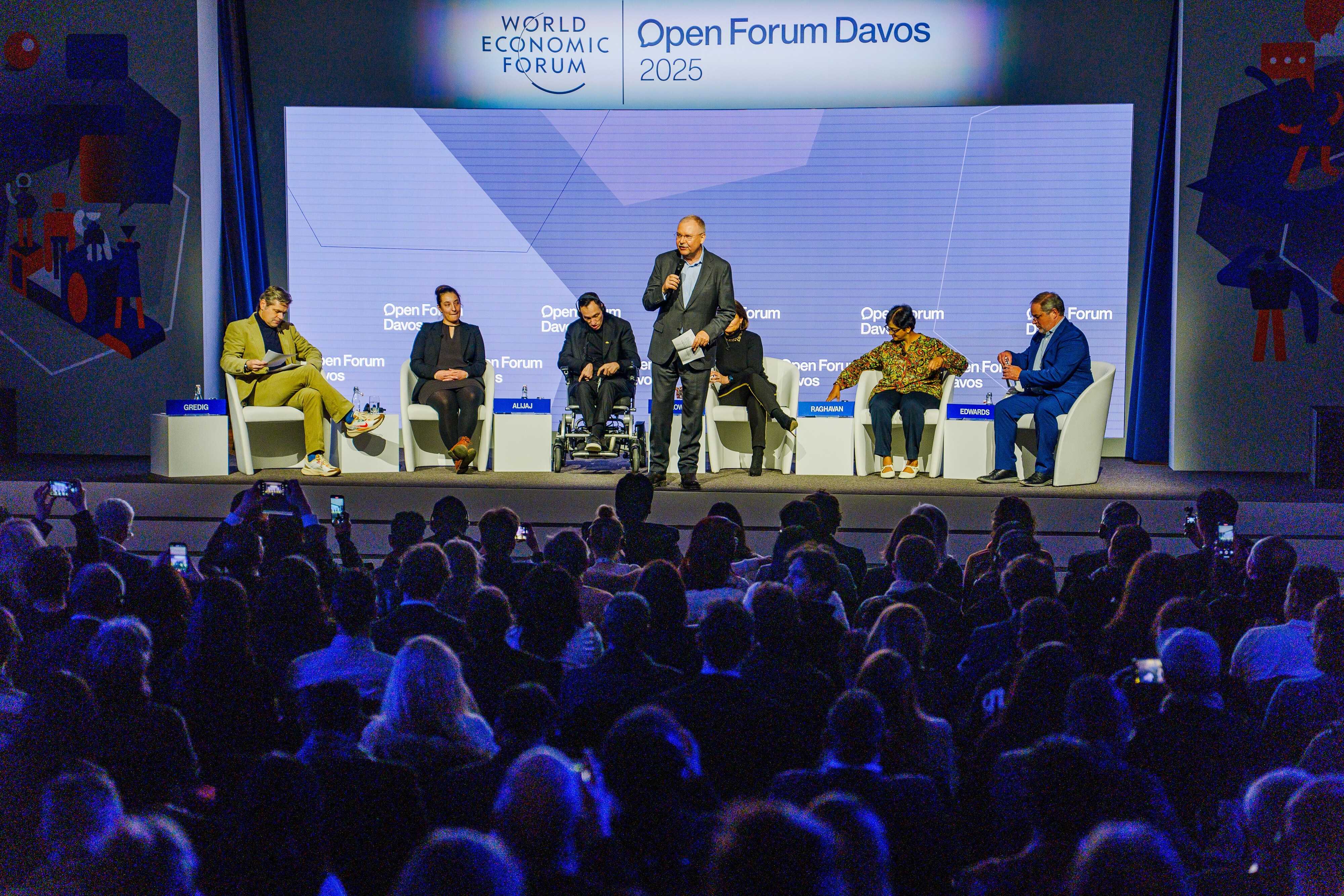
Jane Goodall speaks to young people at the Open Forum in Davos in 2024. Image: World Economic Forum / Boris Bal
- The Open Forum is a public event that takes place in Davos during the World Economic Forum Annual Meeting.
- Launched in 2003, it has featured voices ranging from Jane Goodall and will.i.am to the Swiss President, Indigenous leaders and student moderators.
- The theme of the Open Forum at #WEF26 is Visions of 2050: Tomorrow Starts Now. Here's what you need to know.
When the late Jane Goodall agreed to take part in the World Economic Forum Annual Meeting 2024, she made it a condition that she would only go to Davos if she could speak at the Open Forum again.

The British primatologist, who passed away in October 2025 at the age of 91, first spoke at the Open Forum in 2019 and had enjoyed it so much, she was keen to return.
Five years later, she addressed an audience of young people (toy monkey at her side) and told them, "There's no stopping you," solving the biggest challenges the world faces.
When an event is so inspiring that musician and entrepreneur will.i.am asks to return every year, you know it resonates.
But what exactly is the Open Forum and how did it come about?
The Davos Open Forum – An overview
The history of the Open Forum predates social media and livestreaming. The first one was held in 2003 at a time when what happened behind the closed doors of the Congress Centre in Davos was only reported in traditional media – and not accessible to the public.
At the turn of the Millennium, there were widespread anti-globalization protests around the world. The Open Forum was conceived as a way of demystifying the Annual Meeting by creating a space for diverse voices to share experiences and hold leaders accountable.
It offers high-level, free-to-attend panel discussions that challenge the status quo and ensure that broad perspectives are integrated into the solutions designed to address the world's interconnected challenges.
The Open Forum was initially run by the Swiss Protestant Church Federation and the Reformed Church Federation of Switzerland in Davos, in collaboration with the Forum, which provided speakers. It was taken on as part of the Global Leadership Fellows programme in 2012 before becoming part of the Forum's Swiss Public Affairs remit from 2017.
It also takes place at selected meetings globally, with previous editions having been held in Cambodia, India, Jordan, Viet Nam and Saudi Arabia.
The Open Forum has evolved from a transparency initiative into a critical platform for amplifying underrepresented voices – including Indigenous communities, youth activists and marginalized groups – on urgent global issues such as climate justice and social inequality.
How the Forum helps leaders navigate economic transformation for people and work
Inclusivity is part of the design, so the sessions are open to everyone, from Swiss locals to Davos participants.
Hosted in the auditorium of the Swiss Alpine School in Davos, schools have always played a key role, with students on panels or moderating sessions, and Swiss high school students always attend.
Each year, the Open Forum has an overarching theme, which in 2026 is Visions of 2050: Tomorrow Starts Now. The 10 sessions throughout the week will tackle the most pressing issues facing humanity today – from melting glaciers to the growth of quantum technologies – and how we can collaborate to create a better future for all.
Watch sessions from the past decade here.
Speaking openly and creating impact
Over the past two decades, speakers have ranged from the President of the Swiss Confederation to the Ukrainian Klitschko brothers, US ballerina Misty Copeland and Nobel Prize winners Malala Yousafzai and Kailash Satyarthi.
In 2019, the Open Forum screened the documentary Price of Free, which charts Satyarthi's struggle to rescue children from slavery. When he walked on stage, the audience erupted and there was an emotional outpouring.
A year later, 13-year-old gun violence activist Naomi Wadler joined will.i.am on stage to tell the audience the future was in their hands: "We can choose who we want to elect and we can be the ones running for office."

The sessions are always inclusive, open and educational, providing a proof of concept for multilateral dialogue in an age demanding it.
As the Open Forum is held in Switzerland, it makes a point of including Swiss voices and perspectives. Speakers from academia, politics, youth organizations and businesses in Switzerland regularly take part.
Inspired by attending the Open Forum in 2017, students from the International School of Zug and Luzern decided to start the Youth Forum Switzerland. In 2018, they visited the Forum's Geneva headquarters for training on how to put together sessions and organize an event.
The first Youth Forum Switzerland was held that year and now takes place every year just before Davos, with the theme this year being The Power of Small Changes.
A school in Baden aligns part of its curriculum around Open Forum sessions each year, teaching students about the topics, and then the learning culminates in attending the sessions.
By treating schools and young people not just as audiences but as equal thinkers, shaping conversations that matter, the Open Forum's real impact is in modelling how institutions can democratize high-level discourse and distribute leadership.
In a world facing interconnected crises, that's not just nice to have; it's essential.
License and Republishing
World Economic Forum articles may be republished in accordance with the Creative Commons Attribution-NonCommercial-NoDerivatives 4.0 International Public License, and in accordance with our Terms of Use.
The views expressed in this article are those of the author alone and not the World Economic Forum.

Forum Stories newsletter
Bringing you weekly curated insights and analysis on the global issues that matter.
More on Forum in FocusSee all

Kaya Bülbül and Kate Whiting
January 30, 2026


