5 strategies to accelerate AI adoption responsibly

Scaling responsible AI requires careful planning Image: Getty Images/iStockphoto
- As organizations accelerate their AI adoption and time to value, leaders seek strategies to achieve a sustainable edge.
- Common approaches have emerged and they are often rooted in proactive mindsets and responsible practices.
- Here see key strategies that top performers often adopt and learn how you can manage risks and enable innovation with speed.
AI adoption is happening around the world and across industries at increasing rates. Competitive pressures and a drive towards operational efficiencies lead organizations to seek strategies that can help them meet these objectives and gain market advantage.
Top strategies for accelerating AI adoption
Accelerating AI adoption and improving time to value requires strong coordination, rigorous prioritization, partnerships, frequent evaluation and responsible AI by design practices. To enable this, leading organizations often adopt these five strategies:
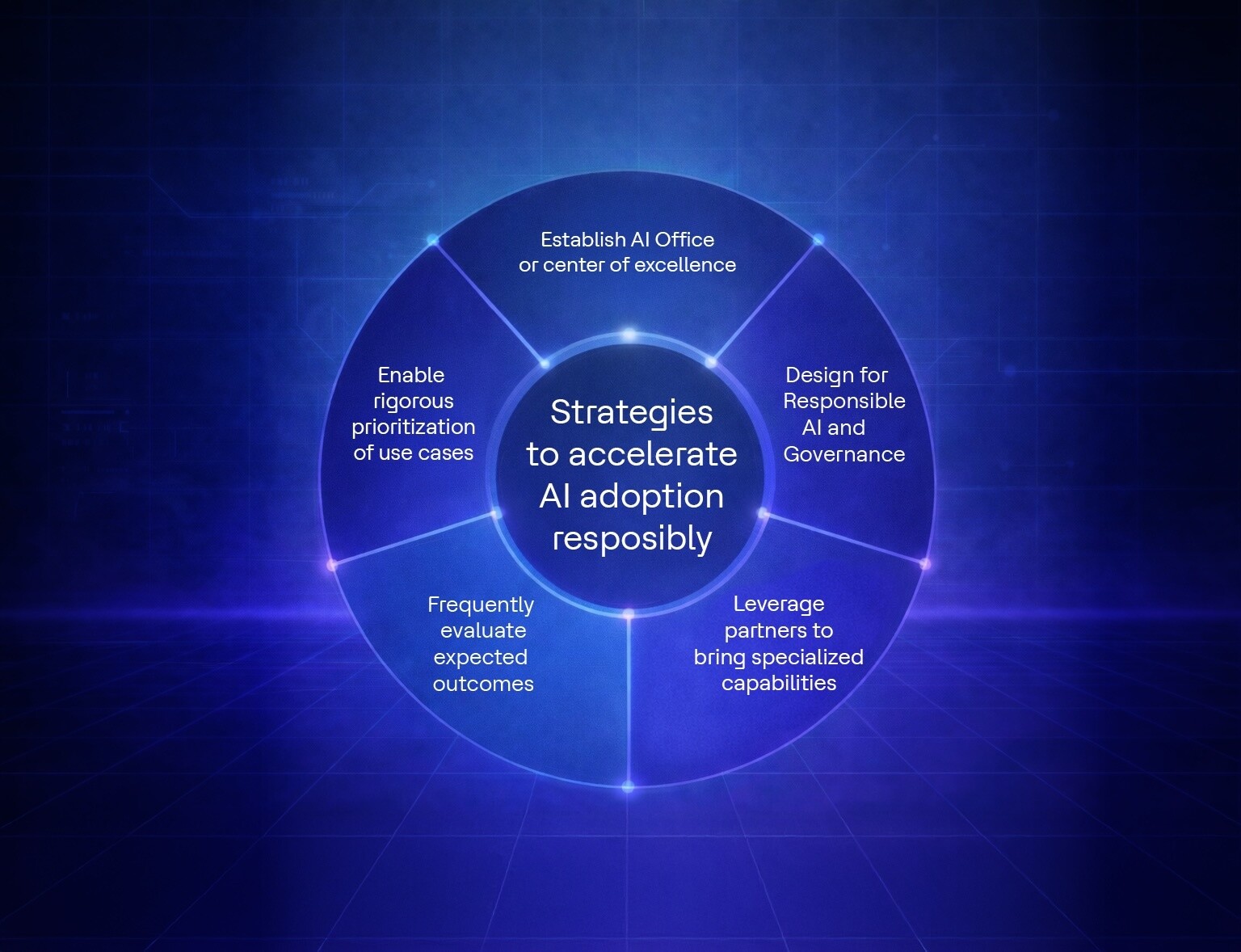
1. Establishing an AI office or centre of excellence
Organizations that create a centralized AI office or centre of excellence benefit from effective use of specialized expertise and collaboration amongst key stakeholders across AI initiatives. Without this, organizations often struggle to identify top priority AI use cases and to scale them appropriately. An effective AI office typically includes individuals that can perform key activities required for successful AI deployments, such as AI developers, product owners and governance professionals.
2. Enabling rigorous prioritization processes and use case selection
Selecting the most promising AI use cases is critical to assigning the necessary focus and resources that will help them effectively scale with speed. Without proper prioritization, organizations’ use cases may take too long to scale and miss an important market opportunity. This can also lead to the failure of AI initiatives due to misalignment of resources and controls. To avoid this, one approach is to enable a lab-like environment for testing potential use cases. My company, HCLTech, for example, helped accelerate innovation in research and drug development for a global pharma company by establishing a GenAI Lab. This enabled the company to effectively develop and test AI proofs of concept, identify and prioritize safe and compliant use cases and, ultimately, reduce the turnaround time required for pilots and prototypes.
3. Leveraging partners to reduce time to deploy and bring specialized capabilities
Partners can bring skills and tools that enable AI initiatives to succeed at a speed that would otherwise be unattainable by the organization. For example, partnering with a global technology company to enable an enterprise version of a generative AI tool can help organizations access large language models and agentic technologies that would otherwise require them to invest significant time and resources to develop themselves (if it were even feasible). Partners can also help play important roles, like external verification of controls, for example, by providing AI red teaming assessments for new AI deployments.
How the Forum helps leaders make sense of AI and collaborate on responsible innovation
4. Frequently evaluating expected outcomes
Accelerating AI adoption necessitates a frequent review of expected outcomes and early course correction when required. Establishing key performance indicators associated with the expected outcomes can help organizations define quantifiable measures of success that are easy to interpret and influence quick decision-making. Beyond basic AI system accuracy, other measures might include adoption rates, customer satisfaction scores or time saved.
5. Designing for responsible AI and governance from the start
Organizations often fear that governance and compliance activities will slow down innovation. The reality is often very different when organizations apply a responsible AI by design approach, building in appropriate governance checkpoints and controls throughout the AI development and deployment process. By engineering the AI system or deployment from an early stage with responsible AI guardrails, organizations feel confident at later stages and can proceed more quickly during final deployment and scaling efforts. For instance, testing for representative data sets when training the system can enable early resolution of potential issues and prevent costly mitigations to re-train or fine-tune based on more balanced data sets later in the AI lifecycle. According to research from the Ohio State University, leaders report that most of the value from responsible AI comes from improvements in product quality and enabling a competitive advantage.
These five strategies help accelerate AI adoption through a coordinated and disciplined approach to enabling implementation efforts that deliver value beyond pilot phases into scaled deployments.
Underpinning these strategies are the leaders and people who make them a reality. While the people aspects of success can be challenging, bringing the right mindsets and skill sets to the table create the foundation to make it all work.
Setting it right: Mindsets and skill sets
Three common characteristics relating to individual mindsets and skill sets can be observed in top performers and often underpin the successful acceleration of AI adoption.
1. Proactive
Acting before being required by law or stakeholder demands is often the result of a mindset that can be observed in top-performing leaders. Adopting this proactive mindset can help uncover justifications for ethical investments that generate long-term value. Investments in building organizational capabilities through training programmes that upskill employees on AI are good examples of this. Skill sets that can be viewed as proactive are those that are just emerging and where demand may not yet have reached its peak. Examples may include prompt engineering, AI red teaming and multi-agent system design.
2. Progressive
Accelerating adoption of AI requires courage and strategic foresight. It’s important not to stop at an initial challenge or early success. Leaders can continue pressing onwards, leveraging lessons learned to move towards greater achievements. Early proofs of concept, even if successful, still require a progressive mindset that anticipates the additional benefits ahead and actively seeks to bring them into reality. Skill sets often need to progress in a similar manner, pressing on beyond the initial beginner skills towards more advanced levels. For example, moving from skills relating to generative AI foundations towards skills that enable building custom generative pre-trained transformers (GPTs) and leveraging agentic capabilities to deliver more customized and autonomous solutions.
3. Productive
Turning skills into meaningful productivity involves a mindset that invites applying newly acquired capabilities to solve problems and removing roadblocks that previously seemed insurmountable. It is moving beyond skill acquisition to actively using those skills in day-to-day work. This can promote productivity opportunity identification, a skill that can be acquired through applied practice. For example, identifying ways to immediately apply newly acquired prompt engineering skills to design more efficient prompts for common research tasks. Then, taking the next step and applying the time saved to create a proposal for a new product idea that could generate a new revenue stream. According to the 2026 Skills Horizon report, leveraging “Gen AI for productivity” is a skill that can now be considered part of a leader’s “productive base”.
Organizations can expect that the benefits of the right strategies will be amplified by investments they make in supporting proactive, progressive and productive mindsets and skill sets in their people.
Enabled by leading strategies, mindsets and skillsets, organizations can set the stage for new use cases and innovative discoveries. This evolution often delivers measurable returns on investments, responsibly expanding opportunities for creating sustained value to all.
Don't miss any update on this topic
Create a free account and access your personalized content collection with our latest publications and analyses.
License and Republishing
World Economic Forum articles may be republished in accordance with the Creative Commons Attribution-NonCommercial-NoDerivatives 4.0 International Public License, and in accordance with our Terms of Use.
The views expressed in this article are those of the author alone and not the World Economic Forum.
Stay up to date:
Artificial Intelligence
Related topics:


Forum Stories newsletter
Bringing you weekly curated insights and analysis on the global issues that matter.
More on Artificial IntelligenceSee all

Francisco Betti
March 25, 2026


