Reflections with the greats: celebrating 100 years of Black History Month
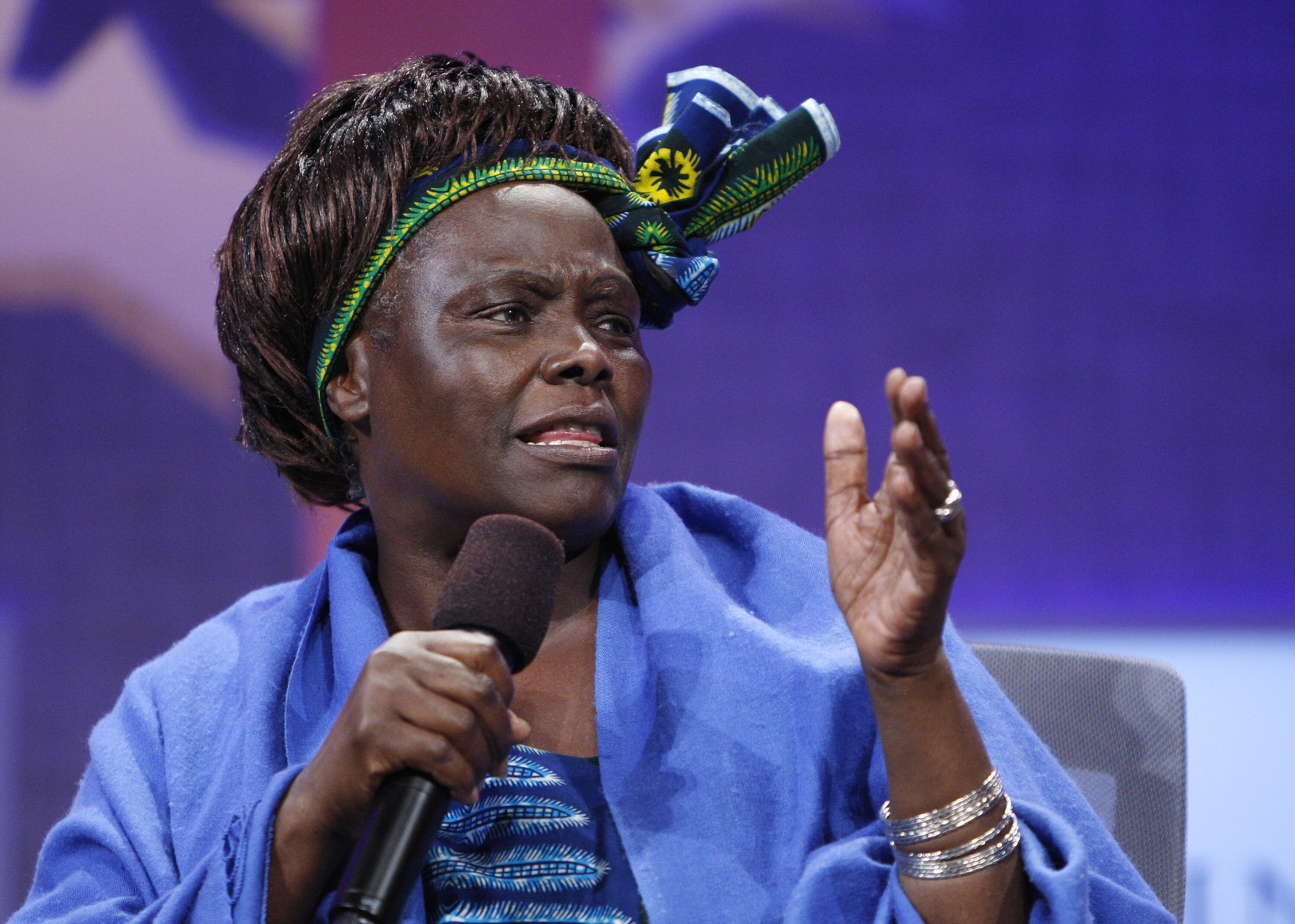
'We have no future unless we understand our past' … Wangari Maathai. Image: Reuters/Chip East
Ginelle Greene-Dewasmes
Initiatives Lead, Artificial Intelligence and Energy, Centre for AI Excellence, World Economic Forum- Black History Month offers an opportunity to reflect on the last century of Black thought to offer globally relevant insights for fractured times.
- Hope is responsibility in action, not passive optimism. It appears through effort, care and choosing to act.
- Learning, creativity and freedom are lived practices, sustained through critical thinking, memory, imagination and moral courage.
Following soon after the 2026 Annual Meeting in Davos, Black History Month arrives at a moment of profound global fragmentation. As alliances are renegotiated and power dynamics continue to shift, voices of the past and present offer hopeful guidance within an increasingly unpredictable geopolitical world landscape.
Black History Month offers a dual opportunity for reflections that remind us of the regenerative power of collaboration over conflict; and the possibility of an inclusive future in which the many – not just the few – can thrive.
Reflecting on this year’s theme of 100 years commemorating Black history and excellence, this legacy is best understood not as a closed chapter or a fixed archive, but as a living story.
Much like the ecosystems we all inhabit, Black history – and the wisdom it offers regarding shared global realities – unfolds as a breathing, evolving conversation about the human experience. Its messages echo across generations, continents, cultures, disciplines and aspirations. They are recorded in poems and policies, thrum in musical notes, written in classrooms; they are whispered in moments of doubt, enacted through social movements and cultural trends, and proclaimed in moments of courage.
As we celebrate Black History Month, here are answers from leading Black thinkers past and present to globally relevant questions:
- What keeps you learning?
- Why create when the world resists you?
- Where does hope come from?
- What is our responsibility to one another and to the future?
On learning, curiosity and persistence
What does learning make possible? Why does it matter so much?
For many of the world’s most transformative leaders, education was never an end in itself, but a catalyst for conscience, courage and change.
Martin Luther King Jr, Nobel Peace Prize Laureate, United States, framed education as a moral and intellectual discipline, with a reminder that “the function of education is to teach one to think intensively and to think critically”.
According to Wangari Maathai, Nobel Peace Prize Laureate and environmental activist, Kenya, such critical thinking must be grounded in memory: “We have no future unless we understand our past.”
However, understanding alone is not enough. US civil rights activist John Lewis urged movement: “Do not be afraid to give up the good to go for the great.”
In times when that journey demands endurance, Nelson Mandela, former president of South Africa, reminded us that perseverance is inseparable from learning itself:
A winner is a dreamer who never gives up.
—Nelson Mandela”Taken together, these reflections show that learning transcends the accumulation of knowledge. It is the disciplined practice of critical thought, historical awareness, moral courage and persistence.
Why create? Why insist on imagination in a world that often feels inhospitable?
Across generations, creation has carried a dual role, of joy and play, as well as for deliberate acts of resistance and possibility.
Manuel Zapata Olivella, writer and anthropologist, Colombia, grounds creation in cultural memory, reminding us that imagination sustains freedom across time: “A people without culture is a people without memory, and without memory there is no freedom.”
Maya Angelou, writer, poet and civil rights activist, United States, builds on this perspective, framing creativity as a renewable resource:
You can’t use up creativity. The more you use, the more you have.
—Maya Angelou”Rather than waiting for permission or for others to act, creative leadership often begins with bold first steps. Ngũgĩ wa Thiong’o, writer and decolonial thinker, Kenya, emphasizes the power of conscious choice in shaping imagination itself: “The choice is between a language that empowers and a language that enslaves.”
Beyond individual expression, creation carries collective consequences. Claudia Jones, journalist, activist and pan-Africanist, Trinidad and Tobago, ties art directly to liberation: “A people’s art is the genesis of their freedom.”
Creation, especially in inhospitable conditions, is therefore not optional. It is how memory is preserved, power reclaimed, and absence transformed into possibility.
Where does freedom begin? How do dignity and joy endure?
Mia Mottley, Prime Minister of Barbados, challenged world leaders in her 2021 United Nations General Assembly address to uphold this tradition of moral responsibility by echoing the words of Bob Marley, asking: “Who will get up and stand up?”
The question points inward before it points outward. Bob Marley, musician, songwriter and cultural icon, Jamaica, makes this explicit, grounding liberation in consciousness and values: “Emancipate yourselves from mental slavery; none but ourselves can free our minds.” “Don’t gain the world and lose your soul; wisdom is better than silver or gold.”
Freedom often begins with the courage to assert one’s own dignity. Before it can be defended collectively, it must first be claimed personally, in voice, in presence, and in the simple insistence on being respected. Through music, Calypso Rose, musical icon and women’s rights advocate, Trinidad and Tobago, sought to express this insistence into being: “Leave me alone, let me live my life.”
Such refrain is less a plea than a declaration, a demand for agency, space and the fundamental right to exist on one’s own terms.
Alice Walker, writer, poet and activist, United States, develops the idea further:
The most common way people give up their power is by thinking they don’t have any.
—Alice Walker”Taken together, these voices suggest that freedom is first an internal decision, an awakening of self-belief and moral clarity, that must then be translated into daily action. Dignity and joy endure not by accident, but through conscious choice, resistance and care for one another.
What does it mean to be responsible to the world we inherit? What do we leave behind?
Across generations, responsibility could be understood not as sentiment, but as action shaped by awareness.
Frantz Fanon, psychiatrist, philosopher and anti-colonial thinker, Martinique; Algeria, argues that this begins with accountability to reality and to one another: “Each generation must, out of relative obscurity, discover its mission, fulfill it, or betray it.”
Responsibility, then, is not abstract. It shows up as effort, participation and choice. Barack Obama, former president of the United States, grounds hope in motion rather than waiting: “The best way to not feel hopeless is to get up and do something.”
June Jordan, poet, essayist and activist, United States, echoes this call, rejecting the myth of a distant saviour:
We are the ones we have been waiting for.
—June Jordan”To act wisely, however, requires understanding. Dr Eric Williams, first prime minister of Trinidad and Tobago, offers essential perspective: “The future… depends on the ability of its people to understand the forces that have shaped their past.”
Looking forward demands not only courage, but ambition. Ellen Johnson Sirleaf, former president of Liberia, insists that hope must stretch beyond comfort: “The size of your dreams must always exceed your current capacity to achieve them. If your dreams do not scare you, they are not big enough.”
Hope, as reflected here, is not passive optimism. It is stewardship; the deliberate choice to act, to question, to dream boldly, and to leave the world more positive than we found it.
The above messages resonate beyond Black history. They contain universally relevant messages as not simply something to remember, but as something to be carried forward. To learn deeply. To create bravely. To protect joy. To act with care. To leave the world more awake than it was found.
In celebrating Black excellence, the invitation is to look beyond individual spotlight moments of historical figures. Hope for collective progress, especially in times of fragmentation, will emerge from the collective processes that sustain change. The accumulated one hundred years and counting of celebrating Black wisdom demonstrate that success amid turmoil has been shaped when people of differing perspectives choose collaboration even when division seems easier.
Don't miss any update on this topic
Create a free account and access your personalized content collection with our latest publications and analyses.
License and Republishing
World Economic Forum articles may be republished in accordance with the Creative Commons Attribution-NonCommercial-NoDerivatives 4.0 International Public License, and in accordance with our Terms of Use.
The views expressed in this article are those of the author alone and not the World Economic Forum.
Stay up to date:
Human Rights
Related topics:


Forum Stories newsletter
Bringing you weekly curated insights and analysis on the global issues that matter.
More on Civil SocietySee all

Francesca Bosco, Michael Daniel and Philip Reitinger
February 9, 2026