Why financial leadership on nature matters for sustainable growth

Image: Bailey Zindel/Unsplash
- Over half of global GDP is moderately or highly dependent on nature, yet seven of nine planetary boundaries have already been breached.
- Closing the $700 billion annual biodiversity finance gap is not just a necessity, but also a major economic opportunity.
- The financial sector can support an economy-wide transition to nature-positive systems for sustainable growth.
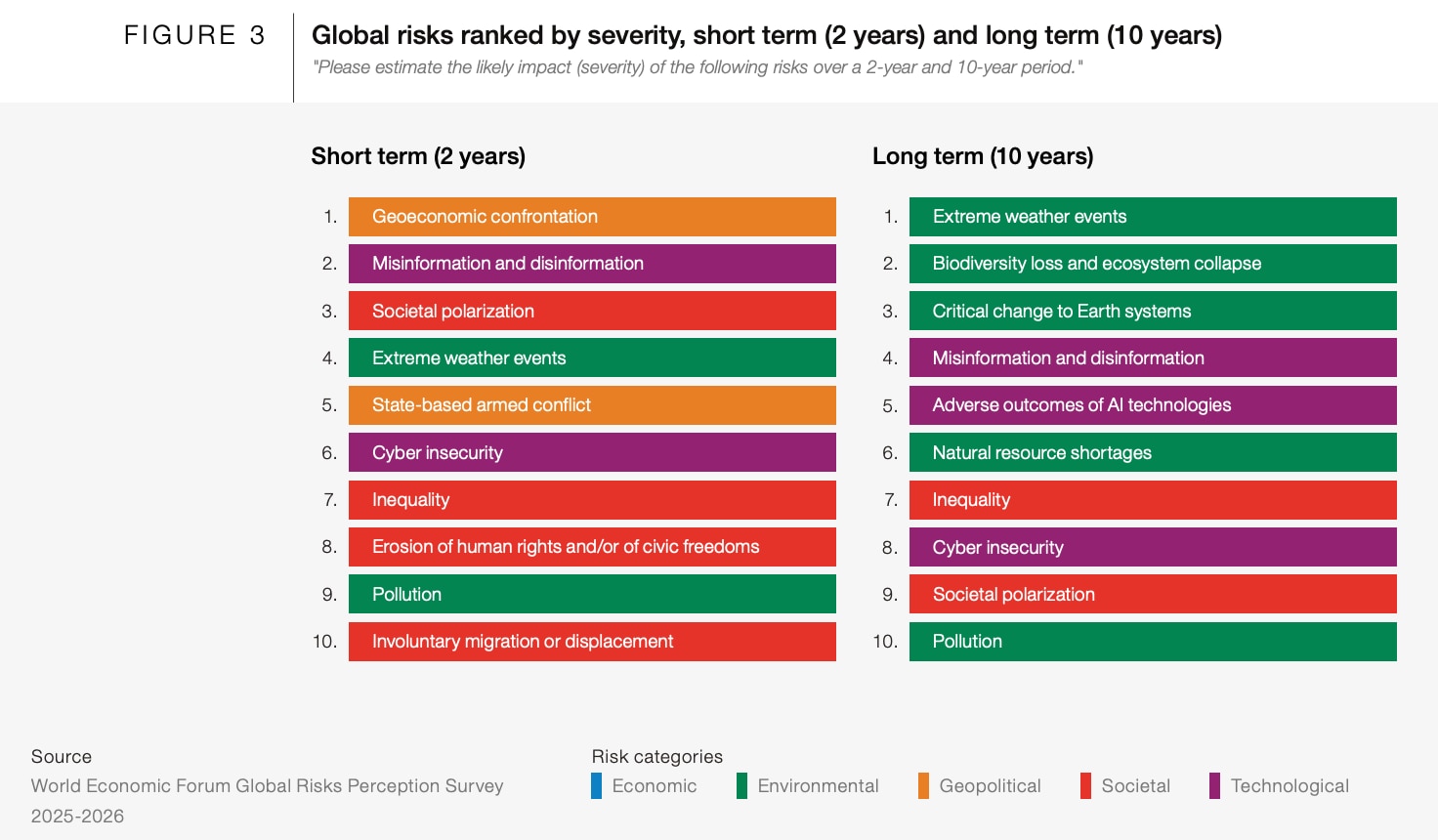
While geopolitical and economic risks are the most severe that we face in the short-term, according to the World Economic Forum's Global Risks Report 2026, environmental risks including biodiversity loss and ecosystem collapse are the most serious long-term threats.
Have you read?
These risks have profound implications for natural systems, human well-being, and global financial stability. And, crucially, they are deeply interconnected with short-term socioeconomic risks such as conflict, displacement, inequality or economic downturns.
Long-term does not mean distant: about four billion people experience severe water scarcity for at least one month each year, while drought impacts cost an estimated $307 billion annually.
Yet global finance remains misaligned with this reality. The United Nations Environment Programme’s (UNEP) State of Finance for Nature 2026 report finds that for every $1 invested in protecting nature, $30 is spent on activities that destroy it.
This imbalance accelerates systemic vulnerability and increases the likelihood of abrupt and irreversible impacts on the natural systems on which our societies and economies depend.
Nature underpins the real economy, yet seven of the nine planetary boundaries have now been breached, including ocean acidification – which entered the danger zone in 2025.
As calculated by the World Economic Forum, more than half of global gross domestic product – around $58 trillion – is moderately or highly dependent on natural systems – from agriculture and infrastructure to manufacturing and global supply chains.
Physical risks such as water scarcity, soil degradation, deforestation and ecosystem collapse are already affecting cash flows in most sectors. For banks, insurers and investors, such impacts translate into physical, transition and financial risks that directly affect asset values and the long-term stability of their clients.
Why closing the global biodiversity finance gap is vital
Closing the $700 billion annual global biodiversity finance gap is not only a necessity, but also a major opportunity, as highlighted in the Intergovernmental Science-Policy Platform on Biodiversity and Ecosystem Services’ (IPBES) recently-published Business and Biodiversity Assessment’s Summary for Policymakers.
Endorsed by 152 countries, the report offers the strongest evidence to date of how nature underpins business value and how managing impacts on nature can strengthen economic resilience. Investments for nature‑positive outcomes, such as regenerative agriculture, sustainable forestry, watershed restoration and ocean-based solutions, are also emerging as investable asset classes with distinctive risk return characteristics.
In parallel, rapid advances in nature‑related technologies, including monitoring, reporting and verification (MRV) and geospatial data tools, are lowering information barriers and enabling financial institutions to better manage nature‑related risks, as well as to develop credible nature‑related key performance indicators for financial products.
Taken together, new investment opportunities and enabling tools can support portfolio diversification, contribute to climate objectives and generate long‑term value for financial institutions.
They can also help align financial flows with societal goals articulated in the 2022 Kunming-Montreal Global Biodiversity Framework and reinforced by more recent global commitments, including the 2025 Global Mutirão decision under COP30 in Brazil to halt and reverse deforestation and forest degradation by 2030.
At the same time, regulatory momentum is accelerating, with new policies, disclosure requirements and market expectations coming into force across all regions, including in the Global South, where larger shares of economic activity are directly dependent on nature and where biodiversity loss is increasingly recognized as a macroeconomic risk.
Concrete examples include the participation of South Africa’s Prudential Authority in pilot assessments of bank exposures to nature‑related risks, the integration of nature into China’s Green Bond and Green Finance Taxonomy, or Brazil’s leadership through initiatives such as the Tropical Forests Forever Facility. These signals point to an inevitable convergence between nature protection, financial regulation and capital allocation.
Business case for integrating nature into financial strategies
Despite challenging times globally, the business case for integrating nature into core financial strategies remains very clear. Nature finance is moving from niche innovation toward the mainstream of capital markets.
Within UNEP Finance Initiative’s (UNEP FI) Principles for Responsible Banking community, which represents half the global banking system, 45% of signatory banks are taking action on nature.
How the Forum helps leaders align climate action with nature-positive growth
This momentum is also reflected in the rapid uptake of the Taskforce on Nature-related Financial Disclosures (TNFD), adopted by more than 620 organizations across more than 50 countries and areas, as well as the fact that the International Sustainability Standards Board (ISSB) is now scoping how to integrate nature into its standards framework.
In a period marked by geopolitical fragmentation and economic uncertainty, some companies may instinctively pause or pull back, but financial institutions cannot afford to lose sight of the horizon.
This is precisely the moment to take action or continue to take action, because nature represents both a source of systemic risk and a foundation for long-term prosperity.
By grounding decisions in science, strengthening risk frameworks and scaling finance for outcomes that are nature positive, the financial sector can help steer an economy-wide transition to nature-positive systems – one that builds resilient growth and shared prosperity within planetary boundaries.
Don't miss any update on this topic
Create a free account and access your personalized content collection with our latest publications and analyses.
License and Republishing
World Economic Forum articles may be republished in accordance with the Creative Commons Attribution-NonCommercial-NoDerivatives 4.0 International Public License, and in accordance with our Terms of Use.
The views expressed in this article are those of the author alone and not the World Economic Forum.
Stay up to date:
Financial and Monetary Systems


Forum Stories newsletter
Bringing you weekly curated insights and analysis on the global issues that matter.
More on Nature and BiodiversitySee all

Adriana Mata and Judith Ketelslegers
April 9, 2026


