How human-centred physical AI will be key to transforming cities
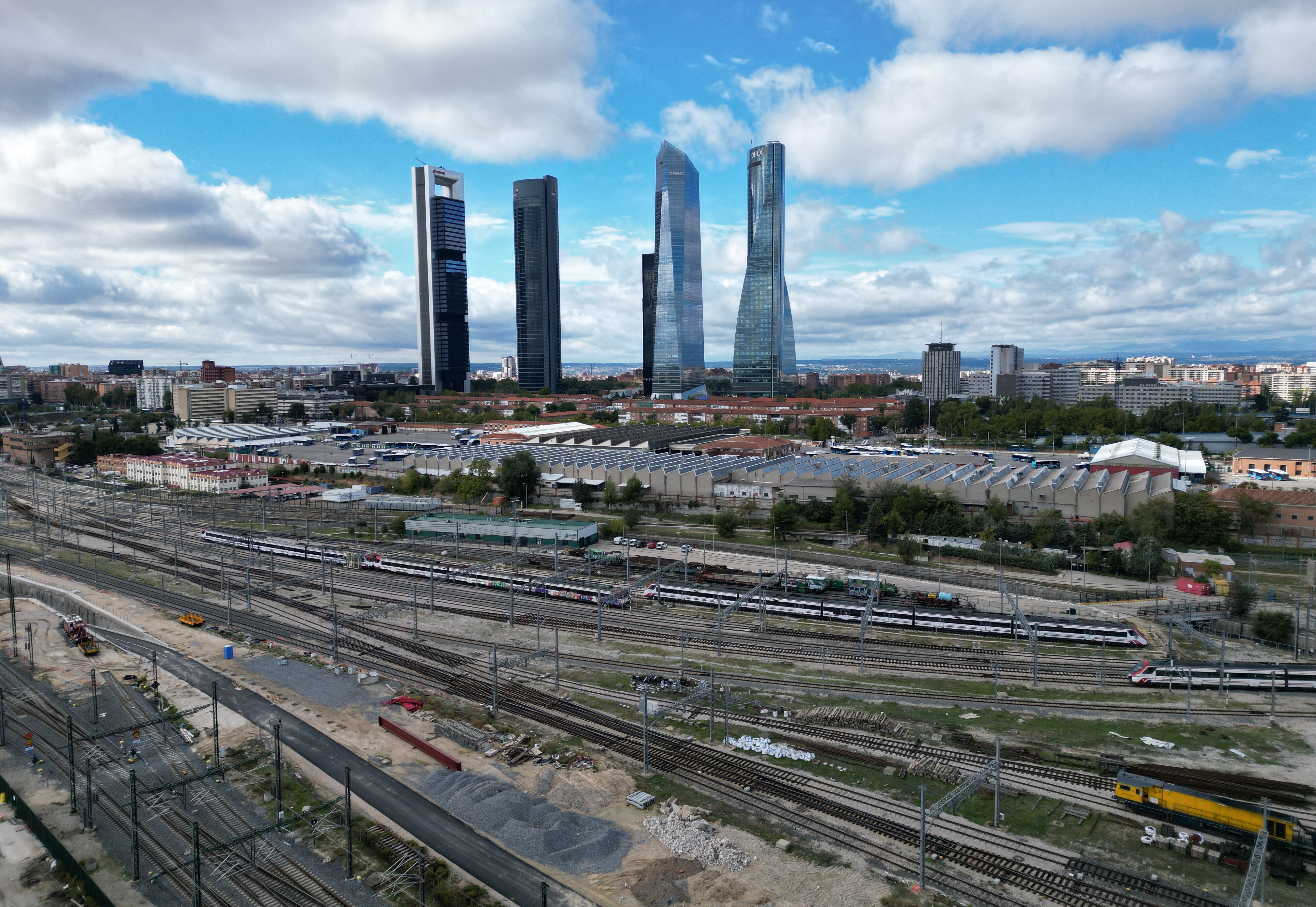
Madrid's Chamartín railway station highlights how cities can use physical AI to streamline movement. Image: Reuters/Guillermo Martinez
- Over two-thirds of the world's population is expected to live in urban areas by 2050, but many regions lack mobility strategies and sustainable design.
- If cities are to flourish, they must adopt an approach that blends physical AI, collaborative ecosystems, digital connectivity and human-centric design.
- By blending creative financing with integrated innovation ecosystems, cities can build a more connected, inclusive and sustainable urban future.
It’s 7.42am in a big city. A burst water main shuts a key intersection. Buses, lacking real-time updates, scramble to reroute. Logistics trucks queue at a port exit. Mobility apps crash under the sudden load. Thousands of commuters are stranded, not because the city lacks infrastructure but because its systems aren’t connected or resilient enough.
As urban populations surge, gaps in mobility and infrastructure networks become a critical challenge. The World Bank says that over 80% of global gross domestic product is generated in cities, but the mismatch between growth and planning threatens sustainability.
More than two-thirds (68%) of the world’s population will live in urban areas by 2050, according to the United Nations, often in regions lacking long-term mobility strategies or sustainable urban design – underscoring the need for immediate action.
If megacities are to flourish, they must adopt an approach that blends the power of artificial intelligence (AI), collaborative ecosystems, digital connectivity and human-centric design into a unified transformation strategy.
Why physical AI is a new blueprint for urban evolution
For decades, cities’ mobility initiatives have relied on transportation authorities and urban planners. But relying on these traditional stakeholders alone has created blind spots. Citizens, startups, vehicle manufacturers, logistics providers and technology partners often sit on the sidelines despite being critical to the system’s success.
The most efficient cities are using physical AI to break down these silos.
Physical AI combines the internet of things (IoT) with AI, but with a decisive architectural shift: computing happens at the edge. By processing data locally rather than in the cloud, cities achieve faster response times and lower latency. The models themselves are lightweight, cost-effective and grounded in physics and mathematics rather than language-based abstractions.
Cities are, by nature, physical systems. They manage roads, utilities, buildings and other public spaces in real time. While AI has already been applied to digital domains – such as optimizing IT budgets – physical AI marks a turning point. It enables continuous, real-time management of physical infrastructure, delivering a step change in responsiveness, reliability and service quality.
Its applications span air and water quality, traffic management, public safety and security, fire prevention and weather response. As more autonomous cars arrive in urban environments, reliance on physical AI will increase exponentially.
The need for integrated innovation in cities
But are cities ready? What they need is an integrated innovation ecosystem – one that brings business, academic researchers and civic leaders together to co-create physical AI solutions. These collaborations can deliver both social and economic value, turning cities into engines of efficiency, sustainability and inclusion.
Yet ecosystems alone aren’t enough. AI is expensive, as evidenced by the latest valuations and the data centre boom. Cities need new ways to fund and scale AI innovation and urban transformation. New financing mechanisms enable cities to modernize ageing systems and pilot emerging technologies:
- Public-private partnerships distribute risk and accelerate the deployment of AI infrastructure and mobility services
- Outcome-based financing models connect investments to specific, measurable urban improvements such as reduced traffic congestion, improved water quality and lower emissions. This approach ensures that funding directly supports tangible results, making urban transformation efforts more accountable and effective.
- Innovation funds and shared-value models enable multiple stakeholders to co-invest in solutions that benefit the whole city, leveraging the data centre boom in urban settings.
Digital connectivity as the new AI infrastructure
Just as 20th-century cities relied on roads and electricity, 21st-century cities rely on connectivity. Broadband, 5G, IoT networks and AI platforms lay the foundation for mobility, energy, logistics and public safety.
Innovative cities are already demonstrating what’s possible, with examples across the world:
- In Brownsville, Texas, private 5G is being used to deliver physical AI solutions for public safety.
- In Madrid Nuevo Norte, Spain, open digital architectures and data platforms improve commuter accessibility and streamline movement.
- At the Chamartín railway station, also in Madrid, digital twins and AI provide real-time visibility of occupancy, passenger flows and operational needs.
- Mobility data trusts offer a secure, sovereignty-preserving marketplace for mobility information where public and private stakeholders share data without compromising trust.
Physical AI as a service for seamless movement for people and goods
While goods movement is the lifeblood of a city, it’s also a major source of congestion and emissions.
Physical AI as a service is reimagining how deliveries flow in and out of ports, rail terminals and distribution hubs. Through collaborative planning, data-driven routing and improved rail connections, cities can:
- Reduce traffic around logistics terminals
- Accelerate freight movement
- Lower costs and emissions
- Incentivize a shift from road to rail
Human-centric urban design is essential for connected cities
AI alone doesn’t create great cities; people do. Every innovation – including digital twins and physical AI – must ultimately serve human needs such as accessibility, safety, equity, sustainability and quality of life.
It’s the essence of human-centric urban design: using technology and financing strategies to improve the experiences of every citizen, regardless of where they live or how they move.
However, there is a growing headwind: the rapid expansion of AI and hyperscale data centres in dense urban areas around the world is straining electrical grids that weren’t designed for such high demand, driving grid congestion and rising consumer electricity prices.
This raises a deeper question about the new “power equation” of AI-enabled cities.
Simply put, AI capability scales with access to power: Less available energy constrains innovation, while greater capacity accelerates it. Without thoughtful regulation, it risks creating urban inequality in which large technology firms secure preferential access to energy. At the same time, communities bear higher costs and see limited local benefits.
But cities can change this equation. For example, for all city-based data centres, why not carve out a “local breakout” for edge-based physical AI use cases? These data centres will benefit from providing immediate benefits to local communities.
Cities are catalysts for opportunity, innovation and community.
By blending creative financing with integrated innovation ecosystems, they can reimagine their economies, improve mobility and fulfil the World Economic Forum’s vision of a more connected, inclusive and sustainable urban future.
What is the World Economic Forum doing to promote sustainable urban development?
Don't miss any update on this topic
Create a free account and access your personalized content collection with our latest publications and analyses.
License and Republishing
World Economic Forum articles may be republished in accordance with the Creative Commons Attribution-NonCommercial-NoDerivatives 4.0 International Public License, and in accordance with our Terms of Use.
The views expressed in this article are those of the author alone and not the World Economic Forum.
Stay up to date:
Artificial Intelligence


Forum Stories newsletter
Bringing you weekly curated insights and analysis on the global issues that matter.
More on Built Environment and InfrastructureSee all

Karikari Achireko
October 2, 2026


