Here's why the India-EU trade pact is the 'mother of all deals'
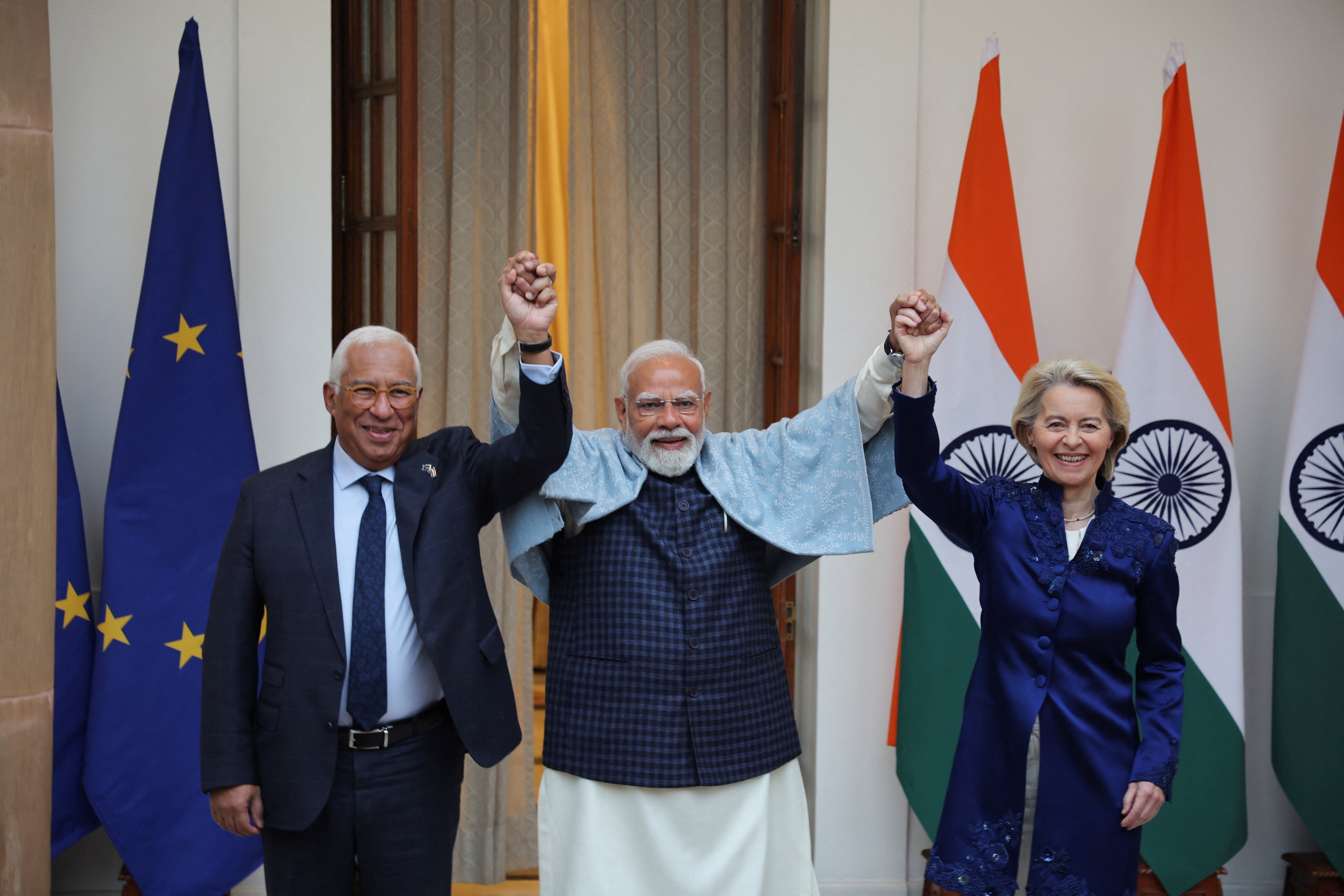
India and the European Union have signed a free trade deal, creating the world's largest free trade zone. Image: REUTERS/Altaf Hussain
- India and the European Union have signed a free trade deal, creating the world's largest free trade zone.
- The trade deal is expected to bolster numerous industries in India and the EU.
- In Davos last month, European Commission President Ursula von der Leyen spoke of the deal as part of a "new Europe" strategy.
India and the European Union reached a landmark free trade deal last week, concluding negotiations in one of the world’s most ambitious trade pacts.
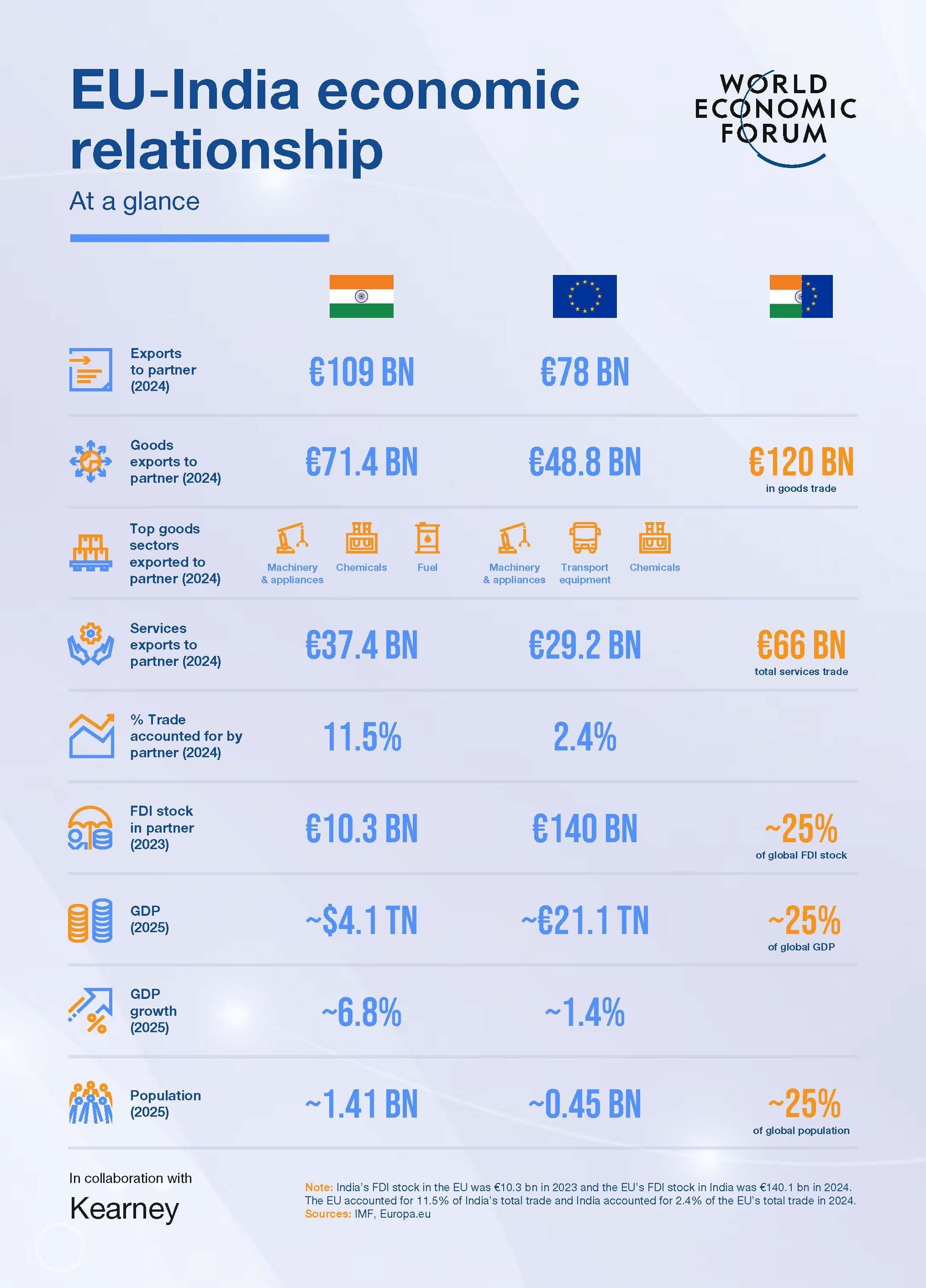
The deal, which aims to remove trade barriers and open up new export opportunities, creates the world’s largest free trade zone, encompassing two billion people and nearly 25% of global gross domestic product.
"We have delivered the mother of all deals," European Commission President Ursula von der Leyen said in a statement. "This is a tale of two giants – the world's second- and fourth-largest economies. Two giants who choose partnership in a true win-win fashion."
What’s in the EU-India deal?
The EU and India already trade €180 billion worth of goods and services every year. Moreover, with roughly 6,000 European companies operating in India, the trading relations supports nearly 800,000 European jobs.
The economic relationship between the two blocs is expected to surge after the free trade deal comes into force following a review by EU institutions and a legal vetting process in India. Indian Commerce Minister Piyush Goyal told reporters that the final legal review is expected to be completed this year.
Under the deal, India will eliminate or reduce tariffs on 96.6% of EU exports by value. Meanwhile, the EU will reciprocate by reducing tariffs on 99.5% of Indian goods. The European Commission projects $4.7 billion in annual duty savings, with exports potentially doubling by 2032.
"This agreement will deepen the economic ties, create new opportunities for our people, and strengthen the partnership between India and Europe for a future characterized by prosperity," said Indian Prime Minister Narendra Modi.
How will industries be impacted?
The trade deal is expected to bolster numerous sectors in India and the EU.
European carmakers, for example, stand to benefit as under the deal India agreed to slash car tariffs from as much as 110% to 10% over five years, creating quota-based access for 250,000 EU vehicles annually.
In exchange, the EU granted immediate zero-duty access for India's labor-intensive exports including textiles, apparel, leather, footwear, gems and jewellery. The deal is also expected to boost India's agricultural and food sector, with the Ministry of Commerce and Industry noting in a statement that India secured "preferential market access for its agricultural exports, boosting competitiveness for processed foods."
The services dimension may prove transformative, too. The EU committed to opening 144 subsectors — particularly IT, professional services and education — and facilitate easier labour mobility.
Yet some complications do persist. Notably, the EU's Carbon Border Adjustment Mechanism remains intact despite Indian objections. Brussels, however, has pledged $590 million to help India reduce emissions as steel and aluminium exporters face new carbon costs from 2026.

A deal 20 years in the making
India and the EU first tried to negotiate a trade deal in 2007. However, talks stalled in 2013 over patent protection, data security and the right of Indian professionals to work in Europe. Negotiations were relaunched in 2022.
In recent years, geopolitical pressures have in part pushed the two blocs to finalise the deal, with both India and the EU looking to diversify their export markets amidst tensions with the United States.
Just days following the announcement of the EU-India deal, the United States and India reached an agreement to lower US tariffs, de-escalating a months-long trade dispute.
Last month at the World Economic Forum Annual Meeting in Davos, Switzerland, von der Leyen noted that the world is "more fractured and more fractious than ever," adding that a strategy for a "new Europe" is emerging.
"Europe wants to do business with the growth centres of today and the economic powerhouses of this century, from Latin America to the Indo-Pacific and far beyond," she said. "Europe will always choose the world, and the world is ready to choose Europe."

'Economic and trade partnership'
Earlier in January, the World Economic Forum released the Global Cooperation Barometer 2026, which found that while global multilateralism has weakened, more "flexible and smaller arrangements of cooperation" continue to persist.
Cooperation today, the report notes, is "more bespoke, more interest based and, most importantly, still present."
While announcing the EU-India free trade deal in New Delhi, von der Leyen stated that the pact sends a "signal to the world that rules-based cooperation still delivers great outcomes."
Meanwhile, a statement from India's Ministry of Commerce and Industry noted that the deal demonstrates the "political will and shared vision to deliver a balanced, modern, and rules-based economic and trade partnership."
How the Forum helps leaders make sense of regional, trade and geopolitical shifts
License and Republishing
World Economic Forum articles may be republished in accordance with the Creative Commons Attribution-NonCommercial-NoDerivatives 4.0 International Public License, and in accordance with our Terms of Use.
The views expressed in this article are those of the author alone and not the World Economic Forum.
Related topics:

Forum Stories newsletter
Bringing you weekly curated insights and analysis on the global issues that matter.
More on Trade and InvestmentSee all

Rumaitha Al Busaidi and Sarah Mostafa-Kamel
March 20, 2026


