'The hardest advances in robotics are behind us': What comes next?
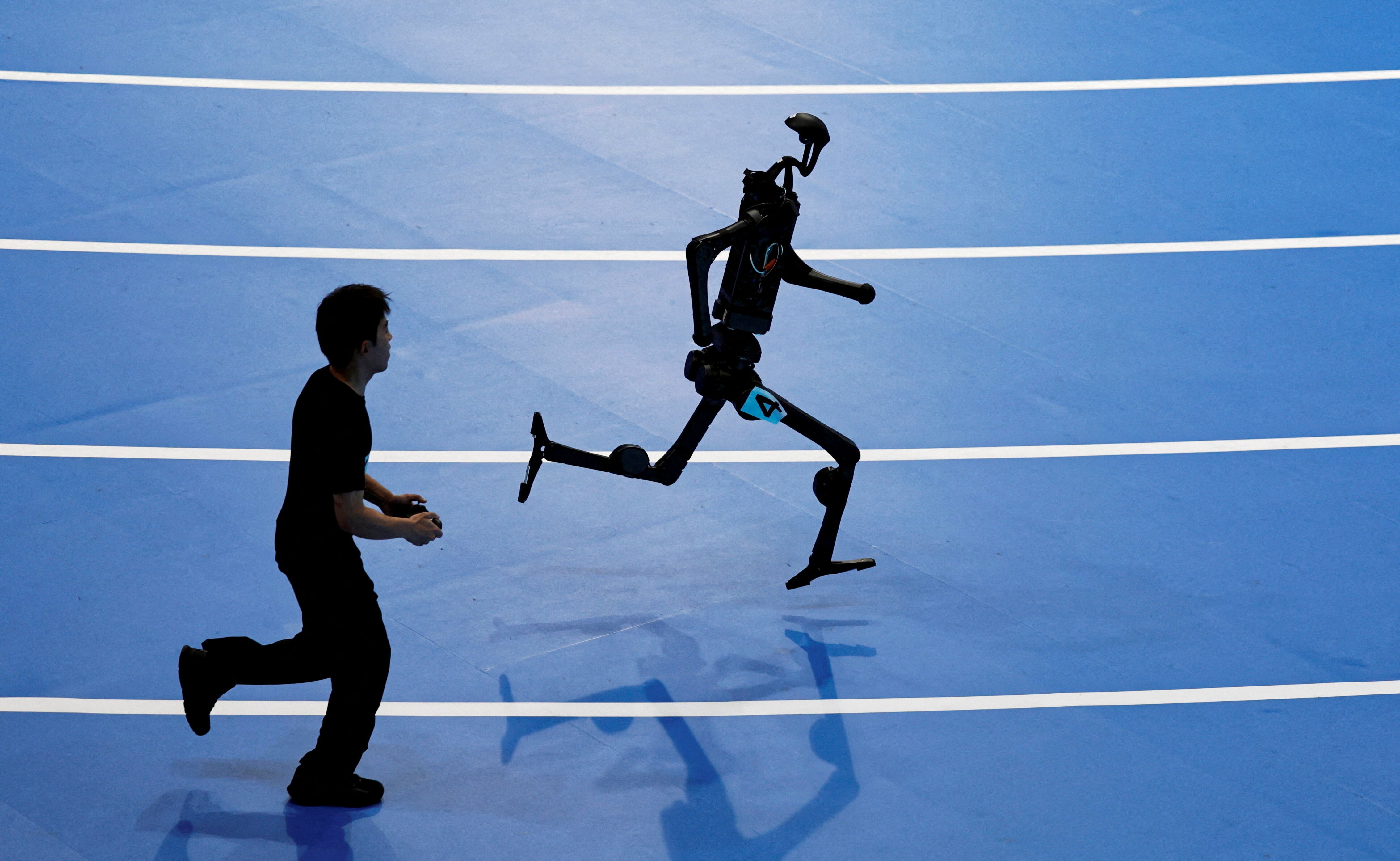
Robots have come a long way over the past decade thanks to foundational breakthroughs. Image: REUTERS/Tingshu Wang
- Autonomous robots have moved from labs to real-world industry, operating at scale in ports, warehouses and factories.
- In a recent episode of Radio Davos and in a session at the World Economic Forum's 56th Annual Meeting in Davos, experts on physical AI explored what's next for autonomous systems.
- Experts say that the hardest technical breakthroughs are now behind us, but that the transition to domestic robotics requires further advancements.
After a decade of largely unseen progress, autonomous robots are now operating in manufacturing, healthcare, logistics and more – from self-steering cars to digital therapists and algorithmic diagnoses.
The core technical groundwork for physical AI is largely complete, leaders at Davos 2026 agreed, yet the industry’s full impact will only be realized as these systems move from isolated industrial zones into the complexity of everyday life.
The World Economic Forum recently welcomed experts on physical AI to its 56th Annual Meeting in Davos, where they explored, in the panel session 'Living Autonomously' and on Radio Davos, what comes next for the technology.
Why leaders say the hardest part is done
The past decade has brought fundamental breakthroughs, unlocking what was previously impossible. So what are these recent advancements?
Daniel Kuepper, Managing Director & Senior Partner at BCG, shed some light in the recent Radio Davos episode 'What is Physical AI?':
- Massive compute acceleration over the past eight years – 1,000x increase, outpacing Moore’s Law expectations by 25x.
- Narrowing of the simulation to reality gap – robots can now be trained extensively in virtual environments thanks to digital twins and synthetic data. They then transfer that learning to the real world.
- Vision-Language-Action models allow robots to interpret complex commands and unfamiliar situations by drawing on broad training.
- Hardware has become better and cheaper, making development and testing more economically viable and improving competition.
Where is physical AI already making an impact?
Robots thrive in structured environments where little is left to chance, such as ports or warehouses. Free from the chaos of uncontrolled settings, they have been deployed with great success.
As Daniela Rus, Director of the Computer Science and Artificial Intelligence Laboratory at Massachusetts Institute of Technology (MIT), confirmed while moderating the 'Living Autonomously' session: "We have entire fleets of robots that operate 24/7, moving shipping containers without human intervention."
Moreover, Kuepper added that by 2050, "roughly 70% of all global manufacturing operations will be largely autonomous."
Why robots aren't in your kitchen (yet)
Factories are typically more predictable than homes, free from pets running wild or children racing around. For robots to make it into the home, the next barrier to overcome is the ability to independently respond to unpredictable variables.
Shao Tianlan, Founder and Chief Executive Officer of Mech-Mind, explained to the Living Autonomously' audience that robots struggle to calculate risk, detect abnormalities and make human-like judgement calls.
He compared these intelligent robots to familiar, high-utility tools – such as cars or chainsaws – which are useful despite their inherent risks. To deploy them safely, the industry must focus on well-defined boundaries and clear rules.
"We don't have to wait until humanoids are working among us and interacting directly with all human beings before we deploy hundreds of millions of useful robots," he noted, adding that for the next "few hundred days", the focus remains on relatively controllable environments in manufacturing and logistics.
Cost is the final barrier, as MIT's Rus explained: "I can give you a robot that can wash your dishes or fold your clothes, but it might cost you half a million dollars."

But experts acknowledged the 'innovation curve' factor – arguing that as hardware scales and software becomes standardized, these costs will plummet, making home robotics an eventual reality.
Much like the transition of the smartphone from a high-end industrial tool to a universal commodity, industrial mass production will eventually move these autonomous systems from the factory floor into our everyday lives.
The 'holy grail' of robotics
The next leap for physical AI lies in the manipulation of objects, Tye Brady, Amazon Robotics' Chief Technologist, told Radio Davos.
The manipulation problem is a really, really hard problem. It's almost a holy grail inside of robotics.
—Tye Brady, Chief Technologist, Amazon Robotics”"For example, if you just picked up a cup of water, there's so much that you just take for granted, like how hard can it be?" Brady explained. "People have a model of what, this is a cup of water, about what the weight should be, how hard should I be gripping it? How many fingers should I be using? Is it slipping out of my hand or not? And to get that in a robotic system is actually a really, really hard job."
While humans solve these challenges instinctively, robots must explicitly simulate weight estimation, slip detection and contextual reasoning. In particular, touch will be key, according to Rus, who argued that current hardware lacks the sensory feedback loop found in nature.
"To make progress, we need better sensors, as our robots lack the skin-like sensing that humans do," she explained. Rus noted that this 'tactile intelligence' is the missing link – moving away from rigid hardware towards adaptive systems that can process and respond to the physical nuances of their environment.
The human role in the age of robotics
Fully autonomous systems are still years away, the panellists agreed. While robots handle repetition well, they still struggle to improvise when a process breaks down.
This consensus – that human intuition remains the ultimate fail-safe – means teleoperation – remote control of machines or robots by a human operator – remains essential. By remotely controlling machines, human operators bridge the judgement gap, providing the quick thinking and risk assessment that current AI lacks.
Teleoperation allows workers to stay at a safe distance while dealing with unpredictable or dangerous situations, and experts from around the world to solve problems from afar.
The video below explores how human roles are evolving through these technological developments.
Why unstructured environments are the next frontier
The path to these domestic environments follows a clear hierarchy of robotic intelligence discussed throughout the Annual Meeting 2026:
- Rule-based: Highly deterministic, where every motion is repetitive and predictable.
- Training-based: Where AI comes into play. Robots learn using methods like reinforcement learning. They can handle tasks with more variability.
- Context-based: Leverage multimodal large transformer models and include language and vision to act appropriately in unpredictable situations.
We are currently transitioning from the 'training' phase into 'context-based' intelligence, which allows robots to understand the why behind their actions, not just the how.
The development and mastery of context-based robotics will allow physical AI to move into unstructured environments such as the outdoors or even homes, where society will begin to see the benefits with its own eyes.
The view from Davos 2026 is clear: the foundational era of robotics is over. We are entering the era of deployment, where the challenge is no longer about making a robot move, but making it think – and act – responsibly alongside us.
Where to next?
The last decade solved the foundational problems of perception, mobility and computing.
The hardest advances in robotics are behind us.
—Shao Tianlan, Founder and Chief Executive Officer, Mech-Mind”The coming decades will focus on improving manipulation, risk assessment and contextual reasoning among autonomous robots, as they shift from automating largely in isolation to collaborating with humans in real-time.
The hardest advances may be behind us – but the most visible ones lie ahead.



License and Republishing
World Economic Forum articles may be republished in accordance with the Creative Commons Attribution-NonCommercial-NoDerivatives 4.0 International Public License, and in accordance with our Terms of Use.
The views expressed in this article are those of the author alone and not the World Economic Forum.
Related topics:

Forum Stories newsletter
Bringing you weekly curated insights and analysis on the global issues that matter.
More on Emerging TechnologiesSee all

Cathy Li and Benjamin Larsen
March 16, 2026


