AI, energy and geopolitics: Leadership's triple transition challenge
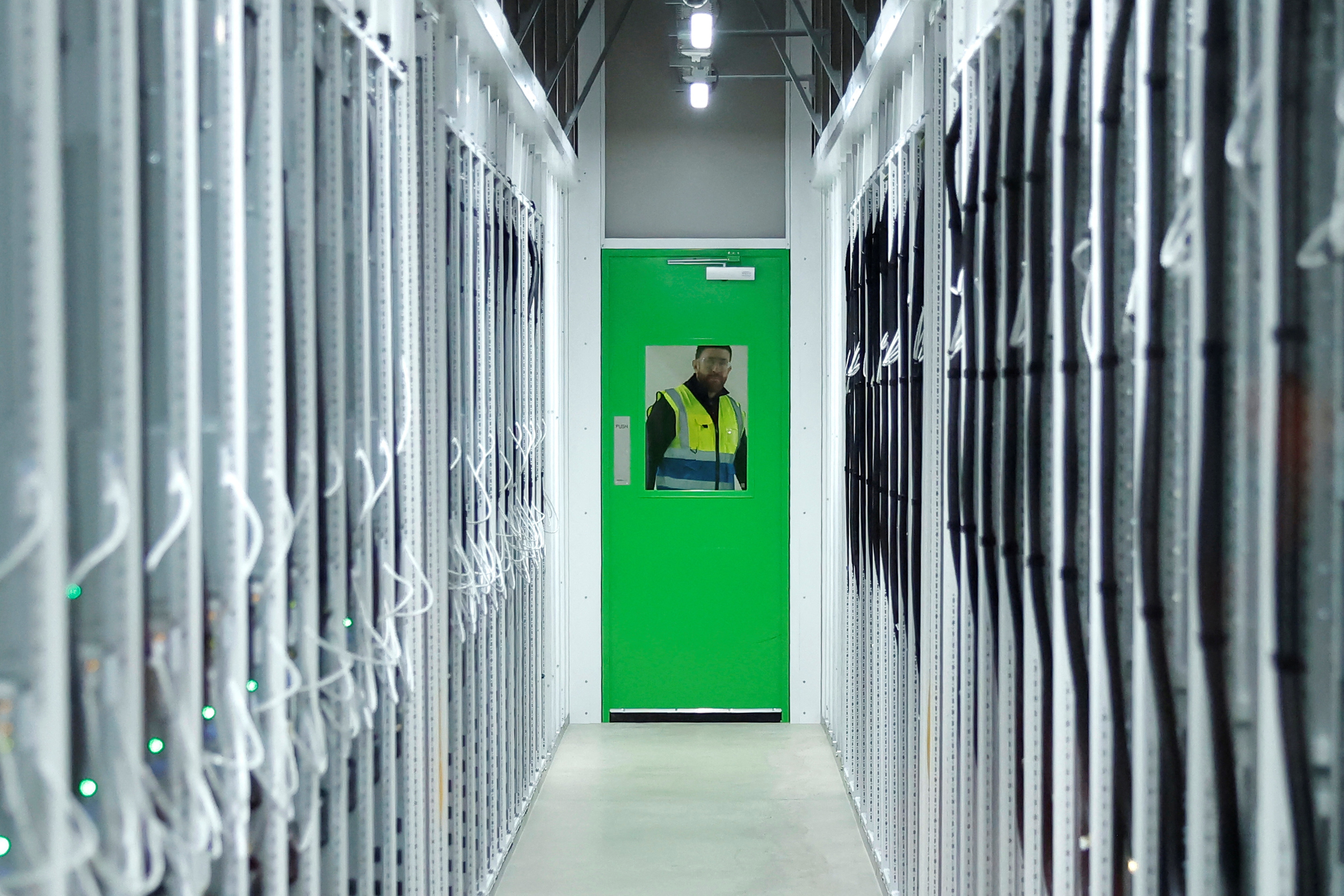
AI, geopolitics and changes to the global energy system are converging. Image: REUTERS/Clodagh Kilcoyne
Mark Esposito
Faculty Associate, Harvard Center for International Development, Harvard Kennedy School of Government- The triple transition of AI, energy systems and geopolitics are all arriving at the same time.
- To deliver on the promises of AI, no leader from the public or private sector can afford to ignore the energy system or international politics.
- For businesses, this is fraught with risk but also presents opportunities if managed correctly.
Artificial intelligence is not simply a new technology. It is a force reordering the architecture of the global economy. Yet the systems required to sustain it, from energy grids and data centres to governance frameworks and geopolitical alliances, are evolving far more slowly than the capabilities themselves.
This widening gap between innovation and infrastructure defines what can be called the triple transition: the simultaneous transformation driven by advances in AI, the restructuring of global energy systems and an accelerating geopolitical realignment.
For businesses, policymakers and institutions navigating this shift, the moment carries both extraordinary possibility and mounting systemic risk. AI is poised to redefine business models, reshape operational landscapes and fundamentally alter how value is created. But its sustainability demands and geopolitical implications will set the boundaries of what is achievable.
Understanding where these three transitions intersect is the prerequisite for resilience in a world where digital infrastructure has become the backbone of economic and social life.
AI's acceleration: Powerful and promising, but uneven
The digital era has already remade the world of work. Over the past four decades, technological change in the US has coincided with rising employment – but without commensurate gains in labour productivity. Data from the US Bureau of Labor Statistics shows that average annual productivity growth has hovered around 2% in recent years, even as digitalization spread across virtually every sector. Companies have adopted digital tools widely, yet the full productivity dividend has been slow to arrive.
Despite these historical patterns, AI adoption today is moving at a different pace. McKinsey's 2024 global survey documented rapid uptake of generative AI across marketing, product development, sales and IT functions. Yet the gains remain uneven. Many organizations still struggle to extract measurable value from their AI investments. Gartner's findings point to familiar obstacles: unclear use cases, complex integration requirements and persistent uncertainty about model reliability.
The long-term trajectory, however, is unmistakable. AI is becoming a universal augmentation layer across cognitive work, driving three fundamental shifts: the amplification of human capabilities, the automation of routine tasks and the acceleration of knowledge extraction and innovation cycles. Employees are adopting AI tools bottom-up – chatbots, copilots, automated research assistants – often faster than their organizations can formalize the standards. The organizations best positioned to capture value will be those willing to redesign workflows, invest seriously in data quality and build human oversight into AI systems as a design principle rather than an afterthought.
Part of what distorts this picture is inflationary expectation. While analysts project trillions of dollars in long-run productivity gains, more grounded assessments suggest that today's AI applications touch only around 5% of business activities, translating into roughly 1% potential GDP uplift. The distance between narrative and reality reflects a pattern familiar from prior technological eras: transformative technologies typically require one to two decades before their benefits diffuse broadly through the economy. AI is unlikely to be an exception.
Sustainability: AI's energy cost
As AI scales, its energy footprint is emerging as a defining constraint on its own growth. Training large-scale models demands extraordinary quantities of electricity and specialized hardware. The International Energy Agency estimates that by 2030, AI-related data centres could consume as much electricity as a medium-sized industrial economy. Meanwhile, the water required to cool server farms already strains local ecosystems across Northern Virginia, Ireland, Singapore and parts of Western Europe.
This creates a sustainability paradox at the heart of the AI story: the technology marketed as an efficiency driver could impose serious carbon, water and grid reliability costs if not managed with intention. Energy systems already under pressure from electrification, ageing infrastructure and climate volatility must now adapt to the rapid proliferation of hyperscale data centres. Renewable capacity is expanding, but not at the pace AI-driven demand requires.
The implications are specific and operational. Compute scarcity is emerging as a genuine risk vector, raising the probability of cloud outages and service degradation. Water-dependent cooling infrastructure introduces climate-linked vulnerabilities in drought-prone regions. Localized grid saturation is generating volatility in both energy pricing and overall power availability. As intelligence becomes an energy-intensive utility, organizations can no longer treat digital infrastructure and climate exposure as separate planning domains.
Geopolitics: Algorithms become infrastructure
AI is also restructuring the logic of global power. Economies increasingly treat strategic control over compute, data and digital infrastructure as a core dimension of national security. Semiconductor supply chains, cloud regions and data corridors have acquired the same geopolitical significance as shipping lanes or energy pipelines.
Governments are moving rapidly to assert technological autonomy. Export controls on advanced chips, investments in domestic semiconductor capacity and the rise of sovereign cloud frameworks signal a deliberate turn toward technological self-reliance. At the same time, cross-border data flows are tightening under the banner of digital sovereignty, as governments move to protect sensitive information and reduce exposure to foreign technology providers.
The consequences are structural. Regulatory divergence across the US, the EU and China threatens to fragment global AI governance and multiply compliance burdens. The concentration of cloud and compute infrastructure in a handful of multinational firms raises fundamental questions about sovereignty, resilience and equitable access. And emerging cyber-physical risks linked to AI-enabled aviation, agriculture, and autonomous systems are challenging safety frameworks that were not designed with these technologies in mind.
These forces bear directly on strategy. Supply chain exposure, operational continuity and regulatory compliance are increasingly shaped by geopolitical positioning. Resilience will depend on the ability to operate coherently across jurisdictions with diverging rules and infrastructure.
Leading through the triple transition
Taken together, the triple transition pf AI acceleration, sustainability pressure and geopolitical realignment represents a systemic inflection point, not a series of parallel disruptions. The organizations best placed to thrive will be those that treat AI not as a narrow technology upgrade but as part of a broader strategic transformation requiring coherent responses on multiple fronts.
To do this, three priorities stand out.
First, build AI responsibly: human-in-the-loop governance, transparency, and rigorous model validation must be embedded in deployment from the outset – not retrofitted after problems surface.
Second, integrate energy and digital resilience: compute-linked climate risks, grid instability, and cloud dependencies belong inside core risk frameworks, not adjacent to them.
Third, prepare for geopolitical divergence: organizations must actively monitor evolving AI legislation, data-sovereignty requirements and supply-chain vulnerabilities to maintain operational continuity across technological environments that are increasingly asymmetric.
The triple transition is more than a technological shift. It is the new operating logic of the global economy. Realizing AI’s potential sustainably demands that innovation be aligned with the energy systems and governance structures capable of supporting it at scale. The choices made in this decade will determine whether AI becomes a catalyst for broadly shared progress or a source of new systemic fragility.
Don't miss any update on this topic
Create a free account and access your personalized content collection with our latest publications and analyses.
License and Republishing
World Economic Forum articles may be republished in accordance with the Creative Commons Attribution-NonCommercial-NoDerivatives 4.0 International Public License, and in accordance with our Terms of Use.
The views expressed in this article are those of the author alone and not the World Economic Forum.
Stay up to date:
Artificial Intelligence


Forum Stories newsletter
Bringing you weekly curated insights and analysis on the global issues that matter.
More on Artificial IntelligenceSee all