Is AI changing the path to gender parity? This and other trends in jobs and skills this month

This Women’s History Month comes at a pivotal moment, as generative AI begins to reshape the workplace. Image: Unsplash/wocintechchat
- This regular roundup brings you essential news and updates on the labour market from the World Economic Forum’s Centre for the New Economy and Society.
- Top stories: The impact of AI on gender equality in the workplace; How leaders and governments can respond; Gen Z approach to retirement savings.
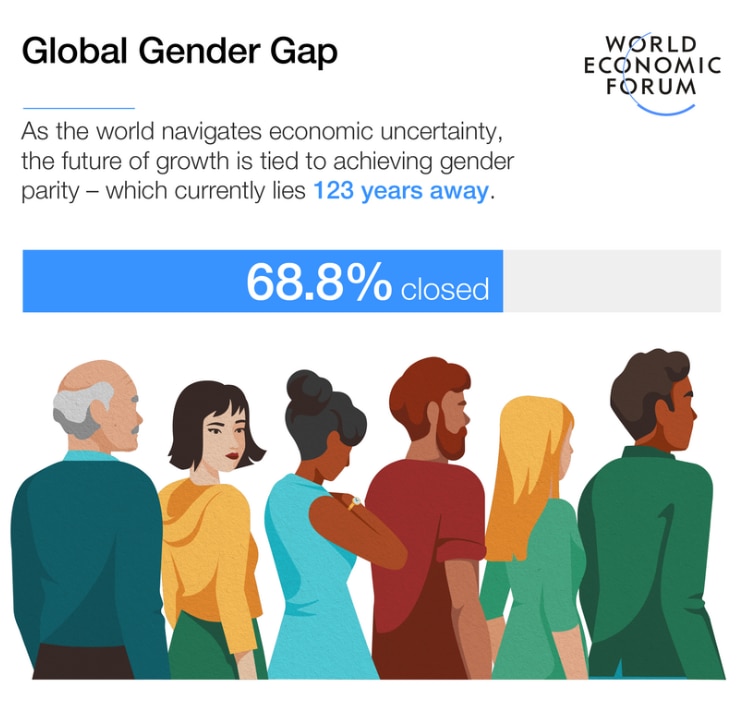
The World Economic Forum’s Global Gender Gap Report 2025 finds that 68.8% of the global gender gap is now closed, up 0.3 percentage points in a year – the fastest improvement since before the pandemic. Yet at the current pace, it will still take an estimated 123 years to reach parity.
In practice, progress remains challenging.
This Women’s History Month comes at a pivotal moment, as generative AI begins to reshape the workplace. Women make up about 41% of the global workforce but only around 29% of top leadership roles.
What does the data say?
Women remain under‑represented in AI and STEM roles, and yet they are also rapidly acquiring AI skills. The dynamism of AI transformation offers an opportunity to break with longstanding gender disparities.
LinkedIn data presented in The World Economic Forum’s white paper, Gender Parity in the Intelligent Age, shows that female AI talent has expanded significantly since 2018 and the gender gap in AI skills has narrowed in 74 of 75 economies.
However, in the United States, according to the same analysis, women make up 57% of workers in roles likely to be disrupted by generative AI, versus 43% of men. Among people without AI engineering skills, 38% of women, compared with 31% of men, are in roles that are being disrupted, and fewer women are in jobs largely insulated from AI.
The International Labour Organization (ILO) estimates that around 29% of jobs in female‑dominated occupations are exposed to generative AI, compared with 16% in male‑dominated occupations, with 16% of women’s jobs falling into the highest risk category versus just 3% for men.
Among approximately 6 million US workers who would find it hardest to recover from AI‑related job loss, 86% are women, concentrated in clerical and administrative roles where tasks are highly automatable, according to this Brookings Institution study.
The data highlights a paradox, where women are both catching up in AI skills and over‑represented in the roles most exposed to AI, while still under‑represented in the roles that design and govern these systems.
That paradox is at the heart of today’s technological transition.
Where progress is being made
Despite concerns, there are clear signs that AI and digitalization could help close gender gaps.
Some labour markets are already combining technology with more inclusive work models. According to PwC’s latest ‘Women in Work’ index, countries such as Iceland, Luxembourg and New Zealand see success by pairing high female participation with relatively small pay gaps, supported by flexible work, digital public services and strong parental-leave systems.
Trials of four-day work weeks also show that when organizations redesign roles they can sustain productivity while improving work-life balance. These shifts can be particularly impactful for women, who shoulder a disproportionate amount of care-giving duties, carrying out three times as much unpaid domestic and care work as men.
At the same time, digital platforms are enabling new forms of participation – from entrepreneurs and content creators to women with disabilities building careers around remote, flexible roles that would have been impossible a decade ago.
And where existing gaps are widening
The ILO warns that in 88% of countries analysed, women’s jobs are more exposed to generative AI than men’s, with exposure particularly high in high‑income countries where office‑based and service roles dominate.
Latest research from McKinsey and Company shows that, in Europe, women’s representation in tech roles has fallen from 22% in 2023 to 19% in 2026, with many of the tech layoffs to date having been in roles disproportionately held by women.
In low- and middle-income countries, women are 7% less likely to own a phone and 19% less likely to have access to mobile internet, according to GSMA data. In many places, the push to digital-first also risks pushing women further to the margins.
In India, only 18% of young women aged 20–29 are in paid work, compared with 79% of young men, despite near‑parity in higher education; in Pakistan, female labour‑force participation was around 21–26% in 2023. As AI drives demand for digital skills and reshapes entry‑level jobs, a lack of access to safe work, reskilling opportunities and the networks that AI‑driven sectors rely on risks holding women back.
Countries need to invest in women’s digital and technical skills and support transitions between sectors, especially where women are currently under‑represented.
How can government and business leaders respond?
AI will not automatically close or widen gender gaps, but it will magnify the choices leaders make.
Three priorities stand out:
1. Embed gender parity into AI strategies from the outset. Build diverse AI and STEM talent pipelines, ensure women are represented in leadership and product roles, and rigorously test algorithms for bias in hiring and performance management.
2. Invest in gender‑responsive skills and career pathways. Targeted AI and digital-skills programmes for girls and women should be paired with mentoring, apprenticeships and re-entry opportunities.
3. Redesign work around care and safety. Flexible and predictable schedules, accessible childcare, equal parental leave and strong protections against harassment remain foundational to participation.
More labour news in brief
A growing share of Gen Z workers are planning for early retirement decades in advance, reports Reuters. Gen Z and millennials now start contributing to workplace retirement plans around age 23 and 28, respectively – nearly a decade earlier than Gen X and boomers – and about half of Gen Z are on track to maintain their standard of living in retirement.
The latest US jobs report shows a “slow hiring, slow firing” labour market: employers cut 92,000 jobs, and unemployment rose to 4.4% in February, but layoffs remain limited and wages are still growing, reports US Bank.
Top earners are now more worried about job loss than lower‑income workers in the US, with surveys shared by CNBC showing confidence among the highest‑paid third at or near record lows as AI disruption fears rise.
License and Republishing
World Economic Forum articles may be republished in accordance with the Creative Commons Attribution-NonCommercial-NoDerivatives 4.0 International Public License, and in accordance with our Terms of Use.
The views expressed in this article are those of the author alone and not the World Economic Forum.
Related topics:

Forum Stories newsletter
Bringing you weekly curated insights and analysis on the global issues that matter.
More on Jobs and the Future of WorkSee all

Jaci Eisenberg
March 10, 2026


