Can economies be supply shocked in positive directions? It’s happened before
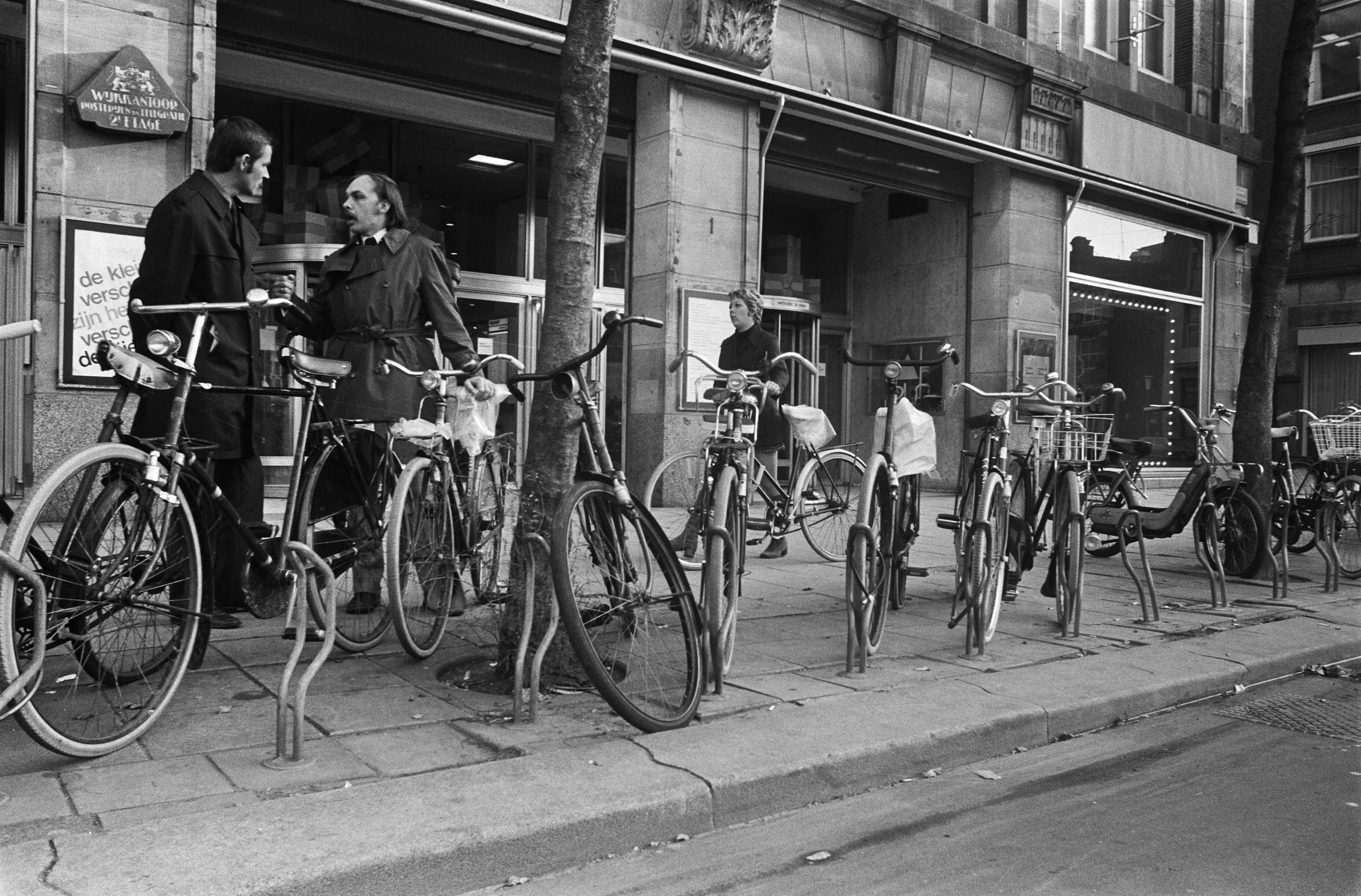
When two-wheeled traffic took hold in Amsterdam. Not much good comes from supply shocks, but some responses are more constructive than others. Image: Wikimedia Commons
- An Iran war-induced supply shock has elevated the cost of energy and raised concerns about a prolonged crisis.
- History shows that these periods tend to nudge economies in new directions – sometimes for the better.
Mindert Visser was thrilled.
A sudden loss of access to oil in 1973 had plunged the Netherlands into crisis. But the 23-year-old couldn’t help gushing to a reporter about only having to vie with two-wheeled traffic on the streets of Amsterdam, after the government responded to energy shortages by declaring “car-less Sundays.”
“You cannot imagine how different this place looks,” a local official said.
Many things would be different after the severe oil shocks of the 1970s. The Netherlands built unrivalled cycling infrastructure that made car travel redundant. France ramped up nuclear energy capacity that partly shelters it from the vagaries of petroleum markets. Japan did much the same, albeit with setbacks. Denmark went hard on wind power. Meanwhile the US cut speed limits in ways that saved both fuel and thousands of lives, and began stockpiling oil in a strategic reserve.
Releases from that reserve and others may help dull some of the pain of an Iran war-induced jolt to global energy markets. There’s been mounting frustration among Americans watching petrol prices tick higher, concern about a looming catastrophe in Europe, and pre-emptive efforts to conserve fuel throughout Asia. No one seems to be sure when this will end.
There is something strange about zeroing in on potential positives during a time of war and scarcity. But history demonstrates that we can adapt, sometimes in ways that actually push economies forward.
The 1973 oil shock was also the result of geopolitical tension in the Middle East. Countries there targeted others with embargoes and cut production. The second shock in 1979 followed the Iranian Revolution and widespread hoarding. The era was marked by an apocalyptic vibe at petrol pumps, and a big hit to the global economy. Countries would have to diversify and learn to do more with less.
To a significant extent, they did just that. In the following decades “energy intensity,” a measure of how much is needed to add a unit of economic output, dwindled. Oil intensity in particular fell sharply beginning in 1973. For every $1,000 in GDP added in that year, .12 gallons of oil equivalent were required; it was down to .05 gallons by 2022.
What’s happening now is more evidence that the pain of supply shocks is inevitably shared in a globalized economy. It’s also a reminder that some lessons never seem to be fully learned.
Among those lessons: try not to rely on a limited number of suppliers for an economy’s essentials. The last wake-up call arrived in 2022, when Russia invaded Ukraine and countries dependent on Russian energy scrambled for alternatives.
Even decades before the 1970s oil shocks, the 1956 Suez crisis had alerted Europe to the dangers of relying on energy shipped through a single transit point. After that, the region focused on building new pipelines and looking for more oil and gas in the North Sea.
A small number of ships transporting oil and gas are still able to slip through the mostly vacated Strait of Hormuz, despite the conflict destabilizing the Middle East. But the short-term outlook is grim.
Nearly a third of the petrol stations in Cambodia have been temporarily closed. The Thai government discouraged civil servants from wearing suits, to limit the need for air conditioning. And companies in India are conserving cooking fuel by asking employees to bring their own lunch to the canteen.
At some point, attention may turn to longer-term adjustments.
Forward-looking in hindsight
In 1970, coal and oil were supplying 85% of France’s energy, and nuclear accounted for less than 1%. Nuclear now accounts for nearly half of the country’s supply, and oil contributes only about a quarter.
Even before the 1973 oil shock, France was actively dabbling in nuclear energy. But the scare hardened its resolve. A plan to build 51 new reactors in the span of a decade quickly followed.
This wasn’t a goal shared by its neighbours.
France was generating about the same amount of nuclear energy as Germany in 1973. A decade later, it was generating twice as much. German concerns about this particular power source originally focused on the fog that would be created by cooling towers. That grew into other kinds of angst, amplified by a 2011 disaster in Japan. That year, Germany opted to phase out nuclear entirely.
By 2010, even before Germany started actively phasing out, France was generating three times as much nuclear energy. In some ways, its commitment arose from a lack of other options. It’s proven to be forward-looking. European Commission President Ursula von der Leyen said recently that the turn away from low-carbon nuclear energy in much of the region was a “strategic mistake.”

Other decisions made under the pressure of a supply shock have been more closely linked to abundant natural resources.
By the time of the 1979 oil crunch, 90% of Denmark’s energy supply was still based on imported oil and it was generating just 0.006 terawatt-hours of wind energy. The low-lying country with an unusually long coastline had been tapping into the wind with primitive turbines as early as the 19th century. The crisis brought new clarity to its efforts. By 2024, only 35% of its energy supply was based on oil, and it was generating 20.6 terawatt-hours of wind power.
Finland ramped up its own wind capacity under duress. The Soviet Union had been supplying more than 90% of its imported oil and all of its natural gas. That dependence on Russian energy persisted after the Soviet Union’s collapse, but was untenable after the invasion of Ukraine. Finland’s generation of wind energy nearly doubled between 2022 and 2024.
The shock generated by the Soviet collapse did prompt at least one very significant change for Finland in the shorter term: a gamble on a burgeoning mobile technology standard, and a compatible phone made by a 126-year-old company called Nokia (if you don’t know what a Nokia phone is ask your parents, they were a big deal).

That same kind of salvation through scarcity has played out in the US. A rubber supply shock there during wartime in the 1940s had the government pleading with people to drive at a slowed-down “victory speed,” to help conserve the precious substance. A search for synthetic alternatives eliminated American reliance on imports and catalysed a broader advanced materials industry.
By the third week of the current war in the Middle East, the average cost of filling a car with petrol in the US was about a third higher than it had been a month earlier. If the disruption lasts a couple of months, according to one oil analyst, the cost of other essentials like food will surely escalate. There’s no word yet on conservation efforts.
One thing about Mindert Visser: when the guy was talking to a reporter about the wonders of car-less Amsterdam 53 years ago, he was doing it on horseback. That’s an image that for many people might be the opposite of progress, as unsettling in its own way as seeing some countries respond to the current energy supply shock by using more coal.
Difficult moments are when the heaviest lifting can be done on shaping economies. It might be jarring and unpleasant, but also overdue.
Progress is a frequent result.
Don't miss any update on this topic
Create a free account and access your personalized content collection with our latest publications and analyses.
License and Republishing
World Economic Forum articles may be republished in accordance with the Creative Commons Attribution-NonCommercial-NoDerivatives 4.0 International Public License, and in accordance with our Terms of Use.
The views expressed in this article are those of the author alone and not the World Economic Forum.
Related topics:

Forum Stories newsletter
Bringing you weekly curated insights and analysis on the global issues that matter.
More on Economic GrowthSee all

Rumaitha Al Busaidi and Sarah Mostafa-Kamel
March 20, 2026


