'The rules have changed': What global strategy leaders say they need in 2026
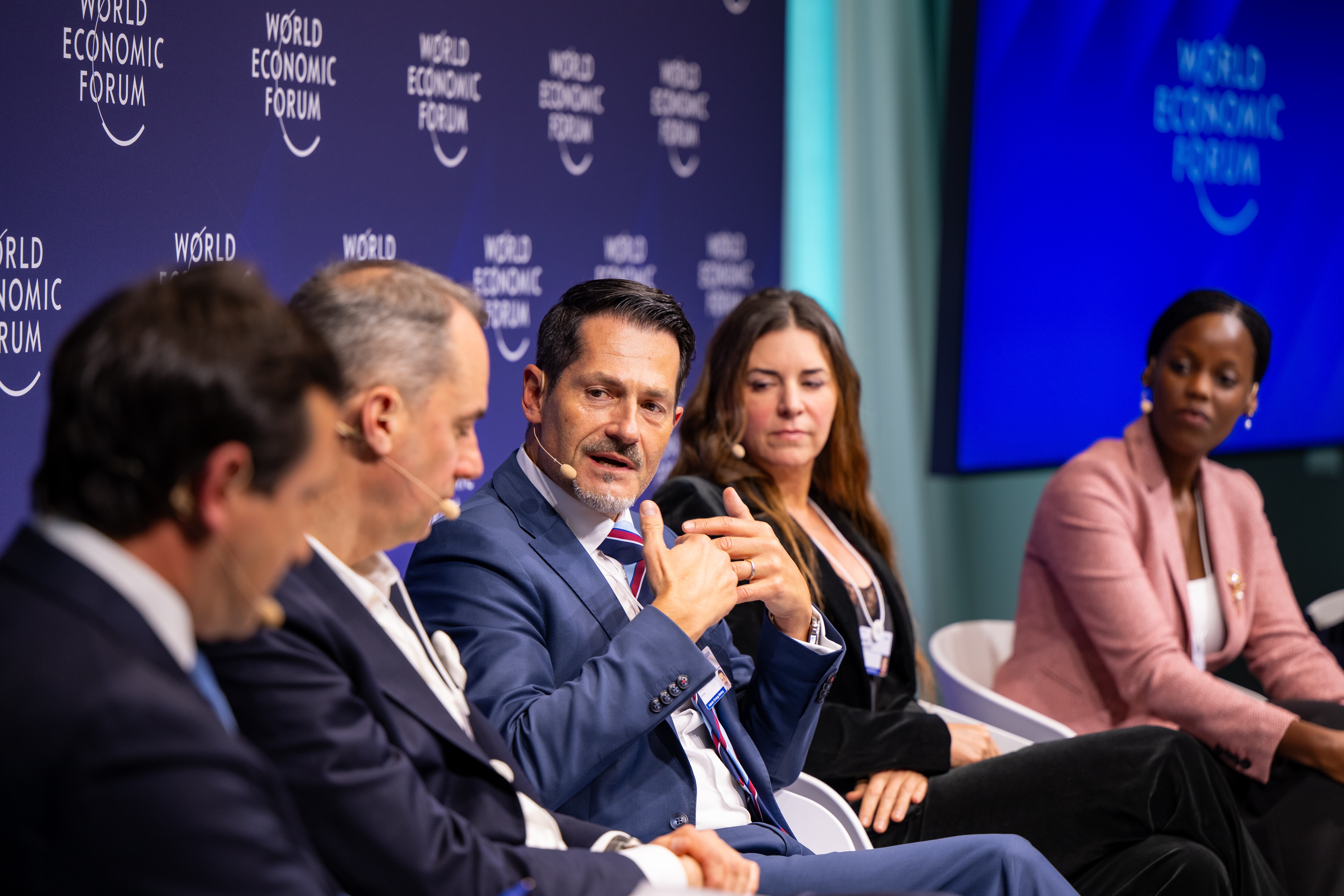
The Industry Strategy Meeting 2026, with over 300 strategy leaders, surfaced six urgent needs. Image: World Economic Forum
Francisco Betti
Head, Global Industries Team; Member of the Executive Committee, World Economic Forum- The predictability that once underpinned corporate planning has gone, according to 330 strategy leaders gathered at the World Economic Forum's Industry Strategy Meeting in Munich.
- Geoeconomic fragmentation, AI disruption, energy volatility and workforce pressure are no longer forces to monitor but the 'core operating environment'.
- From redefining AI strategy to navigating energy demand, six urgent needs emerged that together describe what serious strategy leadership looks like in 2026.
Some 330 corporate strategy leaders gathered in Munich this week for the World Economic Forum's Industry Strategy Meeting agreed on a stark reality: the predictability that once underpinned corporate planning has gone.
Over two days of sessions, first at Siemens headquarters and then at SAP Innovation Lab, they sat alongside policymakers and academics to confront the context in which they now operate: geoeconomic fragmentation, trade barriers, energy volatility, the race to deploy AI, the pressure on workforces everywhere and the need to rethink growth within planetary boundaries.
But unlike in previous years, they moved quickly past defining these forces and focused more on what to do about them.
What emerged was something more actionable: a set of urgent needs, articulated by these leaders from across industries, that together describe what navigating 2026 actually requires.
The need for a new baseline
The most pervasive shift was a change in baseline. For decades, corporate planning was anchored in a world of relative predictability with stable trade rules, open capital flows and broadly functioning multilateral institutions. But that world had structurally changed and businesses are now adapting to uncertainty as ‘a core operating condition’, as one participant noted.
“Uncertainty is no longer a backdrop to business strategy," said one person at the meeting, which was largely conducted under Chatham House rules which guarantees speakers anonymity to allow them to speak more freely.
A session on geopolitics made this visceral. With expert analysis of the ongoing Gulf crisis, which has led to what Fortune magazine called the "largest supply disruption in the history of the global oil market" and pushed Brent crude close to $120 a barrel, the room was reminded that the world can change overnight. And for some, it has meant flexibility and adaptability, often in real time.
"Nobody thought war was in the realm of the possible. We cannot afford that kind of thinking anymore."
”Supply chains that were optimised for cost are being redesigned around a new set of priorities. As one executive in the automotive sector put it, companies have moved from cost to "cost-plus" where the "plus" now includes resilience, diversification and the ability to manage tariff dynamics that were simply not part of the calculus before. Many are moving from global-for-local models back toward local-for-local approaches, a shift that one participant described as feeling like "going back in time but with a cost attached".
A professional services firm described embedding local capabilities within each country rather than relying on centralised delivery. A global steel company described anchoring capital decisions in rigorous scenario planning, not as an innovation but rather a necessity. "In Ukraine prior to the war, nobody thought war was in the realm of the possible," one participant noted. "We cannot afford that kind of thinking anymore.
Scenario planning, multiple sessions agreed, must become a genuine discipline rather than a periodic exercise. "The marketplace is becoming structurally more volatile, with cycles turning shorter and sharper," said Animesh Sinha, Chief Corporate Strategy and Planning Officer at Tata Steel. "We have adopted a more agile strategic planning approach, supported by a robust risk-management framework that enables quick response while maintaining strategic discipline.”
“Scenario planning is becoming a necessity in the new operating era."
The need for proof, not just pilots
Sarah Schmidt, SVP Head of Corporate Strategy at SAP, captured the AI mood in Munich plainly: 2026 is the year companies have to prove AI can return value, or risk losing customers who will simply move on.
Last year, many participants agreed, was defined by pilots and proofs of concept but hardly any movement on the bottom line. The return on investment remained largely absent as a consequence of the approach, which has been too fragmented or too disconnected from the business processes that actually drive performance.
Schmidt's prescription is a top-down redesign of business processes which begins with defining the outcome and then works backwards to the technology. "It must be a strategy that is driven top-down because you need the vision, the use cases," she said. "You have to be willing to disrupt yourself."
But Günter Beitinger, SVP Manufacturing at Siemens, who has lived the deployment reality across more than 30 factories, added a crucial counterweight. The top-down vision is necessary, he acknowledged, but without bottom-up trust, it fails. At Siemens' Amberg plant, included in the World Economic Forum’s Global Lighthouse Network, the introduction of AI into quality assurance processes nearly broke down, not for technical reasons, but cultural ones.
Strategy must be set from the top and adoption must be earned from the bottom.
”The resolution was not to override the resistance but to design with it. "We slowly introduced what we wanted to do and made the people part of the whole development," Beitinger said. Workers were invited to challenge the algorithm, contribute their expertise to training it and see how it made decisions in terms they could audit. Only when the system became explainable did it become trusted.
The tension between Schmidt and Beitinger is not a contradiction but a full shape of the problem. Strategy must be set from the top and adoption must be earned from the bottom. Companies that confuse one for the other are the ones accumulating pilots without returns.
Data infrastructure was reinforced as a crucial pillar to support AI at scale but so was the organisational courage to redesign processes rather than merely automate them.
Hala Zeine, SVP and Chief Strategy Officer at ServiceNow, framed the destination: "The real transformation happens when AI embeds into the flow of work, rewiring how enterprises sense context, make decisions and execute at scale. That's when adoption becomes cognitive dependency. That is the threshold."
The need to define sovereignty
"Sovereignty is a huge word, and everyone understands a different thing by it." SAP's Sarah Schmidt told us on the sidelines.
It was a sentiment echoed across conversations with participants observing three distinct conversations happening under the same label. The first is regulatory, and the second is infrastructural with questions around whose cloud, whose hardware, and whose jurisdiction governs the system. But the third is what Joëlle Pineau, Chief AI Officer at Cohere, called the intelligence question: whether companies' proprietary business logic, competitive knowledge and internal processes leave their walls at all.
"The notion of sovereign AI has not been very well defined," she said. "In some cases, it's about having data not leave your frontiers. What sovereignty means and what control enterprises are really looking for has not been clearly established."
A session on Europe's competitive position surfaced the tension directly. The continent generates significant innovation but repeatedly loses scale and commercialisation. Its single market remains its greatest economic asset but is fragmented in practice, with regulations duplicated twenty-seven times at the national level, as one executive described it.
The green agenda has not faded, many argued, but is being reframed under the rubric of security and sovereignty, with energy independence serving as both a climate and a geopolitical strategy. The nearly €270 billion figure, estimated to be the annual licensing fees paid by European companies to US technology platforms, concentrated minds.
But Schmidt's prescription was clear: what Europe needs is not walls but standards. "How can we make technology from around the world available in a sovereign way to European industries? This is what digital sovereignty must mean. Not saying you can only use European technology but finding the regulatory framework that lets companies access the best available technology without compromising on control."
The need to lead the workforce transition
Across sessions on workforce and AI adoption, a consistent pattern emerged. The barrier to AI deployment is not primarily technical but also human, psychological, and above all, a question of leadership.
"It's not a tech challenge. It's a transformation challenge." The line, from a public sector technology expert, was echoed in breakout after breakout. The hardest part is getting people to trust it, use it and take accountability for what it produces.
A financial services firm described its adoption formula, which begins with leadership alongside people with an appetite and energy to help lead the others. "You have to go with it or you are behind it."
Karin De Bondt, SVP and Chief Strategy Officer at Trane Technologies, illustrated what deployment for people, not just productivity, looks like in practice. “ARIA, our AI-building agent, gives service technicians real‑time, conversational access to diagnostics and maintenance insights in more than 14 languages. EVA, our Employee Virtual Assistant, supports over 25,000 team members globally with fast access to information, guidance and routine task support.”
Other discussions surfaced three structural barriers that go beyond individual company culture: who pays for large-scale retraining without clear ownership, how to access the levers of policy and procurement that shape workforce readiness, and market incentives that currently reward labour reduction rather than transformation. "If the market continues rewarding layoffs," one participant said directly, "we are giving signals that need to be redetermined."
The need to rethink energy systems together
The energy sessions surfaced a tension around the energy transition accelerating and fragmenting simultaneously, and participants agreed the assumptions that made it feel manageable a few years ago were no longer holding.
The crisis in the Gulf continues to sharpen this and for corporate planners in industries from shipping to steel to financial services, it reframes the sequencing question entirely.
Grid infrastructure was acknowledged as the most under-addressed bottleneck, with investments skewed towards generation while transmission and distribution were unable to keep pace. No amount of new renewable capacity resolves this without network readiness, multiple voices highlighted, and the projects most likely to get financed are those that demonstrate value across decarbonisation, security, and affordability together, not single-objective investments that satisfy only one criterion.
Nontokozo Hadebe, Group Executive for Strategy and Sustainability at Eskom, described navigating this from one of the most complex positions in global energy. The utility firm is heavily coal-dependent and serves South Africa, which has over 30% unemployment and over 100,000 workers in coal-dependent communities. It has committed R320 billion ($18 billion) over five years to grid expansion.
"Improved financial performance and our first return to profitability in eight years has strengthened liquidity and enabled greater self-funded investment," Hadebe said on the sidelines of the meeting. But the lesson from its own experience, having closed a plant without adequate social planning then returning to repair the damage to communities, is clear: the human transition must be sequenced before the industrial one, not after.
Linda Freiner, Chief Sustainability Officer at Zurich Insurance Group, framed the systemic risk: "Climate risk is now a more active factor in how organisations think about long-term growth and the conditions needed to sustain it. New investments in clean infrastructure and energy face the same dynamics of increasing climate risk as the assets they replace but with new assets there is an opportunity to embed resilience from the outset."
Henriette Undrum, SVP Strategy at Equinor, described what disciplined balance looks like in practice: "Value-adding growth, cash-flow resilience, portfolio robustness and carbon efficiency while preserving long-term optionality across markets with differing transition dynamics." Not growth versus climate, but growth shaped by climate reality.
The need for long-term thinking
The closing current running through ISM 2026 was perhaps the oldest tension in corporate planning and the one that felt most newly urgent. How do you hold a long-term horizon when the world keeps forcing short-term reactions?
Roland Busch, President and CEO of Siemens, who opened the meeting, drew the technological parallel in the opening session: "AI is like electricity. When it started, nobody knew where it was going. It took thirty years to change society, a computer maybe fifteen. AI technology takes maybe seven." The speed of change is itself part of the strategic problem and part of the opportunity for those who move with it rather than around it.
But it was André Hoffmann, Vice-Chair of Roche and Co-Chair of the World Economic Forum, who set the terms for what this moment actually asks of business leadership: "Successful companies going forward will be the companies which understand what planetary boundaries actually mean. The planet has three big capitals — the social, the human, and the natural. And you have the capacity to influence all three." The future, in his formulation, is sustainable or there is no future.
As Mirek Dušek, Managing Director of the World Economic Forum, put it: "It is clear that dialogue and collaboration are crucial for business strategies in a rapidly changing world economy."
Ultimately, what the leaders gathered in Munich said they need is not a new framework or a new tool. It is the clarity to act on what they already know: that the environment has structurally changed, that AI will reward those who redesign rather than those who experiment, that the workforce transition is a leadership question, not a human resources one, and that the energy system is being rebuilt in ways that will determine industrial competitiveness for decades.
That clarity, as more than one participant noted, is precisely what a gathering like this exists to build. It brings together peers from different sectors and geographies who wrestle with the same questions under the same pressures, without the noise of competitive posturing or the comfort of easy answers.
Find out more about the Industry Strategy Meeting here.
License and Republishing
World Economic Forum articles may be republished in accordance with the Creative Commons Attribution-NonCommercial-NoDerivatives 4.0 International Public License, and in accordance with our Terms of Use.
The views expressed in this article are those of the author alone and not the World Economic Forum.
Related topics:

Forum Stories newsletter
Bringing you weekly curated insights and analysis on the global issues that matter.
More on BusinessSee all

Francisco Betti, Hernan J.F. Saenz, III and Karen Harris
March 14, 2026


