Closing the women’s health gap: 5 key focus areas and why they need more research
Underinvestment in women’s health is widening the gap – and limiting economic potential. Image: Unsplash/Towfiqu barbhuiya
Melissa Patel
Lead, Women's Health Responsible Investing, Health and Healthcare, World Economic Forum- Despite a potential $1 trillion economic opportunity, only 6% of all private health investment is currently directed towards women’s health.
- However, a new Forum report, the Women’s Health Investment Outlook, indicates that momentum is gathering to close this global health gap.
- Five key areas for progress show what a difference strategic investments could make.
Every $1 invested in women’s health could generate around $3 in economic growth, amounting to a $1 trillion opportunity, research suggests.
Yet, according to a new report from the World Economic Forum, only 6% of all private health investments are allocated to women’s health. And half of these investments are in a fragmented set of early-stage companies and concentrated in a narrow band of conditions.
The Women’s Health Investment Outlook, co-authored by Boston Consulting Group, also shows that momentum in closing the women’s health gap is gathering pace.
Here are five areas of women's health where research shows the difference the right strategy can – or could – make.
In-vitro fertilization – a model for women's health?
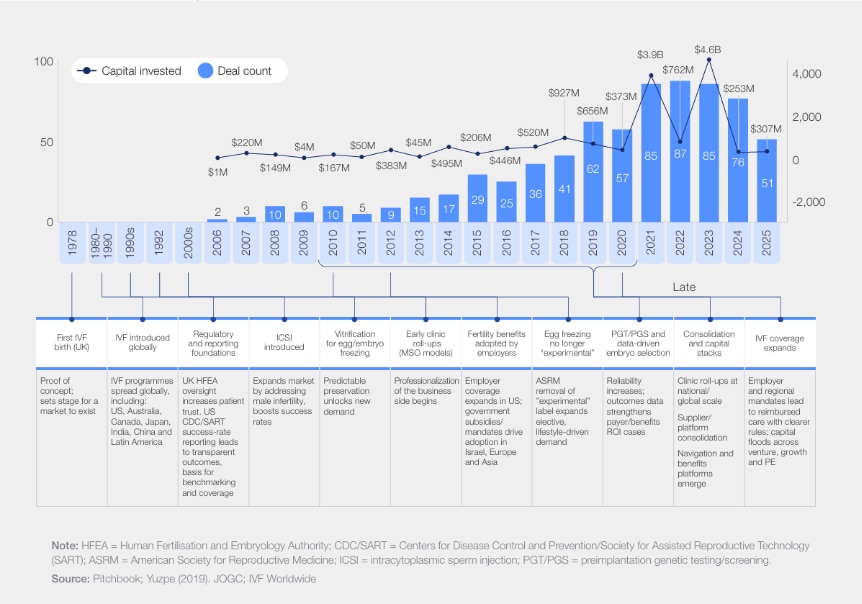
The report highlights In-vitro fertilization (IVF) as a case study of how a combination of scientific advancement, increased demand, supportive policy and targeted investment can help scale treatments, expand access, and sustain growth. Since its origins in the 1970s, IVF has increasingly been covered by public or employer health schemes, making it more accessible to patients and laying the foundation for a growth market.
Can HRT slow the onset of dementia?
Women are more prone to developing Alzheimer’s disease than men. The rate is particularly high after midlife, with a recent University of Cambridge study suggesting menopausal brain changes may be a contributor to women’s greater risk. Other research has suggested that hormone replacement therapy could therefore play a part in protecting women against Alzheimer’s. However, a meta-research analysis by University College London found no evidence of this effect, suggesting that further studies will be needed to explore this relationship further.
Raising awareness of endometriosis
Endometriosis involves tissue similar to the womb lining growing elsewhere in the body, causing severe pain, heavy bleeding, and impacting daily life and work. Yet, diagnosis takes an average of eight years.
Growing public awareness and policy support, such as in the UK, can make a difference. A UK employment tribunal recently ruled in favour of a woman dismissed due to the effects of endometriosis, reinforcing the legal rights of those suffering from the condition. Endometriosis UK runs an Endometriosis-Friendly Employer scheme that helps organizations raise awareness and support for women with endometriosis, bridging another gap in women’s health.
Why women and men experience pain differently
Pain normally decreases as an injury heals, but this may take longer for women, who are also more prone to chronic pain. Michigan State University research suggests the immune system influences this difference. While immune cells cause inflammation, they also help resolve pain. The study found that immune cells in men more often produce a pain-relieving molecule than in women, potentially informing new, sex-specific pain treatments and opening up new growth opportunities at the same time.
Treating heavy menstrual bleeding early
Heavy menstrual bleeding affects many women, often leading to hospital visits instead of treatment by general practitioners. A UK study found 1,332 women received blood transfusions in 98 hospitals (Jan-Jun 2024), incurring a cost of nearly £5,000 per patient. Treatments include contraceptives or tranexamic acid, which reduces bleeding. However, women often delay seeking help early, partly due to the normalization of such symptoms. This, in turn, can lead to severe issues like anaemia that can require costly hospitalization. Researchers recommend community women’s health hubs and enhanced staff training to enable more proactive management of heavy periods.
These five examples highlight the potential to close the health gap between women and men – and how progress could be accelerated. The World Economic Forum's Women's Health Impact Tracking Platform, developed with the McKinsey Health Institute, monitors advances in improving women's health outcomes. It is hosted by the Global Centre for Asian Women's Health at the National University of Singapore’s Yong Loo Lin School of Medicine, which aims to scale the platform to address major women's health concerns across the lifespan.
We are also advancing this work through the Women’s Health Investment Consortium, a growing coalition of partners working to unlock investment and accelerate high-impact innovation in women’s health. By aligning on priority areas and mobilizing capital and expertise, the Consortium is helping move promising solutions from pipeline to scale.
License and Republishing
World Economic Forum articles may be republished in accordance with the Creative Commons Attribution-NonCommercial-NoDerivatives 4.0 International Public License, and in accordance with our Terms of Use.
The views expressed in this article are those of the author alone and not the World Economic Forum.

Forum Stories newsletter
Bringing you weekly curated insights and analysis on the global issues that matter.
More on Health and Healthcare SystemsSee all

Sarah McDonald
March 18, 2026


