How reusable sanitary pads are transforming health in rural India
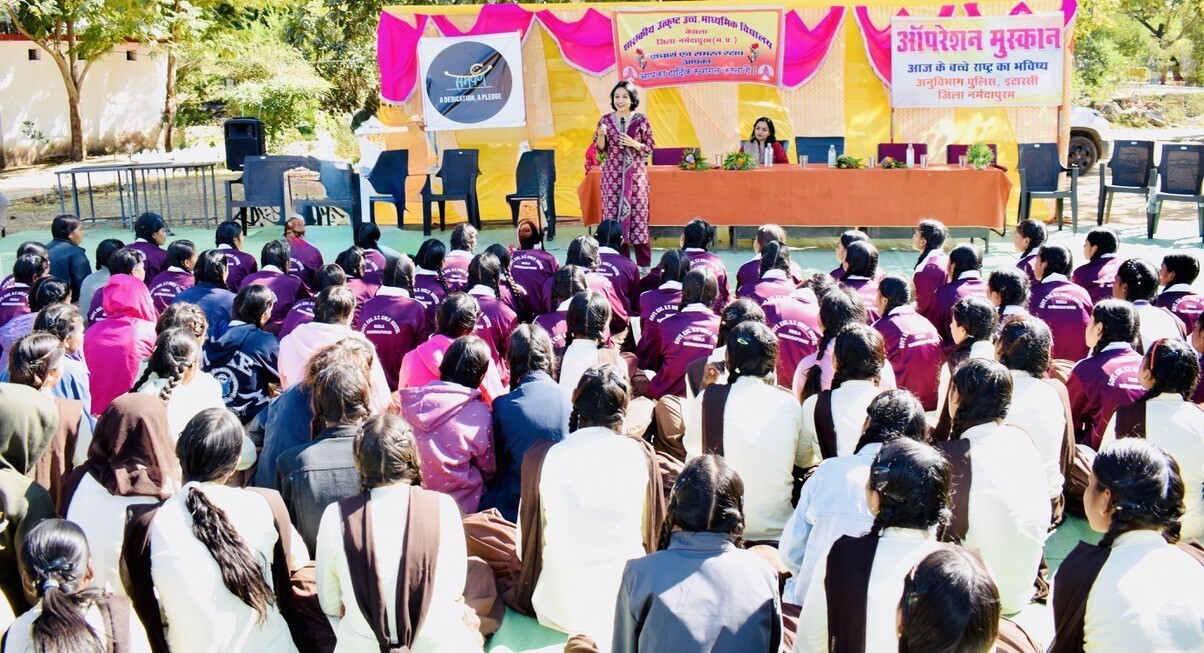
Samarpan, a non-profit organization working in the heart of rural India, to provide girls and women with reusable sanitary pads and health education. Image: Samarpan
- Reusable sanitary pads and health education are helping girls in rural India stay in school during menstruation.
- Sustainable menstrual products reduce significant financial burdens and prevent environmental waste for low-income families.
- Integrated community programmes provide essential medical knowledge to replace social taboos with safe hygiene practices.
In a tribal village in the Indian state of Madhya Pradesh, a girl once missed five days of school every month. She was not ill. Her family did not keep her home. She stayed back because she was menstruating and had nothing safe to use.
In communities where menstruation is rarely discussed openly, her experience is not unusual — it is the norm. Millions of women and girls across rural India manage their periods without safe materials, reliable information or social support. According to UNFPA, more than 500 million women in low-income regions globally lack adequate facilities for menstrual hygiene management.
Today, that same girl carries a small kit of reusable cloth pads. She no longer misses a single day of school. The change appears modest in description. In consequence, it is profound. Across rural Rajasthan and the tribal districts of Madhya Pradesh, the two largest states in India, Samarpan has been working with thousands of women and adolescent girls through a Sustainable Menstrual Hygiene Management programme designed for communities where this support has long been absent.
The programme addresses a problem that is rarely singular. It is four simultaneous crises converging on the same woman, the same body — and until recently, it received no integrated response.
When hygiene becomes a health emergency
The health risk is immediate. According to India’s National Family Health Survey (NFHS-5), about 78% of girls and young women aged fifteen to twenty-four report using hygienic menstrual protection, but access remains deeply uneven in poorer and tribal districts, where many girls and women still rely on reused cloth, ash or husk. These improvised materials retain moisture and bacteria when washing conditions are limited. Public health research links poor menstrual hygiene practices with higher rates of reproductive and urinary tract infections in low-resource settings.
When a girl’s body becomes a source of anxiety rather than a fact of life, the classroom is the first casualty.
”India carries a significant burden of cervical cancer, the second most common cancer among women in the country. While menstrual hygiene alone does not cause cervical cancer, unsafe practices increase vulnerability to infections that weaken reproductive health over time. For those without access to safe products or medical guidance, these risks accumulate silently.
The education crisis follows directly. Approximately 23 million girls in India leave school each year, with inadequate menstrual hygiene management among the documented contributing factors. When a girl’s body becomes a source of anxiety rather than a fact of life, the classroom is the first casualty — and the career, the income and the independence that might have followed. The financial burden compounds this further: a family spending between $0.85 and $1.20 per month on disposable napkins pays close to $72 over five years, a recurring drain on households where daily wages leave nothing spare. In many households, the purchase is simply skipped. And every conventional plastic-based pad takes up to 500 years to decompose — in a country of 121 million menstruating women and girls, the environmental cost of the status quo is immense.
The innovation: A pad designed for the women who need it most
Samarpan, a non-profit organization working in the heart of rural India, has built a response to all four crises at once. The reusable cloth-based sanitary pad at the centre of its programme is soft, multi-layered and highly absorbent — developed with clinical rigour and laboratory-tested against pathogens including E. coli, Staphylococcus aureus and Candida albicans. Unlike plastic-based disposables, it eliminates the skin irritation and rashes that are among the most common and least-discussed health complaints among women and girls in rural communities. It is washable, quick-drying, and requires nothing more than clean water and sunlight — infrastructure that even the most remote villages have.
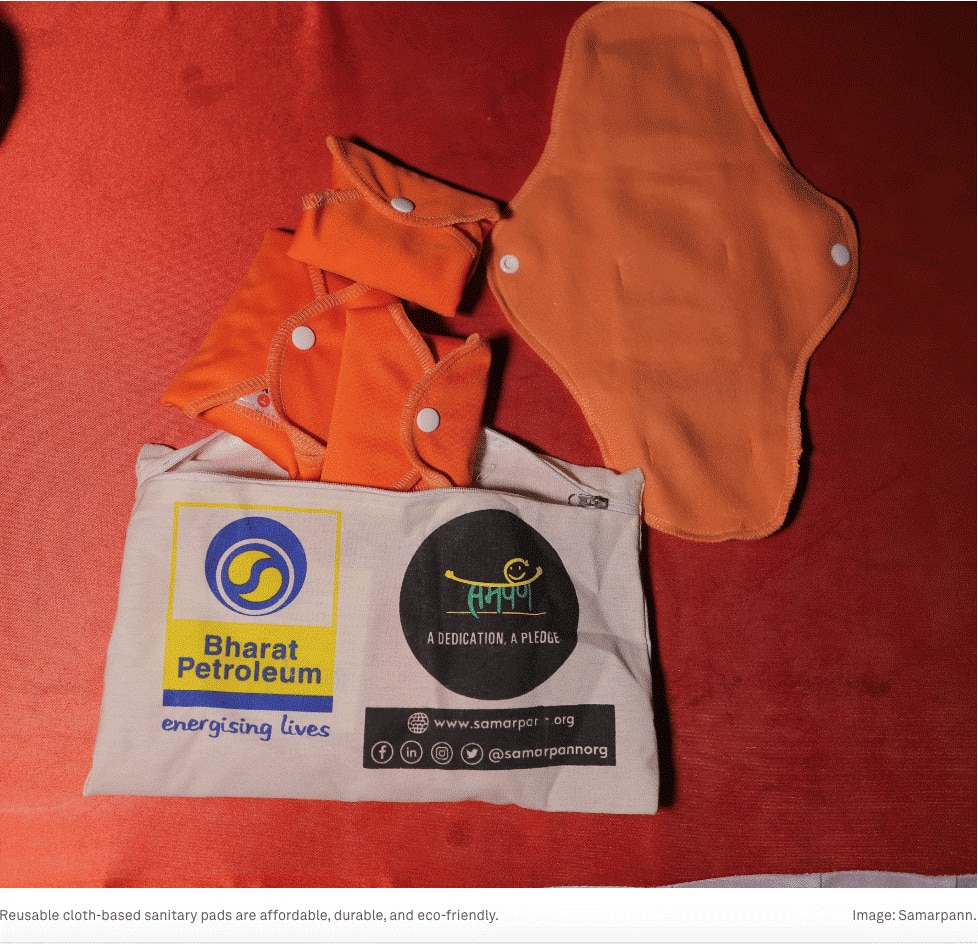
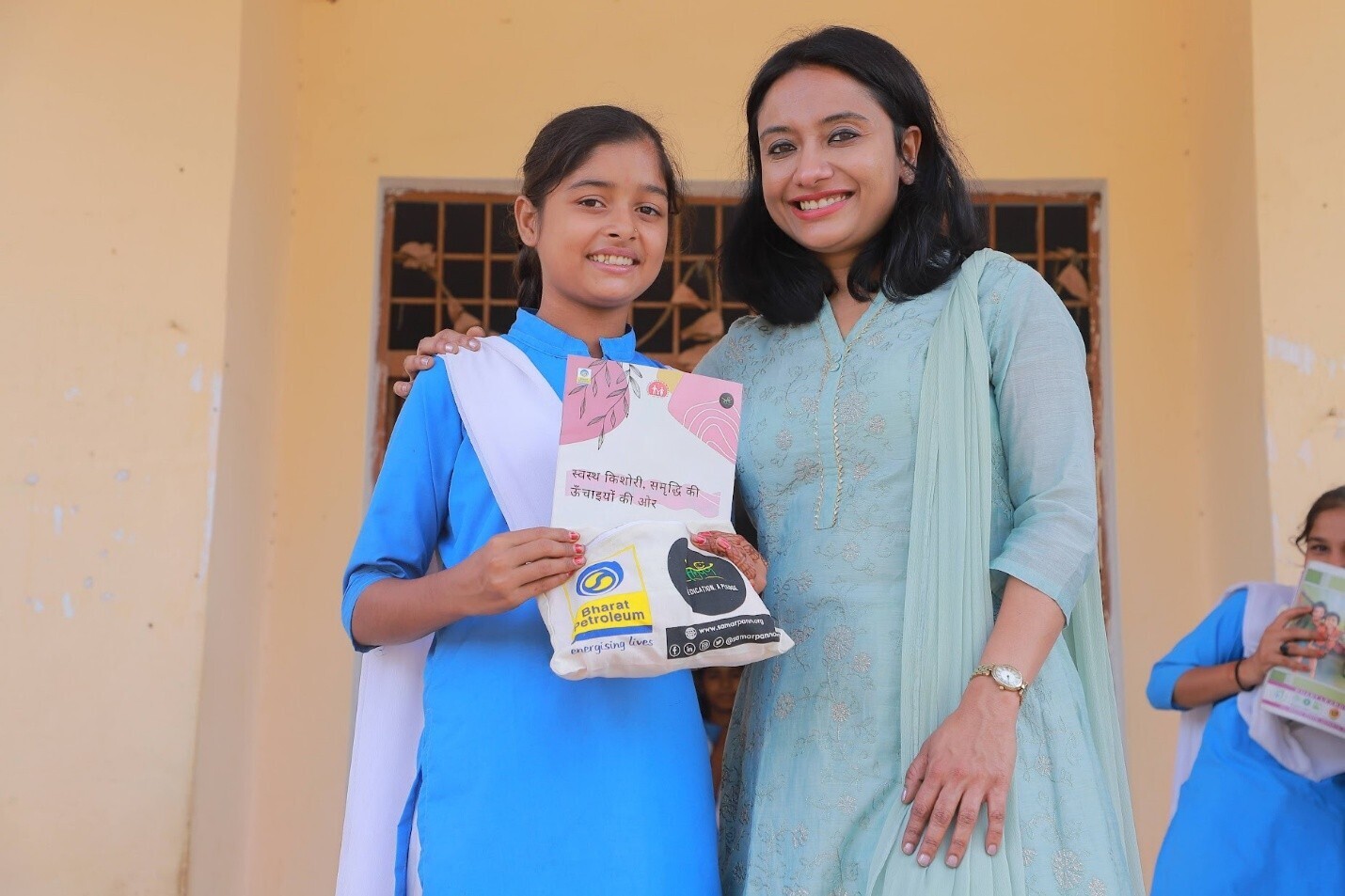
It lasts two to three years with basic care. Each recipient gets a kit of six pads, providing complete monthly coverage from day one. The economics are transformative: a one-time cost of under $7 for six pads replaces years of recurring expenditure totalling close to $72. Over its lifetime, each pad prevents approximately 400 disposable pads from entering the waste stream. Alongside the kit, every recipient gets an illustrated health booklet in her vernacular language — written for first-generation readers, covering menstrual health, hygiene care and pad maintenance in plain, respectful language that treats her as someone who deserves accurate information, not managed silence.
Why schools are where change begins
Samarpan’s work extends beyond product distribution. Awareness sessions in schools, hostels and community centres form the foundation of the programme, and the choice to begin in schools is deliberate. A girl who understands her body before her first period approaches that experience as biology, not crisis. Knowledge absorbed early shapes her relationship with her own health for the rest of her life.
In sessions across these schools, in rooms filled with girls much like the one who opened this piece, these conversations address menstrual biology, hygiene practices and the myths that surround menstruation. Teachers in programme villages report that girls who once missed school during their cycles now attend without interruption.
Many begin speaking openly with peers and family members, replacing silence with knowledge. In several villages, those who attended sessions have become informal community educators, carrying information through trusted local networks rather than through external instruction alone. For many, the programme marks the first time menstruation has been discussed as a health issue rather than a private burden.
Insights from 25,000 women and girls
Across Rajasthan and the tribal communities of Panna district in Madhya Pradesh, Samarpan has reached approximately 25,000 women and adolescent girls — 10,000 in Rajasthan and 15,000 in Madhya Pradesh.
The programme works because product distribution, health education, school engagement, peer networks and family dialogue function together as a single system. Samarpan has also introduced period underwear in some communities, expanding the range of safe and dignified options available to women and girls who until now had none.
The distance that remains
Across rural and tribal India, millions of women and girls still manage menstruation without safe products, accurate information or community support. The barriers are rarely technological — safe reusable products exist, community education models work, and local health networks can carry both. What is needed is institutional commitment to treat menstrual health as a public health priority rather than a private issue.
The girl from that tribal village in Madhya Pradesh is back in school. She has not missed a day since. She is not a statistic; she is evidence of what becomes possible when the right product, the right knowledge and the right community support reach a girl at the same time.
Don't miss any update on this topic
Create a free account and access your personalized content collection with our latest publications and analyses.
License and Republishing
World Economic Forum articles may be republished in accordance with the Creative Commons Attribution-NonCommercial-NoDerivatives 4.0 International Public License, and in accordance with our Terms of Use.
The views expressed in this article are those of the author alone and not the World Economic Forum.
Stay up to date:
Sanitation


Forum Stories newsletter
Bringing you weekly curated insights and analysis on the global issues that matter.
More on Health and Healthcare SystemsSee all

Alicia Zhou
March 5, 2026