Is this how to prepare for an agentic AI driven future?

Agentic AI is quickly becoming pervasive, but it needs guardrails. Image: Getty Images/iStockphoto
- Agentic AI marks a real shift in how work gets done inside an enterprise.
- It's not just a technology evolution, it’s a governance and security problem that enterprises need to address head-on.
- Organizations that succeed in the agentic AI era will earn autonomy through visibility, clear policy boundaries and the ability to audit and override decisions when necessary.
Agentic AI marks a real shift in how work gets done inside an enterprise. We’re moving beyond systems that assist humans to systems that are trusted to reason, decide and act on their own. That change is already underway and it’s happening inside core business workflows - not in labs or pilot programmes.
Let me be clear about why this matters. When AI systems are given autonomy, they become operational actors with authority. They initiate actions, interact with tools and APIs and influence outcomes in real time. At that point, many of the assumptions organizations rely on - about control, oversight and accountability - no longer hold. This isn’t just a technology evolution. It’s a governance and security problem that enterprises need to address head-on.
How can we move from alert fatigue to active defence?
Cybersecurity will also harness and deploy agentic AI in more demanding ways, including in the security operations centre. Security operations are under relentless pressure, with analysts facing a dizzying volume of alerts, false positives and incident response demands. The scale and velocity of threats have now nearly outpaced human capacity, leading to burnout, attrition and difficult trade-offs between security depth and business agility. In many organizations, security has become a resource game that humans alone can no longer win.
Agentic AI promises to be the critical force multiplier to help solve this challenge. In this context, agents function as intelligent assistants that automate the monitoring, triage and management of security events. They classify alerts, enrich events with contextual data, correlate signals across disparate systems and escalate only what truly requires human judgment. Some are already being trained to dynamically adjust security and access policies as business contexts evolve, continuously monitoring for compliance, flagging anomalies in real time and taking limited corrective action autonomously.
Embracing agentic AI should further shift cybersecurity from reactive to proactive, helping to identify and prevent threats before they can damage organizations. Instead of merely alerting to suspicious activity, AI-driven security becomes an active defence system, capable of operating at machine speed without sacrificing precision or visibility. Mean time to detect and respond drops dramatically, blind spots shrink and human analysts regain the cognitive space to focus on higher-order strategy and complex investigations.
Why is agentic AI a tool not a takeover?
The effectiveness of agentic AI in security operations comes down to augmentation, not replacement. Cybersecurity expertise remains scarce and invaluable. What agents do exceptionally well is handle the repetitive, high-volume tasks that drain human attention: alert classification, log analysis, routine investigations and baseline threat correlation. They work continuously, without fatigue, across systems and silos that can be difficult for humans to monitor simultaneously.
Because agentic AI can rapidly process massive datasets and detect subtle patterns, it can surface threats that might otherwise be missed or discovered too late. Early deployments are already demonstrating tighter security postures, greater operational resilience and a significant reduction in bottlenecks that slow incident response. Agentic AI allows organizations to scale security outcomes without scaling headcount at the same rate.
How can we deploy and scale agentic AI responsibly?
As AI agents are deployed and scaled within organizations, new governance gaps will inevitably emerge that will limit operational authority. Who validates an agent’s actions? Who audits its decision logic? How do organizations intervene when an agent’s intent diverges from the desired outcome or when optimization goals conflict with ethical or regulatory constraints?
Autonomous efficiency without accountability quickly becomes unmanaged risk. An agent that can change access policies, isolate systems or initiate remediation actions must be governed as rigorously – if not more so – than any privileged human user. Without strong guardrails, observability and auditability, organizations risk trading human error for machine-driven systemic failure.
As Agentic AI is adopted and scaled at a faster pace, enterprises will need formal AI governance councils that bring together security, risk, legal and business leadership. These bodies will define where autonomy is permitted, under what conditions and with which escalation paths. Policy guardrails must be explicit, enforceable and continuously evaluated. Every autonomous decision must be logged in immutable audit trails, enabling post-incident review, compliance validation and continuous improvement.
This concern is not theoretical. The World Economic Forum’s Global Cybersecurity Outlook 2026 finds that accelerating AI adoption is expanding the cyber attack surface, while organizations struggle to align governance, skills and security controls with the speed of deployment. As AI systems and agents proliferate across enterprise workflows, the absence of governance may prove more dangerous than the absence of automation.
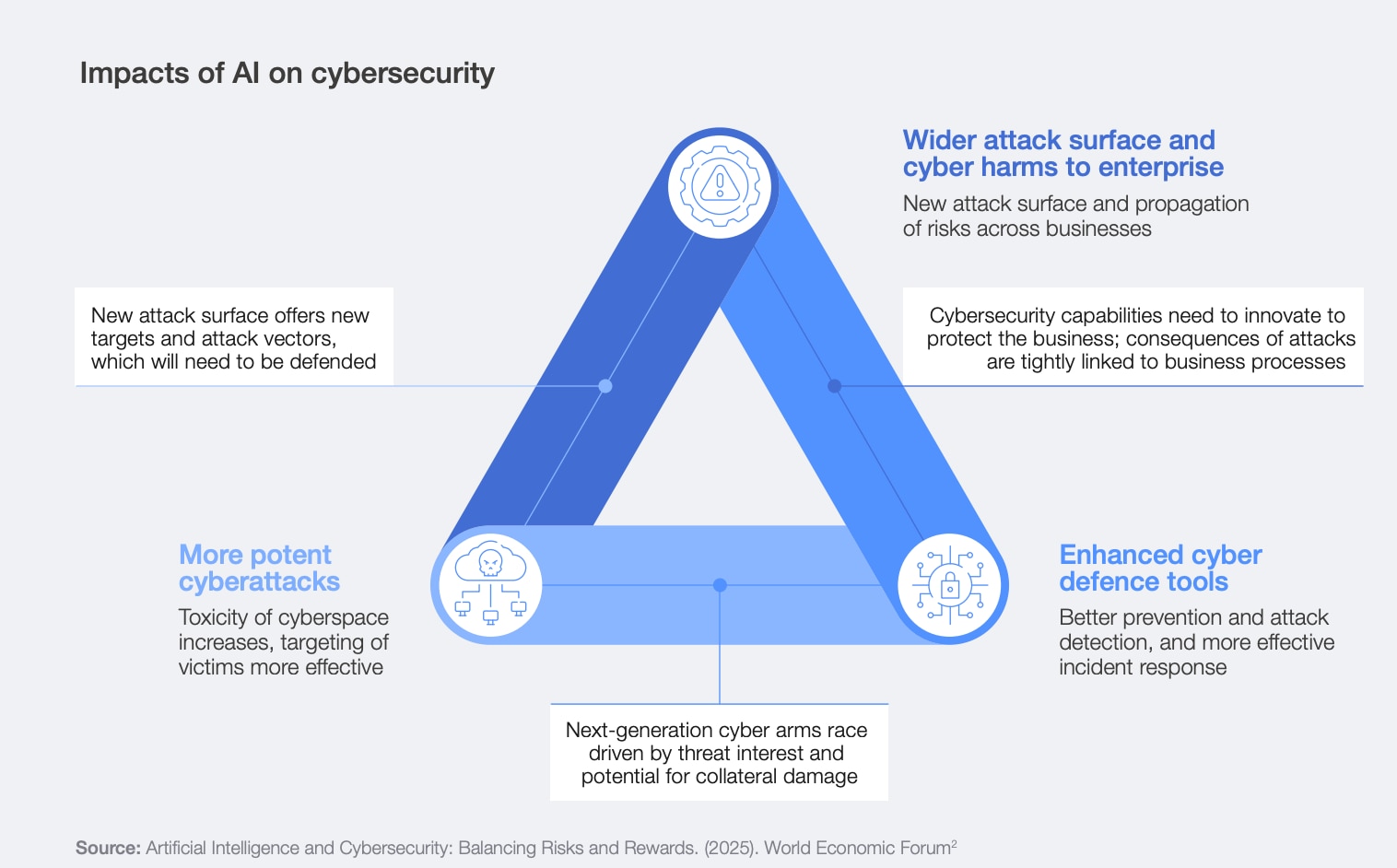
Success in the agentic era hinges on visibility. Enterprises must be able to observe what their AI agents are doing, why they are doing it and what impact their actions have across the environment. This means security platforms must evolve to provide real-time insights into agent behaviours, decision pathways and outcomes. Policies must be designed with prevention-by-design principles, ensuring that agents operate within clearly defined boundaries aligned to organizational risk tolerance.
When agents act, humans must be able to understand, audit and override those actions when necessary. After all, visibility and control go hand in hand.
Autonomous adversaries versus autonomous defenders
The security challenge ahead is straightforward. Attackers are already using AI to automate reconnaissance, adapt techniques and operate at machine speed. Defending against that with human-driven processes alone is no longer sufficient. Enterprises are entering an environment where autonomy exists on both sides. The outcome depends on how well that autonomy is governed.
Agentic AI is not inherently risky. Unconstrained autonomy is. Organizations that succeed in the agentic era will be the ones that earn autonomy through visibility, clear policy boundaries and the ability to audit and override decisions when necessary. Security in this model isn’t about reacting faster - it’s about ensuring that autonomous systems act with intent. Intelligence without governance doesn’t scale. Risk does.
How the Forum helps leaders make sense of AI and collaborate on responsible innovation
Don't miss any update on this topic
Create a free account and access your personalized content collection with our latest publications and analyses.
License and Republishing
World Economic Forum articles may be republished in accordance with the Creative Commons Attribution-NonCommercial-NoDerivatives 4.0 International Public License, and in accordance with our Terms of Use.
The views expressed in this article are those of the author alone and not the World Economic Forum.
Stay up to date:
Cybersecurity
Related topics:


Forum Stories newsletter
Bringing you weekly curated insights and analysis on the global issues that matter.
More on Artificial IntelligenceSee all

Alicia Zhou
March 5, 2026