Why social mobility is Latin America's next inclusion challenge

Mind the class ceiling … Mexico City's Sante Fe business district. Image: Reuters/Raquel Cunha
- While advancing quickly on gender equality, Latin America is yet to seriously address workplace and boardroom exclusion based on class factors.
- A new regional company ranking specifically asks companies to address this issue by disclosing inclusion of socio-economically vulnerable populations.
- Companies must identify and remove structural barriers to people from socio-economically disadvantaged backgrounds, both outside and within organizations.
2025 reshaped the workplace inclusion agenda. After more than a decade of steady progress, diversity, equity and inclusion (DEI) became loaded terms – especially under the regional influence of the US and the rolling-back of such policies. And yet Latin America keeps moving. We can’t afford to retreat from DEI when roughly two-thirds of our population is still socio-economically vulnerable and systematically under-represented in formal workplaces and leadership.
Latin America has actually been ahead of the curve on workplace inclusion in the last decade. When we started measuring companies’ inclusion practices in 2014, only 40 participated. Twelve years later, Aequales’s PAR Ranking has measured more than 2,400 corporations across 20 countries, and scores have improved year after year. As a region, we’ve been especially effective at advancing gender equality: Most organizations now have a diversity policy, and women’s representation in leadership is increasingly common – reaching close to half in some places, including Colombia.
But if we’re honest, it’s far less popular – and reputationally rewarding – to talk about Latin America’s root inequality: socio-economic exclusion, or plain classism. We all recognize it: the bias against how someone sounds, how they dress, which neighbourhood they come from, what school they attended, and how confidently they navigate corporate norms. And yet we often pretend it isn’t shaping hiring, promotions and access to opportunity – even in organizations that proudly describe themselves as meritocratic.
The damage of socio-economic exclusion
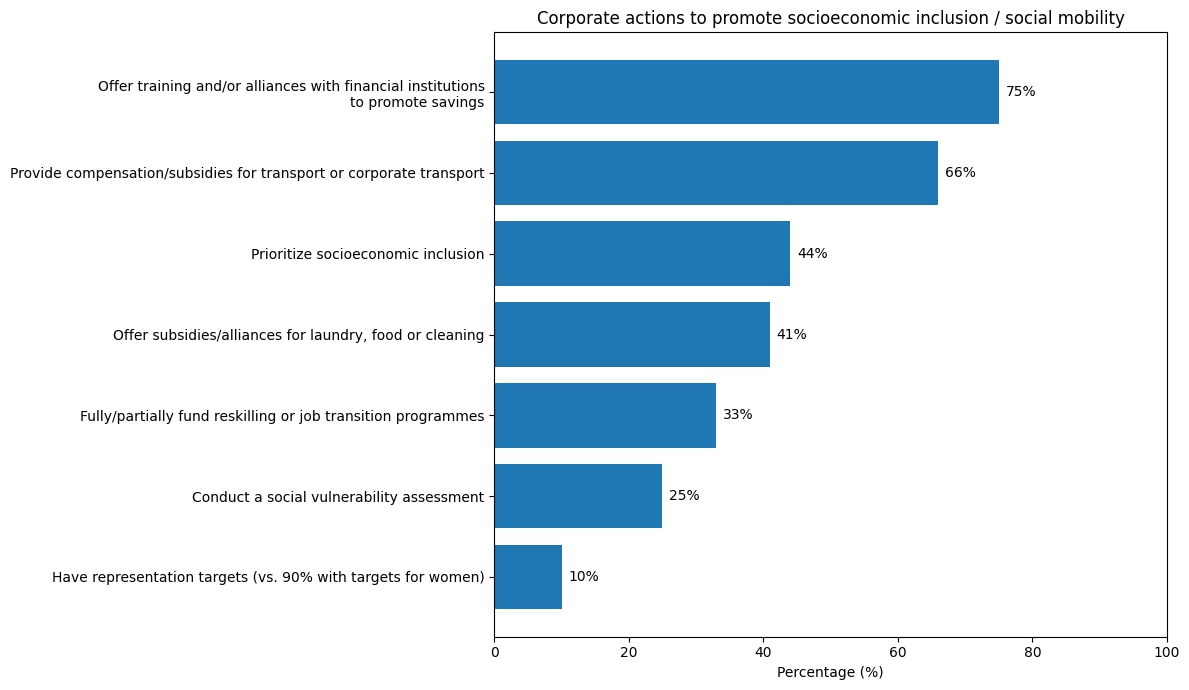
That’s precisely why Aequales expanded the 2025 PAR Ranking to include socio-economic inclusion: to push companies into the uncomfortable conversation, and to recognize those already making progress. The early data shows how far we still have to go: among the 500 companies measured in 20 countries in 2025, only 10% have representation targets for socio-economically vulnerable populations – compared to 90% that have targets for women.
This matters not only because it’s unfair, but because it’s corrosive to performance and belonging. BCG finds that employees from socio-economically disadvantaged backgrounds report the lowest sense of workplace belonging, and the inclusion gap tends to widen as people move up the ranks.
The World Economic Forum makes a complementary point through a systems lens: Businesses are core stakeholders in social mobility, particularly where the state lacks capacity. Yet too few firms provide formal training, and access to training for unemployed workers remains limited. In a region where mobility is constrained, companies can either reproduce inequality – or become part of the infrastructure that helps people climb.
McKinsey’s research on socio-economic diversity in Latin America is blunt: only about a third of companies surveyed report actions or programmes to promote inclusion of employees from socio-economically disadvantaged backgrounds. And the largest gap between what Latin America looks like demographically and who actually is in the workplace precisely reflects the region’s socio-economic gulf.
Put differently: The majority of our population is missing from the spaces where decisions are made. McKinsey reports that only 8% of executive-level positions are held by underprivileged workers – not because talent is scarce, but because our systems are not designed to find it, develop it and reward it. When asked about barriers to entry-level jobs, 42% of underprivileged workers cited inability to get referrals. That should sound familiar to anyone who has ever benefited from networks, internships, “recommended” candidates, or simply knowing how the unwritten rules work.
Democratizing the workforce
So what does corporate action look like when it’s serious? First, it means recruiting beyond the usual pools and being honest about which “requirements” are actually proxies for privilege. A clear example in Latin America is speaking English. English fluency often correlates with private education, not competence. When companies offer English training to new recruits, they’re not lowering standards – they’re removing a structural barrier. According to PAR Ranking, 76% of companies in Latin America have flexible English requirements and 71% give workers the tools to learn English. Only 35% of underprivileged workers in Latin America speak English, which is exactly why this is such a powerful lever.
Second, it means making reasonable adjustments so people can succeed once they’re inside and have access to pathways for socio-economic mobility.
In Aequales’s PAR 2025, 33% of companies provide full or partial funding for training programmes aimed at reskilling or career transitions. Sixty-six per cent offer compensation or subsidies (full or partial) for transportation or provide corporate transport services – because the cost and logistics of commuting are real barriers. Forty-one per cent offer full or partial subsidies, or partnerships, for laundry, food or cleaning services – supports that may seem “extra” until you realize how much time, stress and hidden cost they remove for workers with fewer resources. Seventy-five per cent provide training and/or formalize partnerships with financial institutions to encourage employee savings. And importantly, 25% of companies say they assess employee vulnerability levels – because we often assume everyone employed in our companies has dignified living conditions, until we actually ask. This is the kind of operational work that changes outcomes.
Third, it means understanding that class doesn’t operate alone. Intersectionality matters: Socio-economic disadvantage compounds with gender and race to produce deeper exclusion. The feminization of poverty is one reminder. Youth unemployment and informal work in the region disproportionately affect women, underscoring how economic vulnerability and gender inequality reinforce each other.
And yes, there’s a business case – but I’d argue the bigger point is that inclusion is the only realistic growth strategy for a region this unequal. The Forum’s Social Mobility framing argues that investing in mobility can unlock significant economic value by 2030 while strengthening company performance. McKinsey also connects socio-economic diversity to organizational health: Companies committed to increasing socio-economic diversity score higher on the Organizational Health Index, reflecting stronger alignment, execution capacity and innovation.
Leaders on Latin American diversity
The best part is we don’t need to imagine what socio-economic diversity looks like – we already have examples in the region.
Danper, a leading Peruvian agribusiness, has measured multidimensional poverty among its workers and even within their households to understand what drives deprivation, identify who is most disadvantaged and decide which interventions to strengthen. Measurement is not the end goal: Danper pairs that baseline with gender and respectful workplace policies and with high-impact programmes; evidence developed with IADB Invest suggests these initiatives help reduce gaps in education, access to credit, and access to healthcare for employees and their families. In Colombia, Bancamía (BBVA Microfinance Foundation) measures multidimensional poverty among its clients – entrepreneurs across the country – to pinpoint structural needs and then design targeted products and services, tracking whether gaps in education, health and housing actually shrink as a result. After three credit cycles, entrepreneurs moved above the poverty line, 21% created at least one additional job, and 81% of credits were delivered to underserved entrepreneurs. And in Peru again, a collective of CEOs called created EPA to close education gaps among company workers, their relatives and even vendors and suppliers by providing free foundational schooling – because education is still the biggest asset for social mobility.
How is the World Economic Forum promoting equity in the workplace?
If 2025 taught us anything, it’s that advancing inclusion can’t rely on how popular a cause it is. It has to rely on evidence, discipline and the courage to name what we usually avoid. In Latin America, the next frontier is clear: If we want workplaces that reflect our societies – and economies that actually grow inclusively – we need to measure socio-economic vulnerability, remove structural barriers, and invest in mobility with the same seriousness we’ve brought to gender.
Don't miss any update on this topic
Create a free account and access your personalized content collection with our latest publications and analyses.
License and Republishing
World Economic Forum articles may be republished in accordance with the Creative Commons Attribution-NonCommercial-NoDerivatives 4.0 International Public License, and in accordance with our Terms of Use.
The views expressed in this article are those of the author alone and not the World Economic Forum.
Stay up to date:
Latin America


Forum Stories newsletter
Bringing you weekly curated insights and analysis on the global issues that matter.
More on Equity, Diversity and InclusionSee all

Sam Grayling
March 20, 2026


