What does China’s new 5-Year Plan mean for global trade and investment?
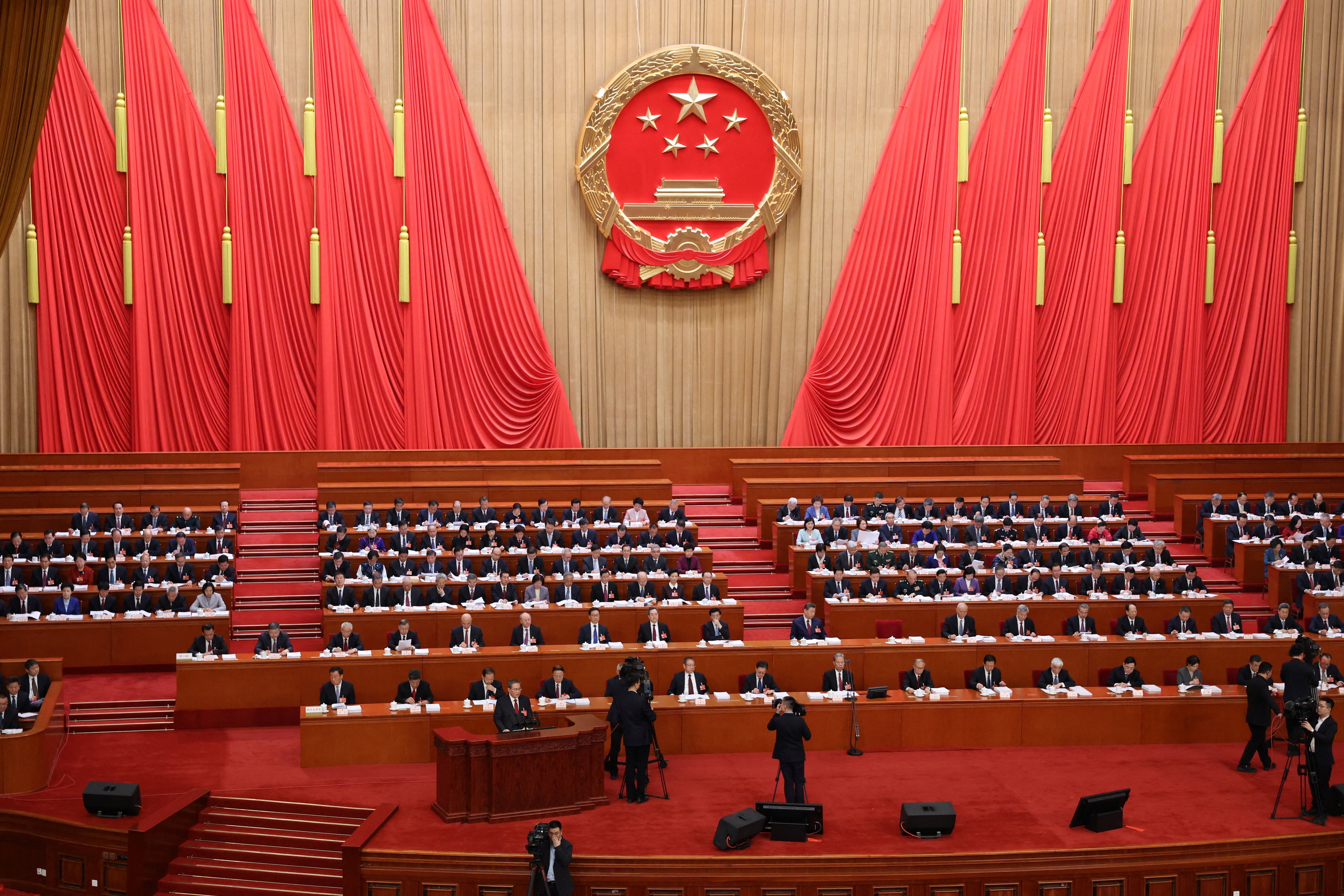
China's 15th Five-Year Plan balances self-reliance and global economic integration. Image: REUTERS/Florence Lo/Pool
- China’s new Five-Year Plan outlines how the country plans to navigate an uncertain, rapidly changing and fragmented global environment.
- The plan underscores continued development of core priorities, with greater emphasis on self-reliance, balanced with global economic integration.
- Innovation will be a strategic driver of China’s economy and a force shaping global technology, supply chains and investment in the years ahead.
China has unveiled its economic playbook for the rest of the decade, outlining a strategy that could reshape global trade and investment flows.
Earlier this month, the country’s National People’s Congress (NPC) formally adopted its 15th Five-Year Plan (2026-2030). More than an internal procedure, China’s Five-Year Plans are high-level policy blueprints that have long guided national priorities, mobilized resources and signalled the country’s economic and social policy direction to domestic and international stakeholders.
This latest iteration provides insights into how the world’s largest manufacturing ecosystem intends to navigate the increasingly complex global environment, marked by geopolitical fragmentation, policy uncertainty and rapid technological breakthroughs.
Like China’s previous Five-Year Plan, 2026-2030 will see the same core priorities develop, especially industrial upgrading and the centring of innovation and technology.
However, this time, innovation is framed more explicitly in terms of self-reliance and the development of “new quality productive forces” – a reference to more high-tech and efficient methods of industrial production.
This new framing reflects a more strategic and security-oriented approach.
At the same time, the plan prioritizes “high-level opening up” – a policy focus signalling continuing external economic engagement. These shifts show how China is seeking to balance stronger domestic resilience with continued global economic integration, with better relations and conditions for trade and investment.
Trading through tensions
Despite some recent distancing from China as a trading partner, the new Five-Year Plan underscores continued support for international trade, explicitly committing to safeguarding the multilateral trading system with the World Trade Organization at its core, while opposing protectionism and indiscriminate tariffs.
Trade innovation has featured more prominently, including intermediate goods, services, digital and green trade and additional support for cross-border e-commerce, offshore trade and export financing tools.
China’s recent export performance demonstrates this enduring commitment to trade, with 5.5% growth in US dollar terms in 2025 despite global headwinds.
While its exports to the United States fell by 20% year-on-year, its exports to other regions, including the European Union (EU) and the Association of Southeast Asian Nations (ASEAN), rose. Alongside stagnant imports, this export boom led to China’s record $1.2 trillion trade surplus last year.
However, this has not been without tensions with many trading partners, including its largest, ASEAN, which is facing a “struggle against a flood of underpriced Chinese goods,” according to some analysis.
In February, Brazil imposed anti-dumping duties on Chinese steel in response to its dominance of the industry.
With the EU, China’s second largest trading partner, Gene Ma, head of China research of the Institute of International Finance, observed that “the issue is not only that China exports more. It is that China exports more of what Europe also produces.”
As China continues to promote exports, its competition with Europe and other advanced economies will intensify, whilst its dominance in lower-cost manufacturing will also squeeze the development of emerging economies.
Against this backdrop, the plan also stresses deepening economic ties with the Global South, particularly through the Belt and Road Initiative, to expand market access, strengthen supply chain linkages and build new growth corridors.
Self-reliance as a core strategy
Technology-led development has been central to China’s economic strategy, with a clear rise in references to technology over the last three Five-Year Plans, since President Xi Jinping took office.
The latest plan calls for strengthening the entire innovation ecosystem, from education and talent to research, to enhance innovation capacity. Key targets include growing core digital industries to 12.5% of gross domestic product (GDP) and ensuring annual growth in research and development spending above 7%.
Self-reliance sits at the base of this technology-led development. The goal is to make “decisive breakthroughs” in critical technologies that underpin industrial and supply chains, from integrated circuits, industrial machine tools, high-end instruments, foundational software, advanced materials and biomanufacturing.
These capabilities are seen as essential to strengthening economic security, especially in an era of rising geopolitical and technological competition.
China is accelerating the use of emerging technologies such as artificial intelligence (AI), quantum technology, biotechnology and clean energy, while increasing support for basic research and original innovation.
Altogether, this approach puts self-reliance at the core of a new growth model built on advanced, high-quality production. Ultimately, it signals that innovation will be a strategic driver of China’s economy and a force shaping global technology, supply chains and investment in the years ahead.
Targeted investment flows
Even with the emphasis on self-reliance, there are positive signals for businesses that export to and invest in China. The plan’s calls for greater high-level opening up – the latest evolution of China’s reform and opening up policy – home in on services China wants to grow, including telecoms, education and health.
China will also adjust tariffs and incentives to encourage imports of advanced technologies, high-quality agricultural products and productive services, aiming to further attract foreign investment in advanced manufacturing, high-tech and green sectors.
There are also plans to improve the broader ecosystem for investment and foreign trade.
These include strengthening connectivity with foreign financial markets, promoting the internationalization of China’s renminbi currency, easing restrictions on cross-border payments and standardizing digital trade documentation; all while making conditions in the country amenable to establishing regional headquarters and deepening existing investments in the country.
Alongside continued export strength, firms are encouraged to expand, invest and form new partnerships overseas. The plan suggests specific support for internet platforms, cross-border e-commerce, AI companies and professional services providers such as lawyers, accountants and auditors.
China’s outbound investment is closely tied to the Belt and Road Initiative, with mentions of expanding cooperation in the digital economy, AI, green, agricultural, tourism, space and health sectors.
This will be a growing trend, as Markus Herrmann, co-founder and managing director of China Macro Group, has noted, China will consider gross national income (GNI) in its future economic policy goals, which crucially includes earnings from foreign direct investment, that GDP statistics do not.
Worldwide implications
The 15th Five-Year Plan sets out China’s policy blueprint and development ambitions until 2030. Through more than 50,000 characters across 62 sections, it makes clear that China’s economic story will be increasingly interwoven with the rest of the world.
Yet China’s policy aspirations do not operate in a vacuum. One report at the NPC noted of the year 2025 that “rarely… have we encountered such a grave and complex landscape, where external shocks and challenges were intertwined with domestic difficulties and tough policy choices.”
External environmental factors, such as disruptions to global trade, energy markets and travel already seen in 2026, will impact the delivery of China’s Five-Year Plan. Furthermore, as its export growth affects jobs and economic growth in other countries, those countries may react with more targeted policies to counteract China’s new direction.
To better understand how China will affect global trade and investment patterns, the World Economic Forum’s Annual Meeting of the New Champions will convene on 23-25 June in Dalian, China.
Don't miss any update on this topic
Create a free account and access your personalized content collection with our latest publications and analyses.
License and Republishing
World Economic Forum articles may be republished in accordance with the Creative Commons Attribution-NonCommercial-NoDerivatives 4.0 International Public License, and in accordance with our Terms of Use.
The views expressed in this article are those of the author alone and not the World Economic Forum.
Stay up to date:
The Digital Economy
Related topics:


Forum Stories newsletter
Bringing you weekly curated insights and analysis on the global issues that matter.
More on Trade and InvestmentSee all

Sreevas Sahasranamam and Jyotsna Sitling
March 25, 2026


