Where is AI moving beyond experimentation? 6 leaders on what's actually scaling
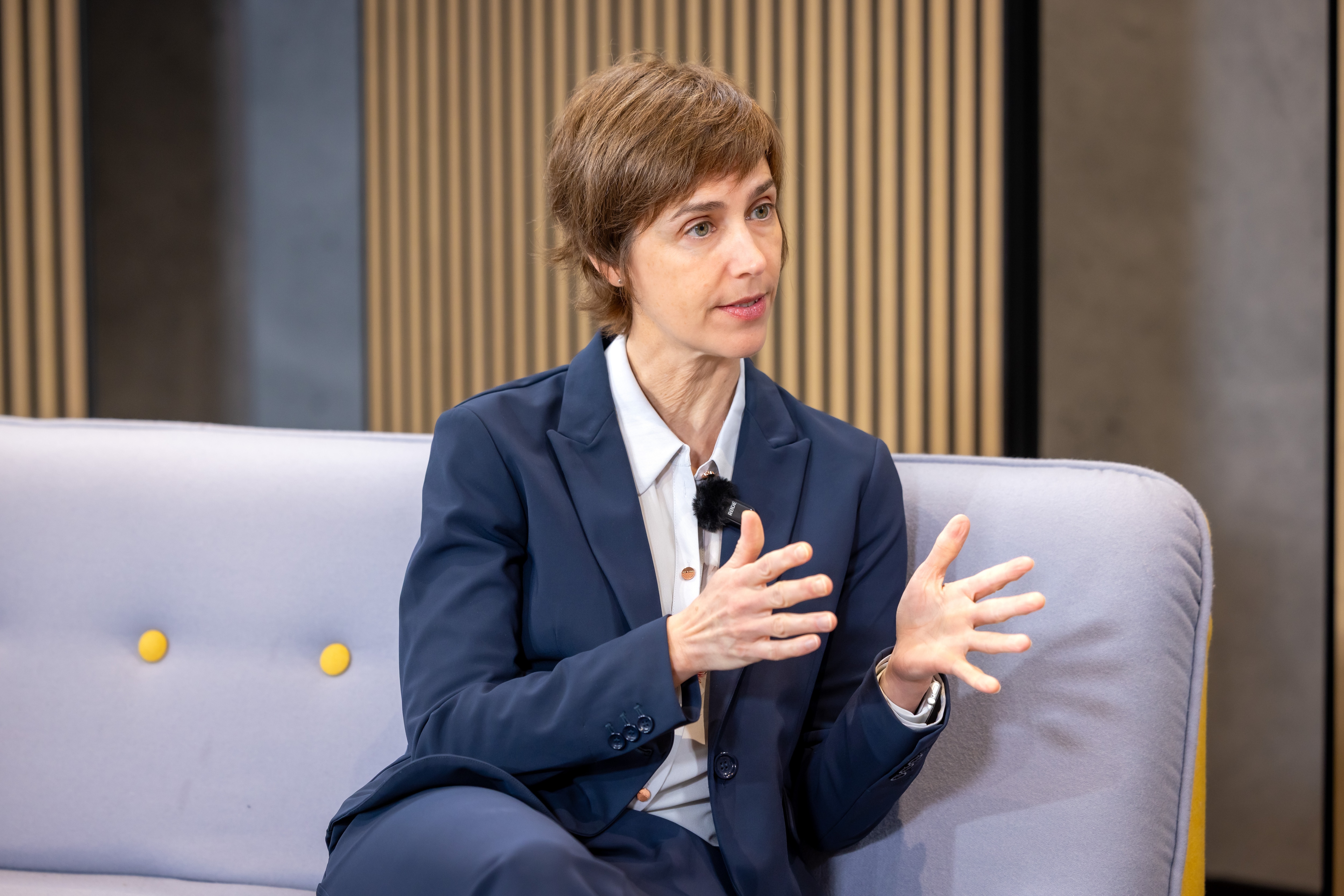
To think that agentic AI would go from a research lab directly to broad adoption in a year seems rather optimistic, says Cohere's Joëlle Pineau. Image: World Economic Forum
Francisco Betti
Head, Global Industries Team; Member of the Executive Committee, World Economic Forum- The World Economic Forum’s Industry Strategy Meeting in Munich in March brought together more than 300 corporate, technology and public-sector leaders.
- They explored how exponential technologies like AI are reshaping business models, value chains and global competitiveness.
- Discover where AI is moving beyond experimentation into large-scale deployment, as industry leaders share real-world use cases, measurable impact on productivity and what it takes to scale.
Artificial intelligence is finally crossing a threshold. Companies have long talked about AI as a transformational force, but most activity stayed in sandboxes and innovation labs. In 2026, that balance has begun to shift.
As more than 300 corporate strategy leaders gathered in Munich for the World Economic Forum's Industry Strategy Meeting this month, the question was less “Can AI work?” and more "Where is it already changing how we operate at scale?".
The pressure to answer that question has never been greater. Discussions at the meeting underscored the scale of the challenge: around three-quarters of companies have yet to generate meaningful value from AI, with many still stuck in pilot phases despite growing investment. As one executive put it plainly, 2026 is the year companies have to prove AI can return value.
Across sectors, emerging technologies including AI, automation and advanced computing are being wired into the core of the enterprise – from decision systems and supply chains to finance, customer service and engineering workflows.
The World Economic Forum’s recent report Rethinking AI Sovereignty: Pathways to Competitiveness through Strategic Investments puts the projected annual investment in AI applications at $1.5 trillion by 2030, while the annual growth in AI investments since 2010 has been 33%.
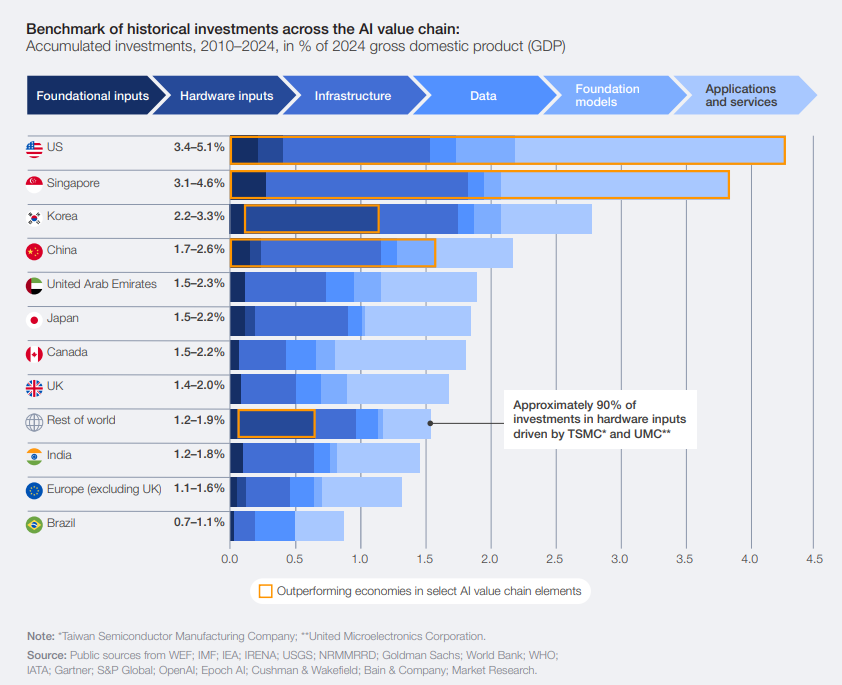
At the enterprise level, research from Capgemini finds a decisive shift from pilots to platforms, with budgets growing and 38% of organizations operationalizing AI use cases. In tandem, early movers are beginning to report tangible results – gains in productivity, faster cycle times, cost savings and new revenue streams.
But the path from proof of concept to production is rarely linear. Leaders must address issues from trust and governance to skills and infrastructure, while keeping business value top-of-mind.
Here, executives from across industries share what the adoption shift looks like inside their organizations and what it actually takes to make AI stick.
1. The technical architecture question
"In our business, Agentic AI for Enterprise Planning & Execution has moved from experimentation to operational deployment. But it has required careful design of the agentic AI solutions," said Dr Ashwin Rao, Executive Vice President of AI and R&D at o9 Solutions.
"Essentially, we combined the strength of neural AI (LLMs) with the complementary strength of symbolic AI (structured enterprise data models and decision models, informed by deep enterprise knowledge).
"This enabled our agents to gain from the scalability, adaptability and learnability advantages of neural AI but also gain from the reasoning, precision and explainability advantages of symbolic AI. So, we've been able to build reliable agents that work well in enterprise practice – as opposed to typical LLM-heavy agents that don't move beyond attractive demos and POCs.
We are combining the strength of LLMs with symbolic AI.
”"In terms of impact, we are seeing massive help for enterprise planners, for instance, in root cause analysis of variances in supply chain plans versus outcomes. This has enabled planners to reduce their investigative time by as much as 80%.
"We are also seeing huge gains through touchless execution for inventory and logistics. This saves even small enterprises tens of millions of dollars in labour costs. And we have found great improvements in enterprise agility where cross-silo decision-making is being performed in a quarter of the time due to AI's help in facilitating Integrated Business Planning."
2. Industrial deployment at scale
The barrier wasn't technical. It was cultural.
”When Siemens introduced AI to its electronics equipment factory in Amberg, there was initial resistance, said Dr Günter Beitinger, Senior Vice-President, Manufacturing; Head, Factory Digitalization, Siemens, speaking at the Industry Strategy Meeting in Munich.
"At the early stage of introducing AI, there were a lot of concerns, especially among shop floor and manufacturing staff, so the fear of 'what will AI do to my job?' ... So, what we did was slowly introduce what we wanted to do and made people a part of the whole development."
For example, the introduction of AI into X-ray quality assurance involved people training the algorithms to identify those products where AI quality assurance was no longer needed in the process, to save time.
"We calculated that if we find 5% of our products sorted out, it's already an economically viable scenario."
Over time, the factory teams trusted AI to correctly identify those products that did not need X-ray quality assurance, and they have reached 30% of products that can skip the extra step.
The people are really confident. They designed the AI from the beginning with their experts, making sure it was safe, ethical and explainable."
The combination of AI and data is supporting three main shifts, said Dr Beitinger.
"We are shifting from efficiency to resilience; that is one thing we are looking for. In the past, we had this global cost optimization. Of course, cost is very important, but resilience becomes more and more important. And we are also going from automation to autonomy and from single factory optimization to a whole production ecosystem. AI is really helping us make these shifts."
We are building AI agents on the solid foundations of our corporate data.
"Data and machine learning algorithms, which represent the basis for the application of AI techniques, allow us today to manage our business increasingly better and more efficiently," said Filippo Ricchetti, Head of Planning and Control and Insurance, Eni.
Among other things, Eni has been able to reduce the uncertainty of mineral resources, digitalize its operational processes and industrial plants, and speed up the development of new businesses and energy chains.
300
number of AI use cases Eni has developed
35%
reduction in drilling time achieved by AI
"For years, Eni has used AI tools across numerous sectors, with around 300 use cases from exploration to operations. The use of AI solutions has improved efficiency by reducing plant downtime, optimizing production and lowering emissions. In the drilling sector, for example, a 35% reduction of drilling time has been achieved. Automation and machine learning have led to these improvements.
Looking ahead, the company is building AI agents on the foundations of its proprietary corporate data and knowledge assets — a deliberate choice to retain control over the intelligence that matters most. Initial applications are already being launched across processes, governed by a Responsible AI framework designed to ensure transparency and accountability at every step.
3. AI native to the enterprise
"Every technology resets the world. The arc is always the same: experimentation, adoption, dependency, irreversibility. What's different this time is the speed – and the stakes," said Hala Zeine, SVP and Chief Strategy Officer, ServiceNow.
"Organizations aren't waiting for proof points. They know that hesitation is a structural disadvantage, so they moved early.
"But experimentation is only the first step. The real transformation happens when AI embeds into the flow of work – rewiring how enterprises sense context, make decisions and execute at scale. That's when adoption becomes cognitive dependency and when AI in the workflow becomes not just useful, but irreplaceable. The organizations that cross that threshold first will compound an advantage that late movers cannot simply spend their way out of.
AI is becoming native to our infrastructure.
”"At ServiceNow, we are built for exactly this moment. AI isn't bolted onto our platform – it's native to the infrastructure that already orchestrates 80 billion workflows and 6.5 trillion transactions annually for 85% of the Fortune 500. Our architecture is designed to move organizations from experimentation to irreversibility: sensing enterprise context across systems, deciding with business accountability, acting autonomously within governed workflows and governing every step with audit-grade controls.
"The results are already compounding. AstraZeneca reclaimed 30,000 hours annually. Pure Storage resolved cases seven times faster. Siemens handles 210,000 tickets autonomously every month. These aren't efficiency gains – they are early signals of cognitive dependency at scale. AI inside workflows is autonomous enterprise execution. That is where competitive advantage becomes permanent."
4. Data as the foundation
"S&P Global is at the forefront of artificial intelligence, transforming data analysis and decision-making across industries," said Swati Sawjiany, Senior Vice-President Strategy M&A and Ventures, S&P Global.
Since acquiring Kensho Technologies in 2018, S&P Global has been leveraging AI to enhance workflows and drive value for customers.
"We are committed to giving customers access to trusted S&P Global data wherever their workflows take place, ensuring we meet their rapidly evolving needs in the AI landscape. That means ensuring they can seamlessly integrate our data and insights into their Gen AI workflows. One example of these efforts is via the LLM-ready Application Programming Interface (API), which enables customers to seamlessly access a range of S&P Global datasets via any Gen AI application."
S&P Global is focused on driving AI innovation, including developing newer AI capabilities in partnership with leading players such as Anthropic, OpenAI, and Google’s Gemini.
AI is going to fundamentally transform how each and every one of us in the financial services industry works.
”"These new capabilities are unlocking connected insights, greater automation, and faster decision-making for our clients.
"AI is going to fundamentally transform how the financial services industry works. The strategic priority is not just deploying the technology — it is ensuring people across the organisation have the fluency to use it well. That means building a culture that embraces AI alongside the training and tools to make that shift real."
5. The honest assessment
It's useful to think about three generations of AI, according to Cohere's Chief AI Officer, Joëlle Pineau, who was speaking on the sidelines of the Industry Strategy Meeting.
"There's predictive AI, which is the ability to use data information to make some pretty narrow predictions, weather forecasting, classification, things like that. Today, almost all enterprises depend on this. If you have a digital footprint as part of your business, you have predictive AI powering some part of that.
"Generative AI is more recent and dates back to about 2022-23. We're starting to see companies experimenting with this. If we think about the big technology shifts of the past, they took decades to really come through.
"Agentic AI is really just bursting onto the scene in 2025. To think that we would go from a research lab directly to broad adoption across the industry in a year seems rather optimistic. There have been a number of very aggressive predictions about AI, including about agentic AI. What's surprising is that we're already starting to see benefits and returns of such a new technology."
There is a mismatch between what organizational processes are set up to do today versus what would be a more welcoming environment for an AI agent.
”The shift from experimentation to deployment is real and accelerating, but it is not primarily a technology story. It is a story about organisational redesign, cultural trust and solid data foundations.
The companies moving fastest are not the ones with the best models. They are the ones that have done the harder work of preparing the organisation to receive them.
Quotes have been lightly edited for length and clarity.
License and Republishing
World Economic Forum articles may be republished in accordance with the Creative Commons Attribution-NonCommercial-NoDerivatives 4.0 International Public License, and in accordance with our Terms of Use.
The views expressed in this article are those of the author alone and not the World Economic Forum.
Related topics:

Forum Stories newsletter
Bringing you weekly curated insights and analysis on the global issues that matter.
More on BusinessSee all

Teniola Tayo
August 7, 2026


