Why the AI economy can’t rely on a single digital Suez
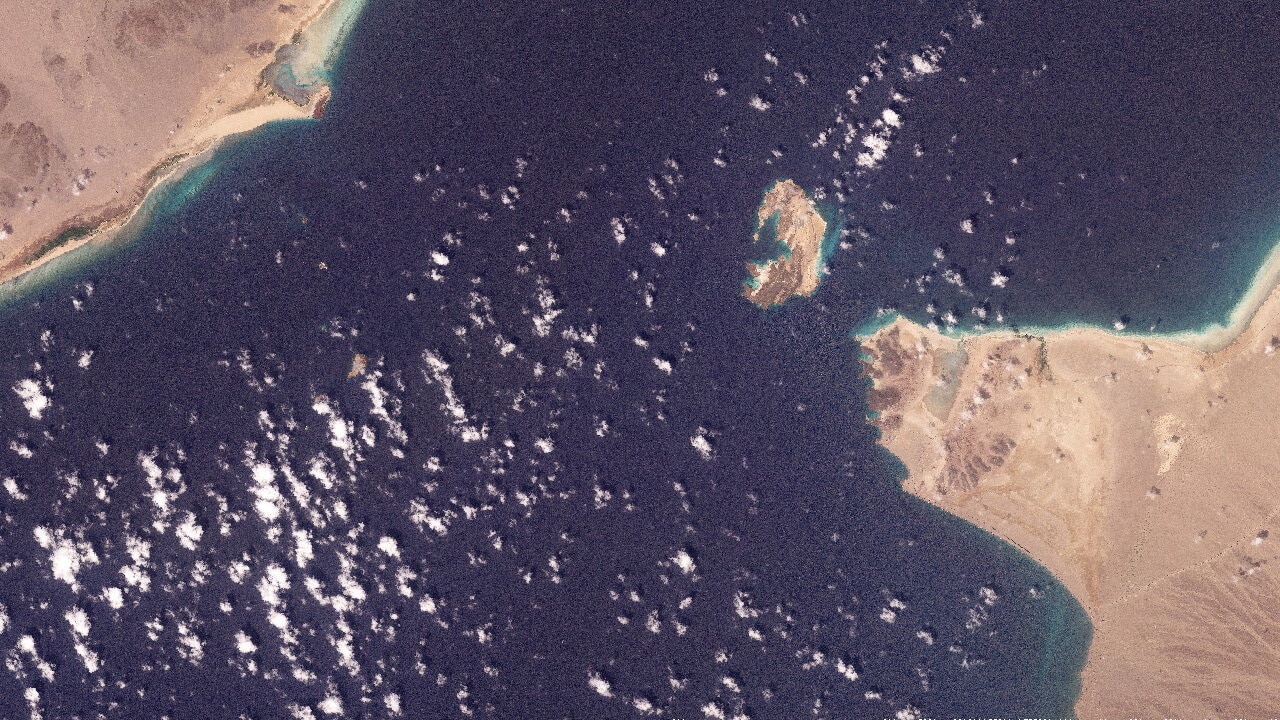
Data pinch-point … the Bab al-Mandab Strait. Image: Reuters
- Attacks on undersea data cables show the vulnerability of current digital infrastructure.
- With AI rapidly expanding global data flows, pinch points like the Red Sea strait carrying vital cables can cause serious economic disruption.
- Governments should continue planning for alternative, land-based infrastructure that gives added capacity and resilience.
When several undersea cables were severed in the Red Sea in early 2024 – initially attributed to accidental damage but later suspected to be connected to Houthi attacks on shipping off Yemen – the impact was felt almost instantly. Latency between Europe, Asia and Africa spiked overnight. Cloud services slowed. Financial transactions faltered. Hundreds of companies and millions of users experienced disruptions without ever knowing why.
For data centres and markets, the impact was immediate. For governments, it should have been a wake-up call. This incident was only one of the suspected sabotage attacks on undersea cables, with at least 11 in the Baltic Sea between 2023 and 2024 and multiple incidents in the waters around Taiwan in 2025. Not to mention the dozens of accidents occurring from fishing and unintentional anchor damage to the nearly 600 worldwide undersea cables.
Those outages exposed a vulnerability most people, including many policy-makers, still tend to underestimate. For example, around 17% of all global internet traffic, and more than 90% of data flows between Europe and Asia, pass through the narrow, politically volatile Red Sea strait of Bab al-Mandab. In this 14-mile-wide corridor, more than a dozen undersea cable systems run side by side. When even one of them is damaged, the effects ripple from Mumbai to Frankfurt in minutes.
The lessons from the Red Sea in 2024 should have been clear, but inertia set in. More important than the cause was the aftermath as repairs dragged on for months when insurers withdrew coverage and naval restrictions kept repair vessels out of the area. In March and again in September 2025, additional cuts hit the PEACE, IMEWE and FALCON cables in the Red Sea, once more choking cloud connectivity and financial-market traffic from London to Dubai.
Each incident drove home some uncomfortable truths. The digital backbone relied upon by today’s world is increasingly vulnerable and repeatedly targeted. At the same time, the architecture is facing enormous pressure for the scale, speed and resilience the AI era now demands. While redundancy (backup systems and paths) in undersea cables and a limited alternative in satellite data transmission moderates the harm, it is unlikely that these alone can handle the vastly increasing need for intercontinental data transmission.
AI’s Achilles heel
AI is transforming economies at breakneck speed. Yet the physical infrastructure that carries its data, whether beneath our seas or through satellites, is inadequate for this need. Undersea cables are indispensable and scalable, but they cannot meet the demands of AI workloads because of capacity and vulnerability. Satellites and other alternatives provide a very low level of redundancy, but face even harder limits on capacity, latency and cost. Anticipated AI workloads will soon overload the existing infrastructure. As AI systems demand exponentially larger data volumes, ultra-low latency and near-perfect uptime, every transmission pathway comes under pressure.
The implications go far beyond connectivity. In the age of AI, data transmission is no longer a narrow technical concern. It has become a core economic, security and resilience issue. Concentrated routes and single point of failure architecture create structural risk. Fragile chokepoints invite disruption, whether accidental or deliberate. The cost of failure now reaches across entire economies. The weakest links now carry global consequences.
What has gone largely unnoticed are opportunities for alternative, land-based routes, which can provide greater redundancy, capacity and resilience for AI-scale traffic. In Iraq, for example, at iQ Group we have built a 4,500-kilometre primarily terrestrial fibre corridor linking Europe via Iraq to the Persian Gulf. With the deployment of secondary routes, including extensions via the Turkish and Syrian borders, the Silk Route Transit Network offers the first operational, high-capacity, AI-ready route that entirely bypasses the Red Sea.
The Silk Route Transit is currently operational, and what makes this corridor particularly significant is not just its geography, but its technology. To handle the scale of data traffic demanded by AI, networks like this must enable secure, stable real-time rerouting, predictive fault management and a global standard of redundancy across multiple paths ideally within the network itself. These safeguards are essential for AI to reach its full potential and are designed to prevent cascading failures like those in the Red Sea. Globally, only a handful of fibre networks meet these standards and can support the strategic urgency of diversifying critical digital arteries.
The ‘second Suez’
Iraq’s corridor is part of a wider global race to build a “second Suez” for data – that is, alternative pathways that carry Europe-Asia traffic without relying on Egypt’s chokepoint. Google and Telecom Italia’s Sparkle are backing the Blue-Raman system, combining subsea routes from India to Oman and Saudi Arabia with overland transit through Jordan and Israel to Italy. Cinturion’s TEAS corridor links India to Greece via Saudi Arabia and Jordan. In Saudi Arabia, stc and center3 are pushing multiple westward systems aligned with Vision 2030. Further north, the Caspian Digital Silk Way aims to connect Central Asia to Europe via the Caucasus.
What sets Iraq’s route apart is that it is already live, fully terrestrial and operational; a working example rather than a concept on a map. But the true lesson for the evolving AI economy is that redundancy matters as much as speed or capacity. Multiple, diverse routes must be part of every AI infrastructure strategy and low-latency, conflict-resistant land paths are possible. Routes that cannot be anchored, mined or blockaded at sea, nor dependent upon limited satellite capacity. While certainly not invincible, terrestrial routes share the same characteristics and acceptable vulnerabilities as oil pipelines.
How the Forum helps leaders make sense of AI and collaborate on responsible innovation
The Red Sea outages were not an anomaly. They were a preview. There are additional and alternative methods for data transmission such as terrestrial routing of data to mitigate risk, provide redundancy and add needed capacity for the AI revolution. The question is whether the world, guided by those of us who have spent decades shaping digital infrastructure, will act before the next cut turns a warning into a crisis.
Don't miss any update on this topic
Create a free account and access your personalized content collection with our latest publications and analyses.
License and Republishing
World Economic Forum articles may be republished in accordance with the Creative Commons Attribution-NonCommercial-NoDerivatives 4.0 International Public License, and in accordance with our Terms of Use.
The views expressed in this article are those of the author alone and not the World Economic Forum.
Stay up to date:
Cybersecurity
Related topics:


Forum Stories newsletter
Bringing you weekly curated insights and analysis on the global issues that matter.
More on Artificial IntelligenceSee all

Tal Goldstein and Giulia Moschetta
March 31, 2026


