5 ways to grow a business mindset in international development
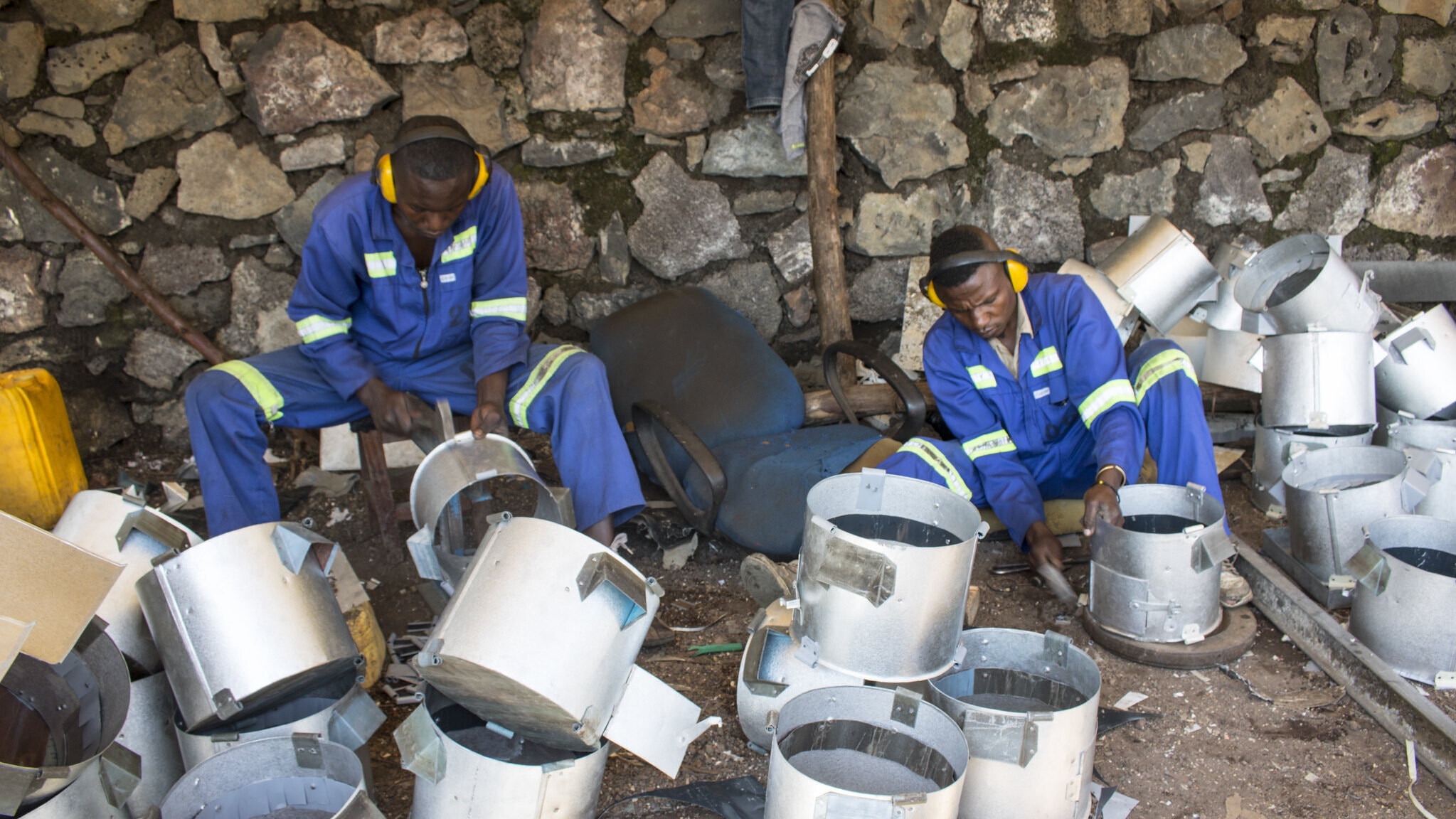
Congolese workers fashion tin stoves funded by international development funding. Image: WCS, WWF, WRI/Molly Bergen
James Purcell
Deputy Head International Organisations and the Humanitarian Agenda, World Economic Forum- Far from them being opposing forces, international development currently needs the added directive focus of commercial thinking.
- Amid a crisis in global aid, the World Economic Forum's GFC on Reimagining Aid seeks to generate proposals for how international cooperation might better address global challenges.
- Many of the solutions to optimizing international development are proven principles already routinely applied in the business world.
For decades, international development and commercial interest were framed as opposing, even antagonistic forces; one driven by public good, the other by profit. That binary thinking is no longer fit for purpose. From climate finance to infrastructure, from SME growth to digital inclusion, the scale and urgency of today’s challenges demand a more pragmatic approach. There is an urgent need to harness the discipline, efficiency and accountability of business to deliver development outcomes.
The traditional aid sector is in crisis, with flows falling in the face of geopolitical turbulence and war. In this context, the World Economic Forum’s Global Future Council (GFC) on Reimagining Aid is aiming to offer a view on how this crisis moment for the sector might offer an opportunity to transform development cooperation for the better. Members of the Council see a growing consensus: We must move beyond debating why development matters and focus instead on how we deliver it effectively.
Encouragingly, many of the answers are not radical. They are practical, proven principles, applied rigorously in business, that can help reshape development for greater impact.
5 key business principles
1. Put clients and outcomes first
Development efforts often lose sight of the very people they are intended to serve. A business mindset starts by putting clients at the centre and being clear about what success looks like for them.
In development, “clients” are ultimately the smallholder farmers and entrepreneurs whose success delivers real-world outcomes, but also the communities in need of efficient, well-functioning essential services. Their needs, preferences and constraints must remain at the centre throughout the project life cycle.
Funders, whether public, philanthropic or private, are best understood not simply as donors, but as investors in outcomes. Each brings a different perspective across the impact-risk-return spectrum: Some prioritize impact, others financial sustainability, many a combination of both. What they all require, however, is a credible investment case, a clear plan for delivery, and confidence in execution.
This shift has important implications. It moves the system away from input-driven models focused on disbursement and activity towards outcome-driven approaches anchored in results. Clear milestones, measurable outcomes and continuous feedback loops are essential. If outcomes are not defined, tracked and delivered, capital – whether public or private – will not be sustained.
This is central to the work of the GFC on Reimagining Aid, which is exploring more equitable, outcome-driven models of partnership that align incentives across all actors.
2. Keep it simple, aim for scale
Complexity is the enemy of scale. Development programmes are too often over-engineered, costly and slow to implement. A key lesson from business is that a sharper focus on simplicity and driving down costs, while maximizing impact, can unlock far greater reach. This does not mean lowering ambition; it means prioritizing clarity and efficiency in execution.
A business mindset also prioritizes evidence over assumption. Rather than relying on “best guesses” of what works and what is needed, development practitioners should interrogate problems rigorously, test hypotheses and adapt based on real-time feedback from clients. Digital tools and data increasingly make it possible to monitor progress continuously and course-correct where needed.
Crucially, systems must align incentives with outcomes. Too often, development frameworks reward spending and compliance rather than results. A more effective approach ties financing and accountability to performance through milestone-based delivery, transparent reporting and consequences for underperformance. Development actors can learn from the discipline of execution shown by businesses.
3. Do smarter risk allocation for greater capital mobilization
If development is to be delivered at scale, significantly more capital must be mobilized. This requires a shift in how risk is understood and managed.
Traditionally, development finance has focused on risk mitigation, often relying on public or concessional finance to absorb or offset all types of risk. In a context where the pool of development finance is falling, we can no longer afford to use this resource inefficiently. A more effective model is risk distribution. This means allocating risks to those best equipped to manage them, including private sector actors who can price and bear risk appropriately.
At the same time, clearer financial pathways are needed to support growth. One of the most persistent challenges in emerging markets is the disconnect between equity and debt financing. Entrepreneurs can often access early-stage capital, but struggle to transition to the larger-scale debt required to grow. Bridging this “equity-debt handshake” is essential to support businesses across their life cycle and unlock sustainable development outcomes.
4. Use partnerships to unlock integration
Development efforts are highly fragmented. Project preparation, financing and implementation are often disconnected, creating inefficiencies and delays. A more integrated, end-to-end value-chain approach bringing together the right expertise early and aligning stakeholders around delivery can significantly improve outcomes.
Governments play a decisive role in enabling this. Stable policy frameworks, regulatory clarity and effective public-private dialogue provide the “air cover” needed for investment and delivery. Without this enabling environment, even well-designed initiatives will struggle to scale.
At the global level, development finance is also characterized by duplication and overlap. A more coordinated, “global balance sheet” perspective that aligns institutions and capital more effectively could reduce inefficiencies and increase overall impact.
Partnerships are therefore not optional; they are foundational. But they must evolve beyond coordination towards real alignment where all actors are working towards shared outcomes, with clearly defined roles, incentives and accountability.
5. Go for incremental and disciplined progress (and impact will follow)
Transformation does not always come from grand gestures.
A useful rule of thumb is that development progress is 70% incremental improvements, 20% structural reform and 10% bold innovation. While breakthrough ideas matter, consistent, incremental change often delivers the most reliable results.
Blending best practices
The call to adopt a business mindset in development is not about commercializing aid or prioritizing profit over people. It is about bringing greater discipline, efficiency and accountability to the way we design and deliver solutions.
As the World Economic Forum’s GFC on Reimagining Aid continues to explore the future of development cooperation, one thing is clear: Blending the best of public purpose and private sector practice is no longer optional, it is essential.
Don't miss any update on this topic
Create a free account and access your personalized content collection with our latest publications and analyses.
License and Republishing
World Economic Forum articles may be republished in accordance with the Creative Commons Attribution-NonCommercial-NoDerivatives 4.0 International Public License, and in accordance with our Terms of Use.
The views expressed in this article are those of the author alone and not the World Economic Forum.
Stay up to date:
Humanitarian Action


Forum Stories newsletter
Bringing you weekly curated insights and analysis on the global issues that matter.