Why leaders must transform cyber resilience measurement

Cyber resilience should be measured upstream and in terms of mitigation and preparedness. Image: Shamin Haky/Unsplash
Humberto Luiz Ribeiro da Silva
Head, Center for Cyber Incident Prevention, Ciberlab, University of Brasilia- Recovery capabilities after an incident are no longer sufficient on their own to measure an organization’s cyber resilience.
- Increasingly sophisticated cybercrime and inherited third-party risk are driving leaders to rethink how they govern cyber risk.
- Cyber resilience should now be measured further upstream, in terms of preparedness and early mitigation, as well as recovery.
As cyber resilience gains greater prominence in board-level and C-level discussions worldwide, leaders increasingly recognize cyber risk as a core business, operational and governance issue.
However, cyber resilience has traditionally been measured mainly at the point of recovery: how quickly systems can be restored, how effectively crisis teams can respond, and how well organizations can contain damage after an incident.
While those capabilities matter, in a world of artificial intelligence (AI)-enabled attacks, expanding digital dependencies and rising third-party exposure, leaders need a broader approach.
Cyber resilience should now be measured further upstream: first as a capacity for risk mitigation and preparedness – the ability to reduce the probability, scale and business impact of disruption before damage occurs – and only then as a capacity for recovery when prevention falls short.
Cyber incidents a costly reality for organizations
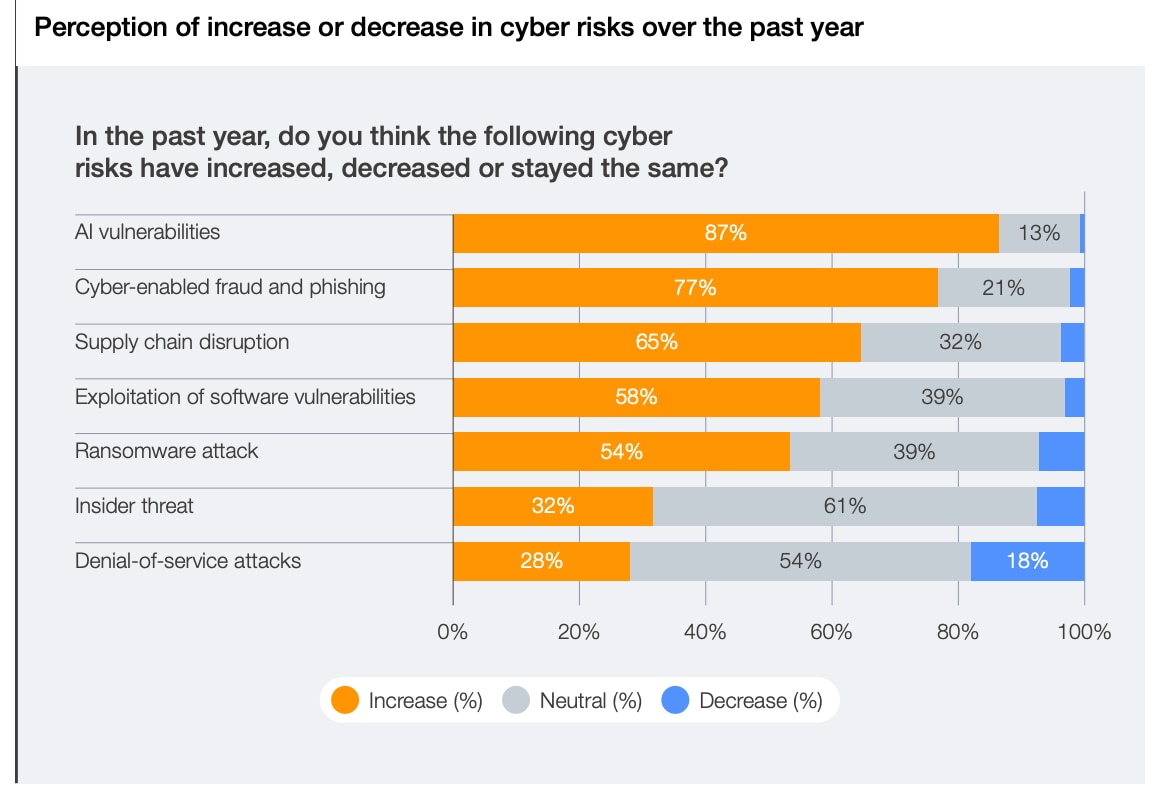
That shift towards focusing on preparedness and risk mitigation is increasingly urgent because cyber incidents are now a daily reality for organizations of all sizes worldwide. The World Economic Forum’s Global Cybersecurity Outlook 2026 describes exactly this kind of fast-moving environment, shaped by AI-driven risk, geopolitical fragmentation and widening cyber inequity.
As recovery is usually far more costly than preparation, there’s also strong economic argument to changing this mindset. IBM’s 2025 Cost of a Data Breach Report found that the global average cost of a breach was $4.4 million, while faster identification and containment were key drivers of lower losses.
Organizations using AI and automation extensively shortened breach lifecycles by 80 days and reduced average breach costs by $1.9 million, the report added. Public cases make the asymmetry even clearer: Maersk estimated the NotPetya attack cost the company $200-300 million in business interruption and recovery.
How measurement of cyber resilience must evolve
The lesson for leaders is straightforward: resilience is not only about surviving shocks, but about reducing the need for costly recovery in the first place. That is why cyber measurement now needs to evolve through four interconnected shifts.
A shift from static to dynamic
Occasional questionnaires and point-in-time reviews are no longer enough for digital environments shaped daily by new architectures, suppliers, software updates, AI deployments and exposed identities.
Modern resilience measurement should function as a continuous monitoring discipline, not merely as a periodic audit. The UK’s National Cyber Security Centre offers a useful example through its Active Cyber Defence programme, which provides ongoing services and automated checks to reduce harm from commodity attacks at scale.
The broader principle is simple: measurement must keep pace, in real time, with the environment it is meant to protect.
A shift from declarative to observable
As cyber risk becomes more complex and fast-moving, cyber resilience cannot rely only on interviews, self-assessments or policy documents; it also needs observable evidence that systems, controls, processes and teams are working effectively in practice.
Leaders and cyber teams increasingly rely on external intelligence to strengthen preparedness before incidents unfold. That means externally assessing internet-facing vulnerabilities, unintended exposures and signs of emerging threats for earlier warning.
The timing advantage matters: obtaining outside-in risk intelligence before internal tools detect signs of compromise can give defenders a chance to act before a threat reaches the perimeter.
Observability is not about waiting for an internal alert to confirm damage, but about using external results – from vulnerability scanning to leak-site and dark web monitoring – to identify where the organization may already be vulnerable, exposed or being targeted, in order to act before compromise becomes disruption.
A shift from compliance to actionable
Compliance remains useful, especially in regulated sectors. But compliance scores alone do not protect the organization. Good measurement findings trigger better management decisions such as which vulnerabilities to fix first, which suppliers require escalation and which assets should be taken out of exposure.
Established incident-response guides and frameworks make this prioritization logic explicit: governing, identifying and protecting are not separate from response and recovery; they help prevent incidents, reduce their impact and improve incident management over time. Measurement has real value only when it informs prioritization, investment and remediation.
A shift from individual to systemic
Many organizations still assess cyber resilience as if risk stopped at their own perimeter, despite growing evidence that resilience depends on coordination, information-sharing and visibility across the wider ecosystem.
A 2025 Verizon report analysed 22,052 real-world security incidents and found third-party involvement in 30% of breaches, roughly double the previous year. That means resilience measurement must occur internally, but also extend across vendors, service providers, software dependencies, exposed credentials and leaked digital assets circulating outside formal boundaries.
SWIFT’s Customer Security Programme is a practical example, combining mandatory controls and attestation to strengthen trust in the financial ecosystem rather than leaving each participant to manage risk in isolation.
Information sharing and analysis centres, or ISACs, offer another practical model, enabling organizations in the same sector to share intelligence and strengthen collective cyber resilience. In interconnected economies, resilience must be measured and managed where disruption can propagate.
Frameworks to support consistent cyber measurement
Organizations can rely on mature frameworks and standards to support consistent measurement across all four shifts. For example, NIST CSF 2.0 provides a practical structure for governing, identifying, protecting, detecting, responding to and recovering from cyber risk. MITRE ATT&CK adds a knowledge base to help organizations map defenses against real-world adversary behavior. Together, these and other frameworks offer a common language across boards, security teams, suppliers and regulators.
Leading organizations are already shifting. Cyber resilience is no longer measured only by what happens after an incident, but by whether organizations are strengthening preparedness, reducing exposure, translating findings into action and addressing the systemic nature of digital risk.
In practice, four questions matter: Are we measuring dynamically? Are we observing operational effectiveness rather than declarations? Are our findings generating action? And does our monitoring extend beyond our perimeter to the broader ecosystem we depend on?
In 2026, organizations and governments that answer yes will be better positioned to prevent disruption, protect trust, reduce direct and indirect damage and accelerate digital innovation with greater confidence.
How the Forum helps leaders understand cyber risk and strengthen digital resilience
Don't miss any update on this topic
Create a free account and access your personalized content collection with our latest publications and analyses.
License and Republishing
World Economic Forum articles may be republished in accordance with the Creative Commons Attribution-NonCommercial-NoDerivatives 4.0 International Public License, and in accordance with our Terms of Use.
The views expressed in this article are those of the author alone and not the World Economic Forum.
Stay up to date:
Cybersecurity


Forum Stories newsletter
Bringing you weekly curated insights and analysis on the global issues that matter.
More on CybersecuritySee all

Tal Goldstein and Giulia Moschetta
March 31, 2026