Why Medellín’s best investment is its people
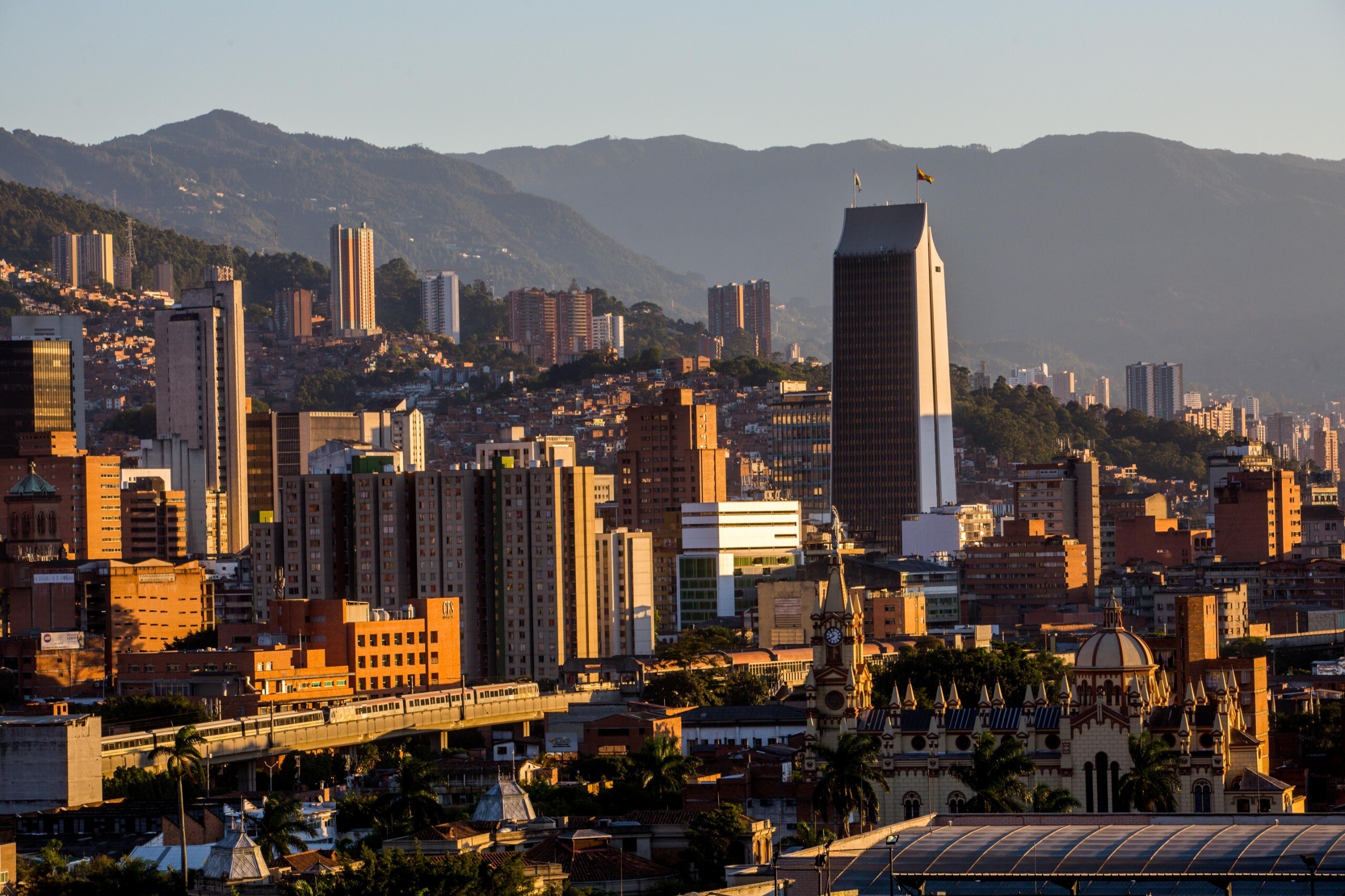
Medellín is focused on an important question: whether its citizens actually experience progress in their daily lives. Image: Medellín's Mayor's Office/Alcaldía de Medellín
- Medellín is prioritizing direct citizen well-being over traditional metrics to restore public trust and social cohesion.
- Targeted educational outreach and skills training have successfully reduced dropout rates and lowered regional unemployment.
- Transparent investment in underserved neighbourhoods fosters a virtuous cycle of civic pride and voluntary tax contributions.
Across the world, the gap between governments and the people they serve is widening. Cities are growing, modernizing and transforming faster than ever, yet trust is eroding, tax evasion is rising and public spaces are emptying. Most cities ask how to do more. But the real question is: for whom?
Medellín – Colombia's second-largest city – is testing a different approach. Rather than defining success by metrics alone, the city has focused on something harder to measure and easier to overlook: whether its citizens actually experience progress in their daily lives. When a city organizes its priorities around this principle, the relationship between government and citizens begins to change. People re-engage. They contribute. They begin to trust again.
What follows is not a blueprint; it is an ongoing experiment — and an honest account of what happens when a city decides to measure its success not by what it builds, but by who it reaches.
Starting with what matters most
Truly putting people first means ensuring no one is left outside systems that create opportunity. Education, employment and skills development are essential foundations. Still, most cities measure progress by student enrolment, not by asking a harder question: what happens to those who leave?
UNESCO reports that 251 million children and youth worldwide are out of school, a figure that has barely changed in a decade. When Medellín saw a 5.4% dropout rate, it created En el Colegio Contamos con Vos, a programme based on a simple idea: if students don't come to school, the city must go to them. Using geolocation to find dropouts, teams went door to door, matching young people with nearby schools. The approach combined direct outreach, early warning systems to detect at-risk students, school meals, transport support and flexible learning for those who had fallen behind.
Dropout rates fell to 2.4% and about 6,000 young people returned to school. This result was not from one programme, but from making education the city’s largest recent investment ($324 million), expanding into skills training that matches a changing economy, including digital literacy, data skills, English and emerging fields shaping the future of work.
When access to relevant skills expands, opportunity follows. Medellín now holds Colombia's lowest unemployment rate at 6.7%, at a time when youth unemployment remains one of the most pressing challenges across Latin America. Over 50,000 residents have participated in income-generation programmes and 136 neighbourhood-level job fairs have brought formal employment directly to underserved communities.
When people have access to tools to build better lives, they make use of them, and when an entire city commits to making that possible, the impact is not measured in programmes delivered; it is measured in futures that would not have existed otherwise.
When trust becomes measurable
When a city invests in its people consistently, in their education, their employment, their daily experience of public life, something begins to shift in the other direction. Citizens start investing back. Not because they are asked to, or because enforcement tightens, but because they feel that contributing is worthwhile. That reciprocity between a city and its people is one of the clearest signs that something fundamental is working.
In Medellín, that shift is visible in what citizens are choosing to do with their own resources. In 2025, a voluntary tax regularization programme saw 37,900 citizens settle their outstanding debts within three months, exceeding the original target by 407%. No penalties, no enforcement campaigns, just an open door and the decision, made freely, that it was worth walking through. Industry and commerce tax revenues grew by 20%, surpassing 900 billion Colombian pesos ($252 million), while property tax collection exceeded projections by more than 10%.
According to the annual Medellín Cómo Vamos survey, civic pride reached 91% in 2025, the highest level in recent years.
But reciprocity does not emerge on its own. In Medellín's experience, it followed a specific sequence: public resources managed with transparency and austerity, invested where gaps were widest, and delivered in ways citizens could see and experience in their own neighbourhoods, a new school, a recovered park, a job fair on their block.
Trust grew not from a communications strategy, but from an accumulation of visible, verifiable decisions. That sequence is replicable. Any city that manages to close the gap between what it collects and what citizens experience in return has the conditions to trigger the same cycle, and gain something far more valuable than revenue: legitimacy.
Infrastructure with intention
Every city builds. The real question is where and for whom. Many cities focus infrastructure on commercial districts and high-return areas, while neglected communities wait the longest. Medellín has tried to reverse this: directing resources first to historically underserved neighbourhoods.
Over 1,800 public works are currently underway across the city, with 13 million square metres of public space recovered. Primavera Norte, one of the city's most ambitious urban development projects, is extending green space and community infrastructure into the northern zone, which has historically been among the most underserved. These are not showcase projects. They are deliberate decisions about who gets access to a better city first.
The principle behind this is straightforward and replicable: use the data on where gaps are deepest to guide where investment goes. Prioritize the areas that have waited longest. And design every project, a school, a park, a public space, around the question of whose daily life it will change. This does not require an exceptional budget. It requires an intentional one.
A bet worth making
Medellín's experience is not a finished model. It is an ongoing test of whether a city can sustain a virtuous cycle: invest in people, earn their trust, and channel that trust into the next generation of opportunities. The early evidence suggests it can, but only if the commitment evolves alongside the economy itself.
That evolution is already underway. Ruta N, the city's innovation and business hub, has become the anchor of a growing ecosystem that connects entrepreneurs, researchers and public investment around knowledge-based economic development.
As the host of C4IR Medellín, the only Centre in the World Economic Forum’s global network located in Latin America, the city is also working to ensure that emerging technologies translate into opportunities and solutions for the challenges its citizens face every day. The ambition is not innovation for its own sake, but innovation shaped by the same question that has guided everything else: who benefits?
The question for any city is not whether it can afford to make this bet. It is whether it can afford not to.
Don't miss any update on this topic
Create a free account and access your personalized content collection with our latest publications and analyses.
License and Republishing
World Economic Forum articles may be republished in accordance with the Creative Commons Attribution-NonCommercial-NoDerivatives 4.0 International Public License, and in accordance with our Terms of Use.
The views expressed in this article are those of the author alone and not the World Economic Forum.
Stay up to date:
Civic Participation


Forum Stories newsletter
Bringing you weekly curated insights and analysis on the global issues that matter.