How rethinking purpose in later life can drive healthy longevity

Initiatives in Latin America and the Caribbean are exploring ways to promote healthy longevity among the region's growing population of older people. Image: Getty Images/skynesher
- A sense of purpose can be a primary driver of healthy longevity, addressing both physical and mental health issues, according to research.
- Today, 166 million people over 50 live in Latin America and the Caribbean (LAC), representing 25% of the region's total population.
- New initiatives are helping older people across the LAC region build healthy longevity through training, employment and entrepreneurship opportunities.
By 2038, Latin America and the Caribbean (LAC) will reach a demographic point of no return. For the first time in history, the number of people over 60 will equal the number of children under 14. This demographic represents a triumph of human progress: more people are living longer. But it also masks a deepening crisis in the form of the morbidity gap – the span of years a person lives with chronic illness or disability.
People experiencing a higher life expectancy may not necessarily be living well. On average, one-fifth of a person’s additional life expectancy is lived with morbidity, according to the World Economic Forum's Longevity Economy Principles report. These years are often marked by chronic illness, financial hardship and social isolation.
In a region where 52% of people report lacking sufficient savings to last through retirement, the traditional model of passive ageing is no longer viable. In LAC, the ability to remain active and purposeful is not a luxury but a health and economic necessity.
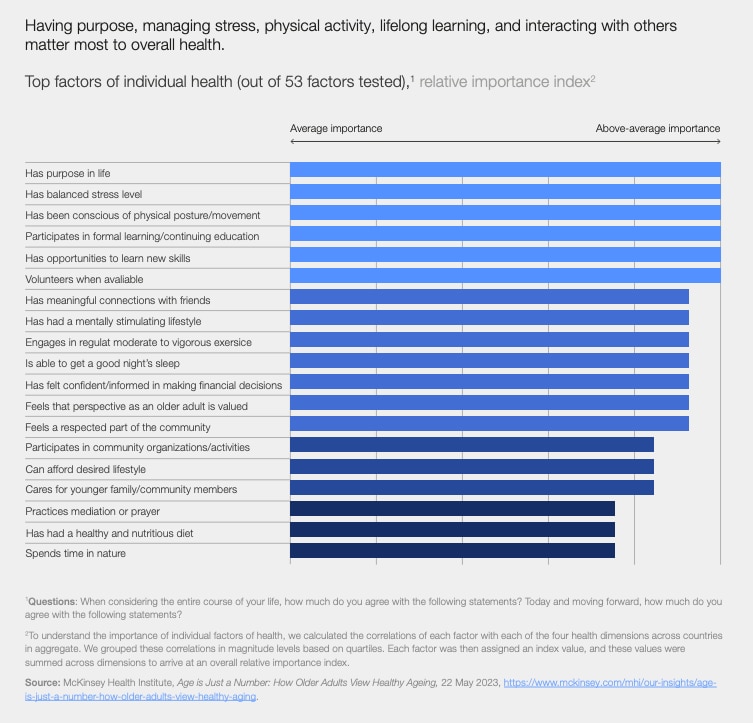
But what if one of the most powerful levers for healthier ageing is not medical, but existential? A growing body of research indicates that a sense of purpose is a primary driver of healthy longevity. High levels of purpose are associated with maintenance of walking speed and grip strength equivalent to being 2.5 years younger.
Beyond physical frailty, purpose can also serve as a critical buffer against the region's mental health challenges. A "reason for living" is associated with a 31% lower risk of functional disability and a 36% lower risk of developing dementia. This is vital for LAC, where dementia prevalence is projected to soar, rising from 8.5% today to over 19% by 2050.
By treating purpose as a health priority, the region can help to mitigate the financial pressures of long-term care.
4 ways to create purpose and build longevity
Purpose is not something one "finds" in a single moment of epiphany, it is a skill to be cultivated through intentional design. And harnessing its potential means shifting the narrative from "consumption" to "contribution".
Purpose-driven healthy longevity rests on four pillars:
1. Foster pro-social missions over passive leisure
Community initiatives must pivot from passive engagement to generative activities. Gathering for a shared cause creates a significantly higher sense of wellbeing than gathering for leisure. When older adults feel their presence is necessary for a group to achieve a specific outcome, social isolation diminishes and systemic value is created.
2. Prioritize values-driven employment
With many older adults needing to work longer due to financial gaps, jobs must evolve for a multigenerational workforce. Meaning is found in "self-concordance" – when daily tasks align with intrinsic values. Organizations that offer flexible, values-driven roles for older talent tap into a reservoir of experience while improving the employee’s health outcomes.
3. Connect with the next generation
A core predictor of purpose in later life is "generativity", or a commitment to nurturing the next generation. Programmes like reverse mentoring allow older adults to transfer knowledge while upskilling from younger peers. But it is not enough to bring generations together in the same room, they must have a shared goal and the skills needed to foster intergenerational connections.
4. (Re)build the confidence to start again
One of the greatest barriers in to healthy longevity is not capability, but psychological inertia. Starting again can feel inaccessible and distant. Ensuring an older adult has the motivation, as well as the tools and resources, to transition to a new stage of life is crucial. Interventions could include entrepreneurship frameworks, digital literacy training, portfolio career design and guided spaces to reinvent themselves.
Lessons on longevity from Latin America
Across the LAC region and beyond, emerging initiatives are helping to build purpose and support healthy longevity by helping people to find and start second careers.
Ecosistema Plateado, for example, demonstrates how purpose can be designed into second careers. Led by the Entrepreneurship and Innovation Center at Universidad del Pacífico in Peru, in partnership with IDB Lab, the initiative has supported 239 adults over 50 through its Emprende 50+ programme.
Nearly half (49%) of these people joined with an existing business idea and developed it further, while 12% identified a need during the programme and built a business from scratch. This has translated into real economic activity, with 15 ventures securing early-stage funding through national programmes so far.
And Ecosistema Plateado’s impact extends nationwide. The initiative has trained nine regional incubators, engaged more than 1,400 people in workshops and activated intergenerational innovation through programmes like Hackatón Plateada, where 81 young participants co-created solutions with older people.
This model embeds purpose as a starting point, treating it as something that can be intentionally designed for the next stage of life.
To address the practical and emotional challenges of career transitions, the Argentinian nonprofit Diagonal launched Diagui in June 2025. It's an AI-driven assistant designed to democratize professional reinvention. Grounded in Diagonal’s long-standing methodology for labour inclusion, Diagui serves as an additional support for adults over 45 navigating job searches.
Diagui has supported over 2,600 users so far, 62% of whom are women, through structured "reinvention paths". The tool promotes self-concordance by guiding users to redefine their professional profiles and align their development with intrinsic goals. Diagui also helps participants create low-friction "action plans" that integrate digital literacy, networking and CV development.
The aim of this intiative is to help people move beyond the psychological hurdles of starting again and take concrete steps toward employment.
Investing in purpose is not expensive. It is a low-cost, high-value intervention that reduces social isolation, protects cognitive health and keeps older adults as active contributors to their communities and economies.
Healthy longevity is not just about extending people’s lifespans, but extending meaning, contribution and vitality across lives. In LAC, where ageing infrastructure is still emerging, purpose may be one of the region’s most scalable and underused assets.
Don't miss any update on this topic
Create a free account and access your personalized content collection with our latest publications and analyses.
License and Republishing
World Economic Forum articles may be republished in accordance with the Creative Commons Attribution-NonCommercial-NoDerivatives 4.0 International Public License, and in accordance with our Terms of Use.
The views expressed in this article are those of the author alone and not the World Economic Forum.
Stay up to date:
Longevity Economy
Related topics:


Forum Stories newsletter
Bringing you weekly curated insights and analysis on the global issues that matter.
More on Health and Healthcare SystemsSee all

Annika Green and Gail Whiteman
March 30, 2026


