This science-based approach to water treatment could change how we view wastewater
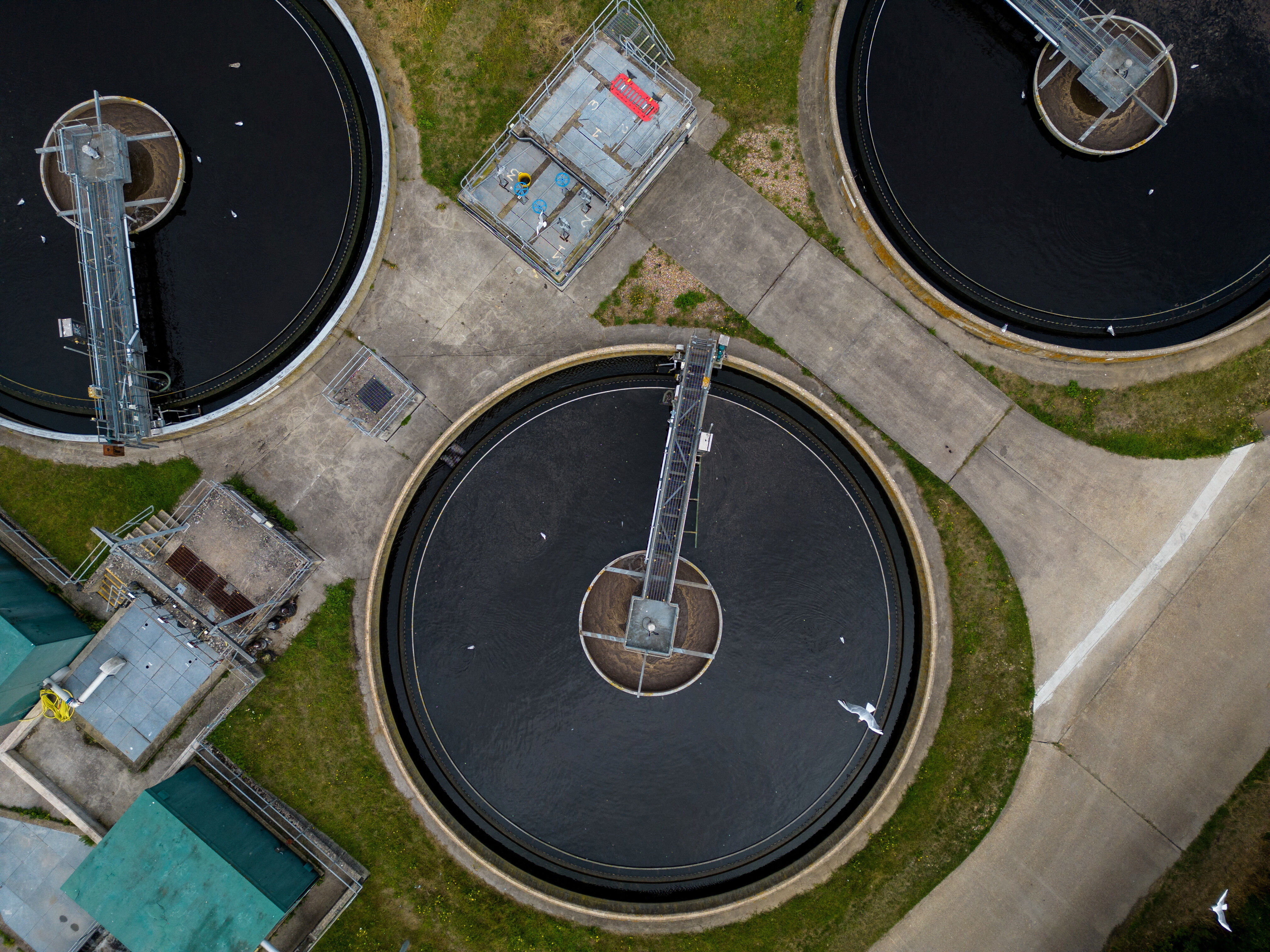
Our current approaches to wastewater often ignore the potential benefits and resources contained within it – but a new approach, harnessing microbes, could change that. Image: REUTERS/Chris J. Ratcliffe
- Each year, the world generates hundreds of billions of cubic metres of wastewater, but only about half is treated.
- Water stress, rising energy demand, fertilizer dependence and ageing infrastructure are making the current linear approach to wastewater treatment harder to justify.
- A novel scientific approach could help change that, harnessing microbes to process wastewater while recovering energy, nutrients and other resources.
Each year, the world generates about 359 billion cubic metres of wastewater – roughly enough to fill Lake Geneva four times – yet only about half is treated.
Even where treatment is in place, most systems are still designed around a linear, energy intensive model: collect wastewater, remove pollutants, discharge the effluent and bear the energy bill.
While that linear model has delivered major public and environmental health gains, it has also locked wastewater infrastructure into a costly logic that overlooks the value embedded in waste streams.
Water stress, rising energy demand, fertilizer dependence and ageing infrastructure are making a linear approach increasingly hard to justify. Against that backdrop, wastewater starts to look less like a disposal problem and more like a missed opportunity.
Three resources down the drain
Wastewater carries three resource streams that are usually managed separately: energy, nutrients and water itself.
The organic matter in a year’s worth of global wastewater contains more than 800,000 gigawatt-hours of chemical energy – roughly one-fifth the total annual electricity production of the US – which is released as the material is broken down.
Wastewater also contains large quantities of nitrogen and phosphorus, two nutrients that modern agriculture depends on and that are often produced through energy-intensive or finite supply chains.
Then there is the water itself: after treatment, reclaimed water can be reused for irrigation, landscaping, industrial cooling, groundwater recharge and, with further polishing, even potable applications.
A new question now emerges: how much value can wastewater treatment recover from streams long managed mainly for disposal? The shift from disposal to recovery could reshape how wastewater systems are designed and financed.
How microbes recover value
In our recent Frontiers in Science article, we examine one emerging approach to recovering energy and materials from wastewater: microbial electrochemical technologies (METs). METs use electrochemically active microorganisms that transfer electrons to electrodes as they break down organic material in wastewater, allowing the energy released during decomposition to be captured and put to work.
Depending on the configuration, METs can generate electricity, produce hydrogen or methane when a storable fuel is more valuable than direct power or recover nutrients important for crop production.
METs sit at the intersection of circular infrastructure, water resilience, industrial efficiency and resource security. Their significance lies in turning wastewater treatment into a more multifunctional system.
Integration is the best near-term goal
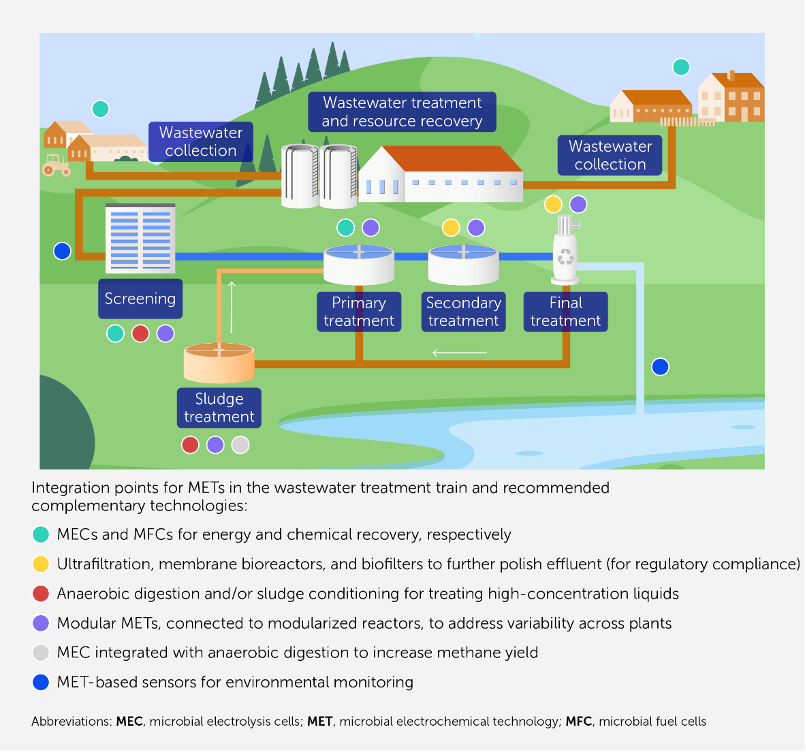
Operators are rarely deciding between a fully conventional treatment plant and a fully experimental one. More often, they are trying to solve specific pressure points: high-strength industrial wastewater, rising energy costs, nutrient removal requirements, off-grid sanitation or gaps in monitoring.
Microbial fuel cells are unlikely to become major electricity generators at utility scale, making METs far more compelling in the near term as targeted improvements to existing treatment systems rather than stand-alone replacements.
METs fit best where wastewater is still relatively concentrated, such as early in treatment trains or in side-streams linked to sludge handling and anaerobic digestion. In those positions, they can recover some of the energy or nutrients in the stream, reducing the load on downstream processes and improving the overall circularity of wastewater management.
Promising use cases
METs’ strongest early opportunities are emerging in situations where conventional treatment is costly, hard to extend or poorly suited to local needs – especially concentrated industrial wastewater, decentralized sanitation settings and monitoring or recovery applications. Among the most promising examples are:
- Agricultural and food-processing waste streams, where concentrated wastewater makes recovery more attractive and treatment costs harder to ignore.
- Decentralized sanitation systems like those that have powered toilet lighting at Glastonbury and in field trials in Uganda, Kenya and South Africa.
- Hydroponic systems that combine wastewater treatment, nutrient recovery and plant growth in the same setup.
- Self-powered biosensors that use microbial electrical signals to track water quality or treatment performance.
The challenge of scaling up wastewater resource recovery
Transitioning from the lab to real wastewater remains a major technical hurdle.
Performance often drops once systems begin handling variable, contaminated and unpredictable streams. Reactors that work well at small scale can become less efficient and more expensive to run continuously, as internal resistance rises and components such as electrodes and separators foul over time.
Progress therefore depends on materials and reactor designs that can deliver durable performance under real operating conditions.
Institutional barriers may be harder still.
Wastewater systems are governed by regulations, procurement rules, depreciation cycles and performance metrics built for a linear model focused on pollutant removal, not a system that creates secondary value streams.
In many countries, recovered products still fall into legal grey zones. Urine-derived fertilizer, for example, may face restrictions that complicate large-scale use even when the chemistry is sound.
Financing creates similar friction. Utilities and funders are more likely to back familiar treatment equipment because its costs and benefits are well established, whereas the value of recovered resources is often harder to quantify in project appraisals.
A more circular wastewater economy will require more than technical validation. It will depend on regulatory frameworks, metrics and business models designed for recovery, not only pollutant removal.
From compliance to circularity
Wastewater treatment has long been defined by what must be removed from the stream before release. A more ambitious model asks what can be recovered – and how that recovery might strengthen sanitation systems, reduce energy demand, lower fertilizer dependence and create more resilient infrastructure.
This shift matters, especially in a world where around 3.4 billion people still lack safely managed sanitation, primarily in places where extending conventional treatment remains difficult.
METs offer a new logic for wastewater infrastructure. Progress is likely to be gradual, but these technologies could still change how cities, utilities and industries think about wastewater itself – not as a burden to manage, but as an overlooked asset stream hiding in plain sight.
Don't miss any update on this topic
Create a free account and access your personalized content collection with our latest publications and analyses.
License and Republishing
World Economic Forum articles may be republished in accordance with the Creative Commons Attribution-NonCommercial-NoDerivatives 4.0 International Public License, and in accordance with our Terms of Use.
The views expressed in this article are those of the author alone and not the World Economic Forum.
Stay up to date:
Sanitation


Forum Stories newsletter
Bringing you weekly curated insights and analysis on the global issues that matter.
More on Food, Water and Clean AirSee all

Naoko Tochibayashi
September 15, 2026


