Why economic growth hides a massive loss of value
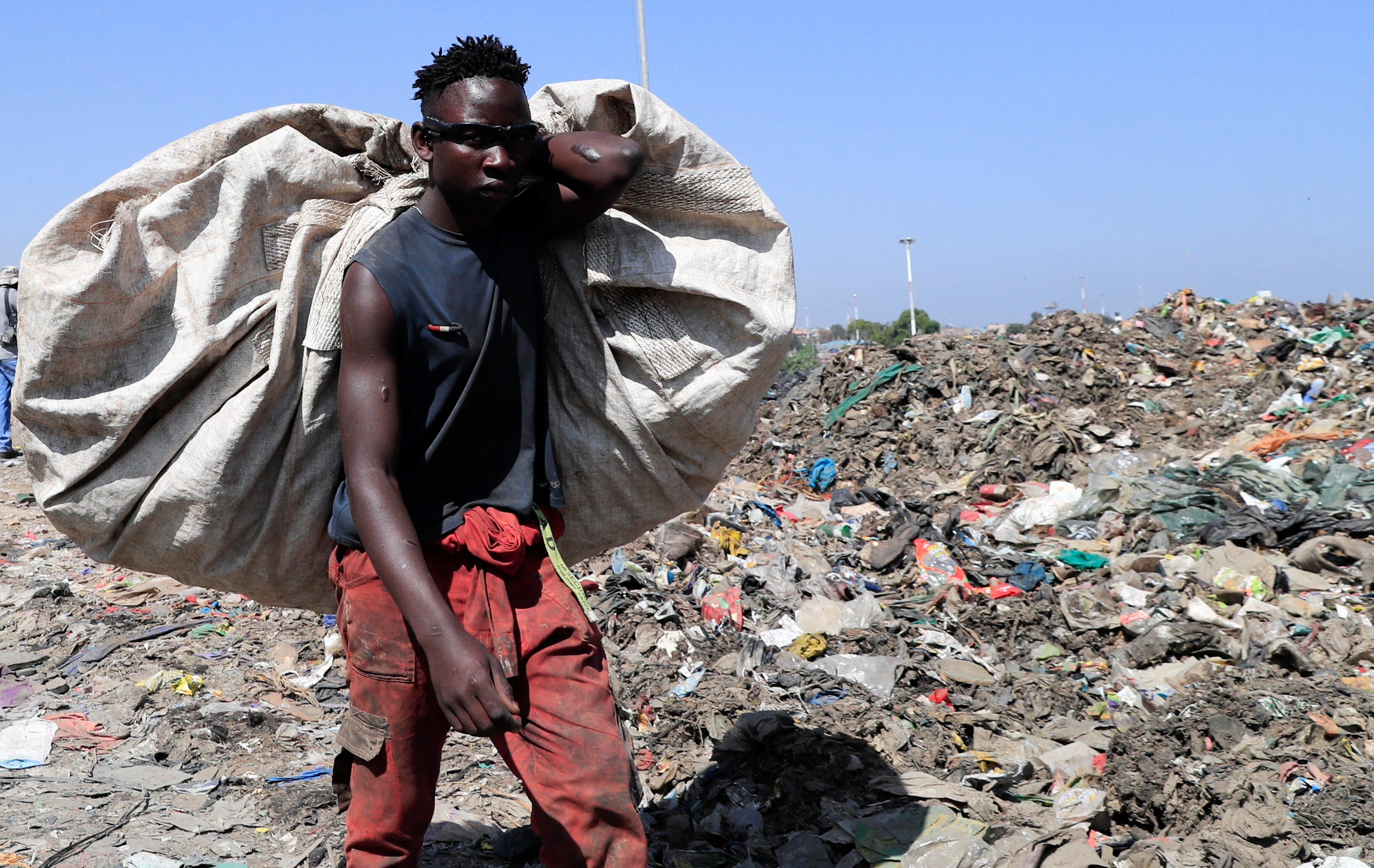
For true economic growth we should prioritize losing less over producing more Image: REUTERS/Thomas Mukoya
- Gross domestic product measures economic activity but not if that activity creates lasting value – a “blind spot” in which resource depletion, pollution, infrastructure decay and inefficient use of materials are ignored.
- The world loses an estimated €25.4 trillion annually due to inefficient resource use and premature disposal, including food waste, energy inefficiency, underused buildings and in-built obsolescence.
- A circular economy could unlock major economic benefits if economies prioritize “losing less” above “producing more,” while adopting broader measures of success such as wellbeing and long-term value preservation.
The global economy prides itself on efficiency. Yet every day, billions of euros of value quietly disappear. Food spoils within supply chains as household grocery costs rise. Meanwhile, electronics with built-in obsolescence force consumers to buy new ones rather than get them repaired.
Buildings and infrastructure also deteriorate due to a lack of maintenance and clothing is too often worn only briefly before being thrown away and exported as waste to countries with inadequate infrastructure to process it. These losses can go unnoticed but their consequences are significant.
Beyond the immediate economic waste of materials and embedded resources, they also carry hidden environmental and social costs – from pollution and resource depletion to unequal access to essential goods – while undermining the resilience of the critical ecosystems that underpin the global economy.
Together, these are symptoms of a deeper structural problem: an economic model that systematically undervalues resources, underutilises physical capital assets and incentivises premature disposal.
The scale of this inefficiency is striking. According to the newly published Circularity Gap Report 2026, the global economy loses an estimated €25.4 trillion in value each year due to inefficient use of materials and resources.
Thus, for every €3 of value created, €1 is lost to linear practices. Yet none of this loss appears in the world’s most influential economic metric: gross domestic product (GDP).
What is the blind spot in economic measurement?
GDP was designed to measure economic activity: the total value of goods and services produced within a given period. However, it was never intended to measure whether that activity creates lasting value.
In practice, GDP has become the de facto proxy for economic success, creating a profound blind spot. GDP captures flows of value but ignores the condition of the underlying natural resources, infrastructure and materials that enable those flows.
It does not account for resource depletion, waste generation or the deterioration of physical and natural capital. Nor does it capture how efficiently materials are used across the economy.
The result is a metric that treats fundamentally different activities as equivalent. Spending €100 cleaning up an oil spill contributes just as much to GDP as €100 invested in education or preventive healthcare. Both increase economic output but only one contributes to long-term value.
As a result, economic growth can coexist with rising inefficiency and loss. Resources are depleted, materials are wasted and infrastructure deteriorates, all while GDP ticks upward. This is the gap conventional economics fails to capture and it is precisely what the “value gap,” introduced in the Circularity Gap Report 2026, seeks to reveal.
The hidden costs of a linear economy
Value is lost across the economy in ways that are often visible, yet rarely quantified. Consider food. Roughly one-third of all food produced globally is lost or wasted, according to the United Nations Environment Programme. Given the vast resources required for food production, wasted food also means wasted land, water, energy and labour.
Energy use is another major source of hidden value loss. The global energy system is remarkably inefficient: nearly two-thirds of all primary energy is lost before it delivers any useful service, whether through heat dissipation or conversion inefficiencies.
Most of this loss is driven by the inefficiency of fossil fuels. Industrial plants discard large amounts of energy as heat, while internal combustion engines convert only a fraction of the fuel's energy into motion.
The built environment tells a similar story. Buildings are frequently underused, poorly maintained or demolished well before the end of their technical life, even as many cities face housing shortages. In the European Union, for example, 33% of people live in under-occupied homes, meaning the homes are considered too large for their households.
In all of these examples, value is lost through a combination of inefficient design, underutilization, premature obsolescence and the failure to account for environmental and social costs.
In physical terms, vast amounts of materials move through the system quickly but much of the economic value embedded in them is never fully realized, a defining feature of a linear economy.
Circularity as an economic opportunity
Addressing this imbalance calls for a shift in how value is created and preserved across the economy and therefore, how we define and measure value in the first place. This is where the concept of a circular economy becomes economically relevant as it provides a new systems framework.
At its core, circularity is about retaining value, designing materials, products and assets to stay in use for longer and ensuring they maintain their highest possible value over time. This goes far beyond recycling.
While recycling recovers raw materials, it often captures only a small fraction of the value embedded in products. Higher-value strategies (such as repair, refurbishment, remanufacturing and reuse) preserve materials and the labour, energy and resources embedded in them.
More fundamentally, a circular economy challenges the assumption that value creation depends on ever-increasing material throughput. Instead, it focuses on using resources more intelligently: extending product lifetimes, improving utilisation rates and designing systems that minimize waste from the outset.
As circular economy thinkers have argued, the real opportunity lies in managing resources more effectively from the outset. Seen in this light, closing the value gap can unlock substantial economic opportunity.
Rethinking economic success
GDP will remain a useful measure of economic activity. However, it is not fit for purpose as a guide to socioeconomic performance in a world facing growing resource constraints and stressed ecological limits.
What ultimately matters is not only how much stuff the economy produces but also how effectively it provides for people by converting resources into lasting value and social well-being. Emerging approaches point the way forward.
Rather than moving “beyond GDP” in isolation, there is growing recognition that we need to move beyond the System of National Accounts itself towards integrated frameworks that capture wellbeing and sustainability alongside economic output.
These approaches aim to account for the stocks and flows of economic, social and environmental systems, offering a more complete picture of how value is created, distributed and maintained over time.
Within this broader shift, a critical distinction comes into focus: economies can generate high levels of economic output while dissipating substantial welfare value. Such systems are not efficient; they are wasteful.
As pressures on natural resources intensify and the costs of environmental degradation become harder to ignore, measuring how much value is lost as well as how much is produced becomes essential to obtain a more accurate picture of economic performance.
The central economic question of the coming decades may not be how to produce more but how to lose less. Measuring the value gap is a first step towards answering that question and towards closing what may be the world’s largest and most overlooked economic leak.
Don't miss any update on this topic
Create a free account and access your personalized content collection with our latest publications and analyses.
License and Republishing
World Economic Forum articles may be republished in accordance with the Creative Commons Attribution-NonCommercial-NoDerivatives 4.0 International Public License, and in accordance with our Terms of Use.
The views expressed in this article are those of the author alone and not the World Economic Forum.
Stay up to date:
Economic Growth


Forum Stories newsletter
Bringing you weekly curated insights and analysis on the global issues that matter.
More on Circular EconomySee all

François Bonnici, Maria Inés Martin and Adam Gavin
September 29, 2026


