The rise of 'judgement work' in the age of AI – and other trends in jobs and skills this month

The adoption of AI tools in the workplace means human judgement is more important than ever. Image: Unsplash/Aerps.com
- This regular roundup brings you essential news and updates on the labour market from the World Economic Forum’s Centre for the New Economy and Society.
- Top stories: How the adoption of AI is making human judgement a more valuable skill; the latest unemployment data from the US and Canada; and India's emergency credit guarantee programme.
As AI tools spread through workplaces, they are changing not just how many jobs there are, but what skills command a premium.
Machines are getting better at pattern-spotting and prediction, what remains scarce and valuable is human judgement – the ability to weigh trade-offs, navigate ambiguity and decide what “good” looks like in context.
But there is a paradox at the centre of this transition: the same technologies that increase the value of judgement may also erode the pathways through which people develop it. As organizations automate routine and entry-level work, fewer workers may get the slow, practical experience that historically built expertise in the first place.
The rise of judgement work
Economists, including Ajay Agrawal writing for the IMF, often describe AI as a “prediction technology”: systems that forecast likely outcomes based on patterns in data. What AI cannot do is decide which outcomes matter and how to interpret them in light of goals and values – that requires judgement. As prediction gets cheaper and more accurate, this distinctly human capability becomes more important.
This division is already reshaping the structure of work. Many jobs are being 'unbundled' into tasks that can be automated and those that are inherently judgement-based. Routine, rule-based work is increasingly handled by software, while people are asked to do more interpretive and interpersonal work.
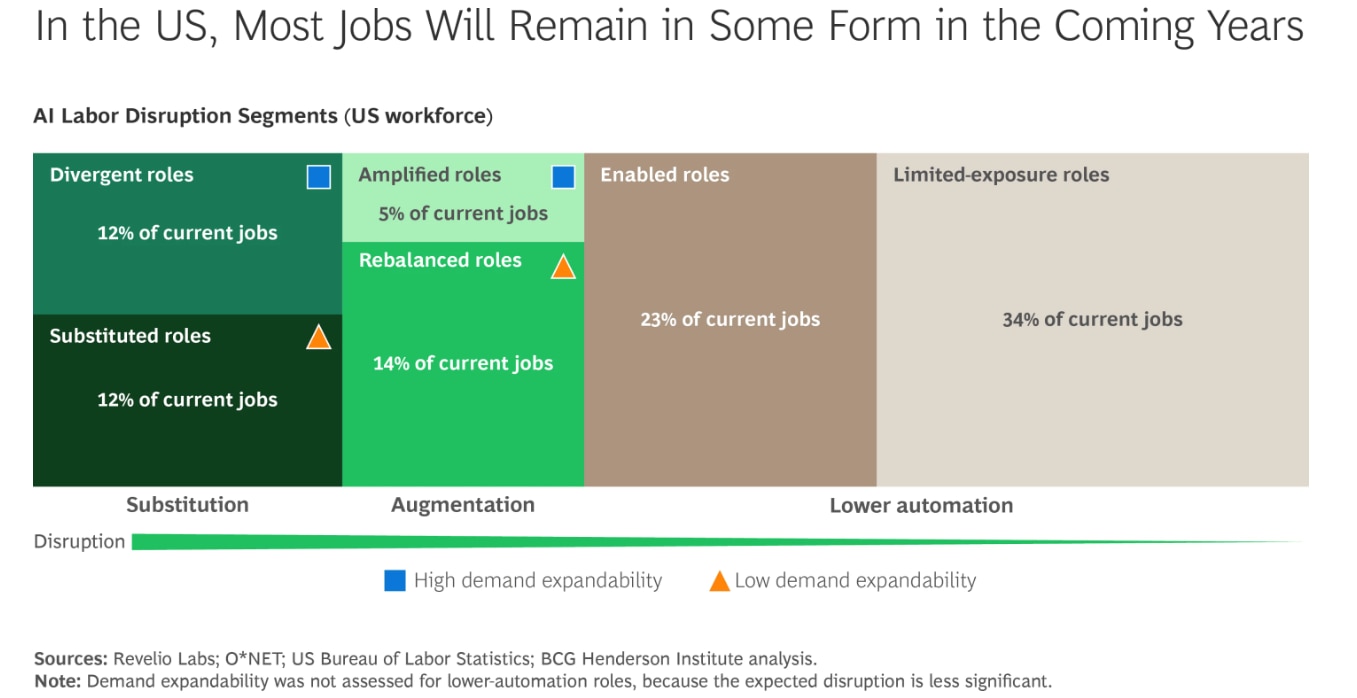
Early labour‑market evidence supports this picture. AI is unlikely to replace most roles outright, it is reshaping the task mix of a large share of jobs, especially in knowledge work and services. BCG reports that between 50 to 55% of jobs in the US will be reshaped by AI in the coming two to three years.
How the judgement premium deepens divides
The very dynamic that makes judgement more valuable can also deepen inequality. Roles that are hardest to automate – those involving complex judgement, creativity and social influence – tend to be held by people with higher levels of education and experience. If AI amplifies their productivity and bargaining power more than that of others, the gains from the technology may accrue disproportionately to those already at the top of the labour market.
Early evidence signals the risk. Experiments where AI is used to support tasks like writing, coding or decision analysis often find that higher-skilled workers benefit more because they know how to frame prompts, interpret outputs and integrate them into existing expertise. In those cases, AI doesn’t level the playing field; it steepens it.
Frictions emerge earlier in the career ladder as well. AI appears to be shifting entry-level work away from routine and administrative tasks, which traditionally provided on‑the‑job learning. The shift can create opportunities for learning and progression but raises the question as to how early-career workers can best develop deep expertise. As Carl Benedikt Frey warns, “if firms respond to AI by hiring fewer junior lawyers and analysts, training less, and assuming the machine will handle the first draft, they erode the very expertise needed to check the machine’s output. The organization will look leaner until the hidden error surfaces in public.”
Why AI adoption must go beyond efficiency
In many workplaces today, AI is being layered onto existing workflows, often with a primary motivation to improve efficiency. And while companies can deploy new AI tools quickly, redesigning jobs, training systems and career pathways around them is often a slower process.
Managing the gap between technology adoption and organizational adaptation is critical, not least because AI changes our relationship to thinking with potential for far-reaching consequences.
Some economists warn that over-reliance on machine-generated analysis could weaken the process of knowledge formation, particularly for younger workers who may have fewer opportunities to do the slow, effortful work that builds independent judgement. Over time, that could make the pool of people able to do high-quality judgement work even smaller, precisely when that capability is becoming more valuable.
The challenge ahead is not simply managing technological disruption; it is redesigning institutions and work in ways that preserve the development of human judgement itself. This requires much more deliberate thought about how capability is cultivated, transmitted and sustained across generations of workers.
More labour news in brief
US employers added more jobs than expected in April, while the unemployment rate held at 4.3%, . The data support expectations the Federal Reserve will keep interest rates unchanged for longer as solid hiring offsets concerns over the impact of recent economic shocks.
Canada’s unemployment rate rose to 6.9% in April, a six‑month high, as the economy unexpectedly shed 17,700 jobs, driven by a sharp fall in full-time positions. Analysts had forecast job gains and a steady rate. Wage growth slowed slightly, while labour force participation ticked higher.
India’s cabinet approved a new emergency credit guarantee programme worth 181 billion rupees ($1.9 billion) to support businesses hit by higher borrowing costs and global uncertainty. The scheme aims to ease access to bank loans, protect jobs and bolster growth ahead of the next financial year.
Germany’s economy grew 0.3% in the first quarter, beating expectations despite higher energy costs linked to the war in Iran. Household and government spending, plus stronger exports, drove the expansion, though unemployment edged above 3 million and earlier quarterly growth was revised slightly lower.
Women now hold 19% of senior roles at central and commercial banks globally, up slightly from last year, according to OMFIF’s Gender Balance Index. The study finds progress in female leadership continues despite political backlash in parts of the US against workplace diversity initiatives.
License and Republishing
World Economic Forum articles may be republished in accordance with the Creative Commons Attribution-NonCommercial-NoDerivatives 4.0 International Public License, and in accordance with our Terms of Use.
The views expressed in this article are those of the author alone and not the World Economic Forum.

Forum Stories newsletter
Bringing you weekly curated insights and analysis on the global issues that matter.
More on Jobs and the Future of WorkSee all

Gustavo Maia
October 2, 2026


