Systems change happens when diverse actors shift their relationships and behaviours to solve complex shared problems.
Real progress requires aligning individual leadership with organizational incentives and broader systemic conditions for lasting impact.
Sustainable transformation depends on building trust-based environments that allow partners to learn and adapt together.
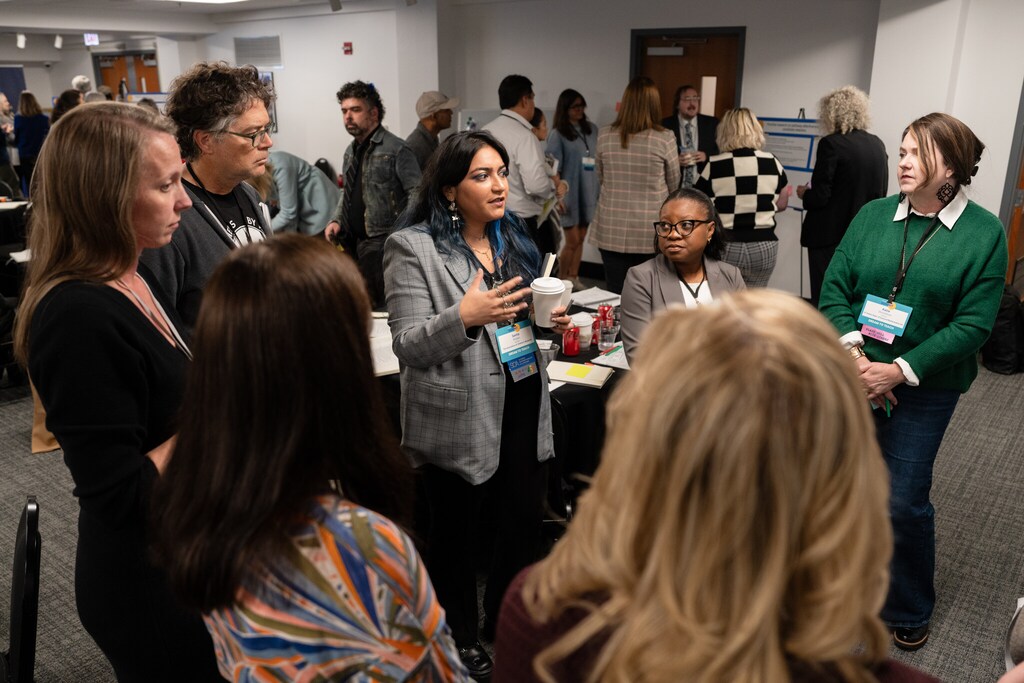
Two years into building 100Kin10 — the network of organizations that prepared 150,000 excellent STEM teachers in a decade and now called Beyond100K — we gathered our partners in Chicago and asked them, straight up: “Will it work?”
No single organization could solve the STEM teacher shortage in the US on their own, so success depended on whether all partners showed up and made this still-fledgling effort their own. Whether they followed up on the connections they had made, adapted new approaches, shared their learning and did more than they otherwise would have. For any of that to happen, they needed to trust us and each other.
“Will it work?” People don’t get asked that question often, especially not at conferences run by the organization asking it. Conferences are for networking, maybe for showing off a solution you designed or research you conducted. But they’re rarely for actually doing work together. The room hushed. One person later described it as a “punk rock” moment. (He meant it as a compliment.)
Why systems change means working together
That moment crystallized something essential about systems change: you can’t get there alone. Systems change does not happen because a single organization has the right solution. It happens when relationships strengthen, incentives change and conditions within a system begin to shift, so people can act differently because the system around them makes a different way of relating possible.
We are all embedded in systems, defined not just by institutions, but by patterns of behaviour, flows of information and underlying power dynamics. When those conditions encourage competition or zero-sum thinking, even the best collective interventions struggle to take hold. But when they are designed to intentionally foster collaboration, new ways of working become possible. Trust builds, people learn together, and the system itself starts to produce different results.
How do you change the conditions that shape the system?
What does that look like in practice? Beyond100K, the organization that grew out of that Chicago room, offers one answer. Facing a nationwide STEM teacher shortage, it did not simply train more teachers on its own. Instead, it worked to change the conditions shaping the system.
It brought together over 200 schools, universities, nonprofits, companies and government agencies, focusing on how they worked together, how they learned, what they prioritized and how those priorities shaped action. Beyond100K identified the root causes of the shortage and the biggest leverage points, helping partners collaborate, test new ideas and share what they learned.
For example, when Beyond100K partner EnCorps sought to expand its model of placing STEM professionals in classrooms, it used a “collaboration grant” offered by Beyond100K to visit partner programmes in Colorado and New York. That peer learning directly enabled its expansion from California to Denver and New York City, reaching teacher candidates that would otherwise not have been reached, and contributing to the shared goal of 100,000 STEM teachers.
The result was not only more teachers. It was a system that became better at training, supporting and retaining teachers over time. So far, the network has helped prepare more than 150,000 teachers and continues to build collective capacity across the field.

Broader lessons for systems change
Beyond100K’s approach reflects a key insight from Harvard Kennedy School’s Leadership for Systems Change programme: systems change requires working across three levels, the individual, the organization and the broader system.
1. At the individual level, leaders must understand that they are part of the system they are trying to change. Their decisions, assumptions and relationships shape outcomes.
2. At the organizational level, institutions translate intention into action. What they measure, fund and reward shapes behaviour.
3. And across the broader system, alignment matters. When different sectors and organizations work in ways that reinforce rather than compete with one another, the system becomes more coherent, easing the path to greater trust, learning and, ultimately, progress.
Systems change happens when these levels move together: when leaders shift how they act, organizations operate differently and the broader system shifts how it functions.
Creating trust-based conditions
Social innovation is most powerful when it enables this kind of change. The most effective innovations do not stop at delivering services; in many cases, they may not deliver services directly at all. Instead, they focus on creating the trust-based conditions for leaders to learn from each other, adapt existing solutions and develop new ones, while shifting behaviours, norms and power structures.
When leaders and organizations act as a network, not just understanding, but acting together, they can move beyond scaling a single solution to tackling root causes and reshaping how entire systems function. Research by Bridgespan found that this pattern holds true across sectors: in every successful multi-year, complex effort they studied, a backbone organization was operating in the background, quietly and effectively fueling the entire field.
Yet too often, success is defined by what can be easily quantified. Measurement and reporting requirements drive action plans, and funders drive measurement and reporting. But systems change requires focusing on what enables learning and adaptation: whether organizations are improving how they work, whether information flows more effectively, and whether actors are becoming more aligned over time, changes that are hard to see and even harder to measure. They show up in stronger relationships, clearer shared understanding and a greater ability to respond to new challenges. Rather than focusing only on reporting requirements, funders must invite their grantees to measure the system conditions and changes that truly matter.
The Schwab Foundation’s efforts to identify and connect innovators worldwide, create spaces for collaboration and learning, and equip leaders through programmes such as Leadership for Systems Change with the Harvard Kennedy School all contribute to building these conditions. This work helps leaders navigate complexity, understand power dynamics and scale innovations that drive systemic change.
An ongoing question: will it work?
So: “Will it work?” The answer was always about whether enough people would show up, trust each other and choose to act differently together in service of a goal bigger than any they could accomplish alone.
In a period defined by climate risk, inequality and fragmentation, that is still the question. Not whether we have the right solutions, but whether we are willing to build the conditions that inspire people to show up, trust each other, and act together, until the systems that uphold the status quo begin to shift under their collective force.