Improving insurability, investability and place-based resilience in an era of extreme weather events
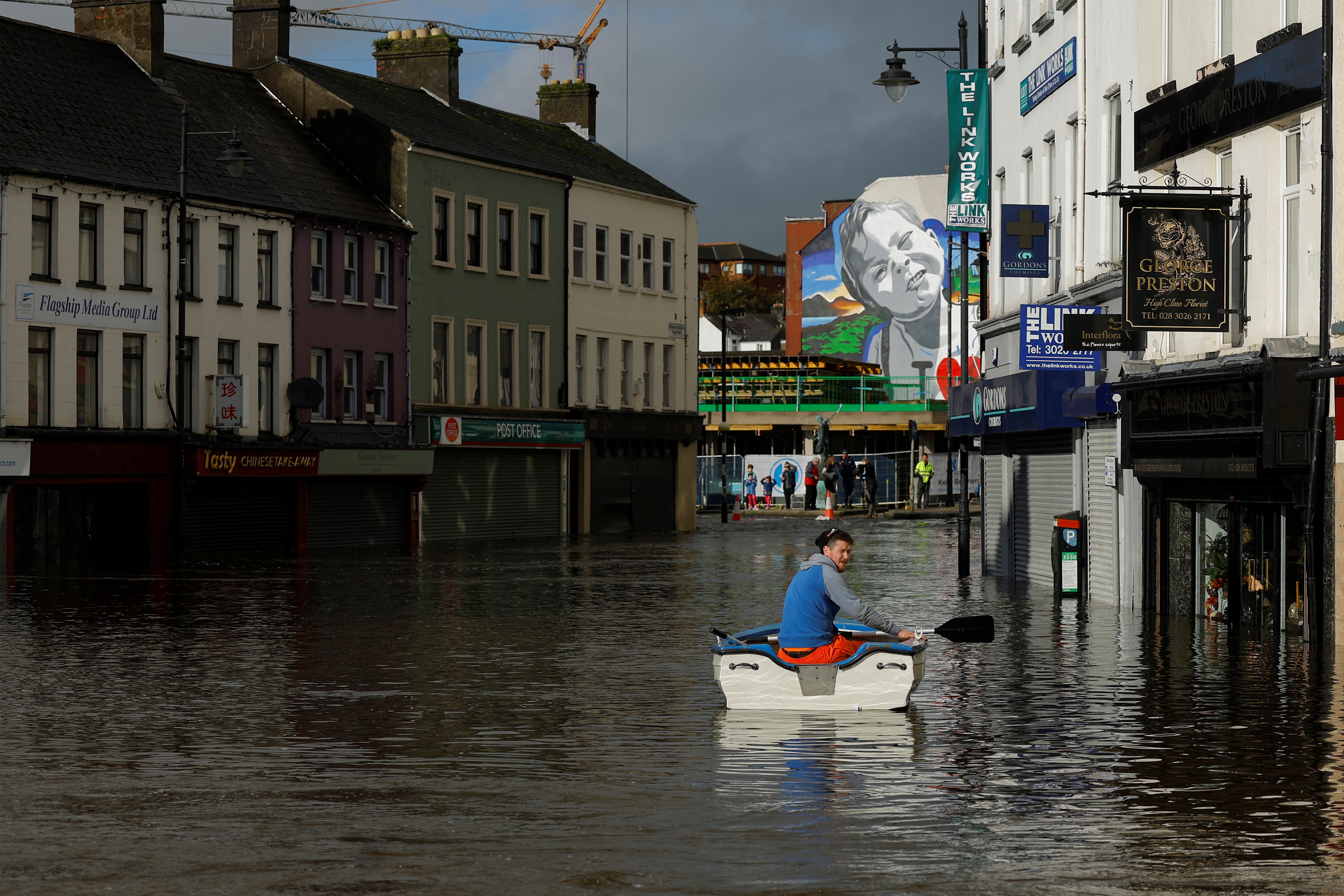
Insurability is vital to cope with extreme weather events such as flooding. Image: Reuters/Clodagh Kilcoyne
- Rising insurance costs are one of the most visible ways climate change is hitting household finances and investment decisions, driven by extreme weather events, inflation and growing exposure to risk.
- Insurability has moved to the forefront of the global agenda, against a backdrop of an increasingly complex risk landscape.
- The World Economic Forum's Insurability in a Changing World initiative aims to bring together insurers, investors, policy-makers and industry leaders to create place-based resilience models which improve insurability outcomes.
Insurability of assets is becoming an early economic signal of rising risk, driven by a range of factors including exposure concentration and increasingly frequent and severe extreme weather events.
Indeed, total insured global losses from natural catastrophe reached $145 billion in 2025 and this figure has surpassed $100 billion in every individual year since 2020.
At the World Economic Forum Annual Meeting in Davos earlier this year, insurability moved to the forefront of the global agenda. Against the backdrop of an increasingly complex risk landscape, insurers, investors, infrastructure leaders and policy-makers came together to confront a shared challenge: what happens when extreme weather risk starts becoming a certainty and disrupting traditional insurance models.
Insurability, at its core, is the ability to transfer risk at a price and on terms that are economically viable. In risk-prone areas, that ability is coming under strain. From extreme weather to rapid urban development in high-risk areas, insurability is becoming a material constraint on business decisions, investment flows and the economic resilience of places.
The World Economic Forum's Insurability in a Changing World initiative aims to tackle these challenges by bringing together insurers, investors, policy-makers and industry leaders to address this challenge head on.
Have you read?
Extreme weather driving rising insurance premiums
As extreme weather events become more frequent and severe, affordability and availability of property insurance is under strain in high-risk areas.
The residential market is flashing warning signs. In parts of the United States (US), particularly places exposed to wildfires, some communities have seen their insurance premiums rise. In the four years to 2022, homeowners living in the top 20% riskiest places paid, on average, 82% more than those in the 20% lowest climate risk areas.
Meanwhile, the commercial property market tells a more nuanced story. This is because several factors impact insurance pricing, including the insurance market cycle, which can mask weather-related trends in a softer market.
An often overlooked dimension is the place-based nature of risk. Assets do not operate in isolation, as their ‘insurability boundary’ depends on the resilience of the place around them. An individual facility may be engineered to high resilience standards, but if the storm drainage systems it depends on are inadequate or wildfire risk reduction buffers insufficient, asset-level risk reduction on its own may not be sufficient to meaningfully reduce the risk.
These dependencies can directly affect business continuity, insurance outcomes and ultimately asset valuation. Therefore, there is a need to better understand place-based dependencies and link place-based risk reduction measures with underwriting and investment outcomes.
What needs to change to address insurability challenges
Four principles need to be taken into account to address these challenges and advance new models for the insurability of physical assets.
- Better place-based data: Many insurability problems stem from poor risk visibility. While we have increasingly granular asset-level data, we need improved risk-decision data about the impact of place-based risk. Drawing on advances in geospatial analysis, local government knowledge and physical risk modelling can give all parties a clearer understanding of the risk and the benefit of interventions.
- Innovative financing mechanisms: We need innovative financing mechanisms that can incentivize investment in place-based resilience and bring in capital markets capacity to spread risks more effectively. This requires aligning incentives across actors, as who pays may not be the same as who benefits.
- Public-private partnerships: Governments have a role in creating the conditions for improved place-based resilience: this includes investing in the shared infrastructure, like energy or water assets, that businesses and homes depend on.
- Certifications and standards: When buildings meet verified resilience standards, insurers can price risk more accurately and provide explicit signals to the market – as seen in the US-based Insurance Institute for Business & Home Safety Fortified Roofs standard, most recently used as part of the world’s first ‘resilience bond’. We need similar standards when it comes to place-based resilience.
Improving insurability at scale
Two recent innovations are bringing these principles into practice and the benefits are already visible.
In early 2025, various national and local government bodies came together in the UK to pilot the Severn Valley Water Management Scheme (SVWMS), a catchment-wide flood management programme to address severe flooding.
The initiative will implement natural flood management and flood storage areas to manage the entire river catchment. With support from Marsh and Oliver Wyman, SVWMS is pursuing private investment funding channels to facilitate private sector collaboration. Benefits include reduced repair costs, insurance premiums and broader economic gains.
In Latin America and the Caribbean, the Urban Infrastructure Insurance Facility, led by Local Governments for Sustainability (ICLEI) with Marsh Risk and Guy Carpenter, embeds risk transfer into place-based resilience. This enables rapid post-disaster liquidity through city-level risk pooling and diversification of exposure, a model that helps businesses stabilize cash flow, budget more predictably for resilience investments and attract public-private investment.
This approach also demonstrates how insurers, municipalities and developers can collaborate to reduce concentrated risk and speed recovery, making infrastructure projects more bankable and resilient in the face of extreme weather.
Both examples demonstrate the same insight: capital flows are required towards interventions that improve insurability at scale – not just at the point of individual assets.
Looking ahead as climate risks intensify
As climate risks intensify, constraints on insurability will increasingly translate into constraints on capital. Assets and places that can demonstrate resilience will be better positioned to attract both investment and favourable insurance terms.
The challenge now is to move from fragmented efforts to coordinated action. This requires stronger links between insurers, investors, national and local governments and infrastructure providers, as well as a shared understanding of risk at the level where it is experienced: places, not just assets.
That is the focus of the World Economic Forum’s Insurability in a Changing World initiative. Bringing together leaders across sectors, it aims to translate place-based risk reduction into insurability, pricing and capital allocation decisions.
Don't miss any update on this topic
Create a free account and access your personalized content collection with our latest publications and analyses.
License and Republishing
World Economic Forum articles may be republished in accordance with the Creative Commons Attribution-NonCommercial-NoDerivatives 4.0 International Public License, and in accordance with our Terms of Use.
The views expressed in this article are those of the author alone and not the World Economic Forum.
Stay up to date:
Climate Indicators


Forum Stories newsletter
Bringing you weekly curated insights and analysis on the global issues that matter.