The next frontier of physical AI: Why process manufacturing needs a molecular revolution
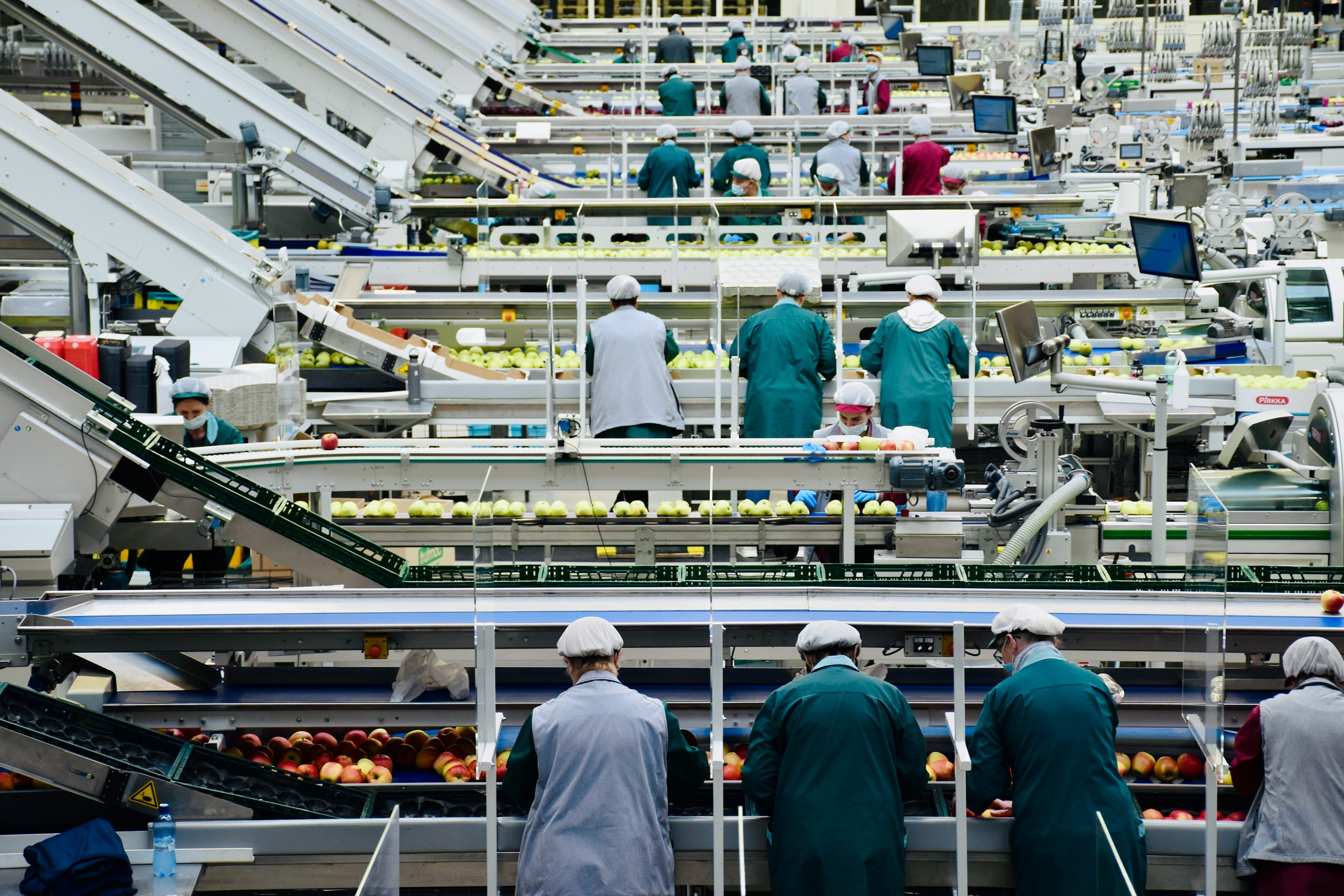
Process-aware AI is a new category of physical AI that addresses the dynamic, chemistry-driven reality of process manufacturing. Image: Arno Senoner/Unsplash
- Advanced physical artificial intelligence is shifting from mechanical spatial awareness to real-time molecular chemistry management.
- Global manufacturers are using process-aware autonomy to simultaneously reduce operational costs and meet sustainability targets.
- How promising ideas become scalable impact is a key focus at the World Economic Forum’s Annual Meeting of the New Champions, also known as Summer Davos, in China from 23–25 June.
In discrete manufacturing – the assembly of distinct, physical items like cars or smartphones – the manifestations of physical AI show up on nearly every factory floor. Pick-and-place robotics, vision-guided inspection, autonomous logistics – each represents a real-world productivity challenge solved through spatial awareness. The results are remarkable, and they are reshaping car plants, electronics facilities and packaging operations all over the world.
The challenge is that spatial awareness cannot be adapted for process manufacturing, the sector of manufacturing that brews, blends, reacts, emulsifies and flows. This type of manufacturing requires an entirely new kind of physical AI that manages products at the molecular level, in real time, across environments that are never the same twice. Industries like household goods, food and beverage, health and beauty, pharmaceuticals – this is where the next frontier of physical AI offers its most consequential gains in sustainability and productivity. But to capture these gains, manufacturing and technology leaders will need to take a fundamentally new approach.
The core difference in manufacturing ecosystems
Discrete manufacturing deals in objects – components that can be seen, measured, picked up and placed. Boston Dynamics’ Atlas humanoid robot is perhaps the most well-known expression of this: spatial awareness, informed by cameras, laser sensors and force feedback, translating into precise physical action.
Process manufacturing deals in something else entirely: products and processes in a continuous state of transformation. Fluids, chemical reactions, phase changes and flows – where a single variable out of range can compromise an entire production run, trigger a line shutdown or fail a safety audit. The industries that produce everything the world eats, drinks and cleans with change the fundamental nature of materials, and that requires a truly different kind of intelligence.
What is process-aware autonomy?
Process-aware AI or process-aware autonomy is a new category of physical AI that addresses the dynamic, chemistry-driven reality of process manufacturing. Process-aware autonomy applies to the same “sense-reason-act” framework that defines physical AI in discrete manufacturing, but is reimagined entirely for an environment where the challenge is compositional.
- Sense is the first step to gather the necessary data for further action. Where physical AI in discrete manufacturing understands physical space, in process manufacturing it uses inline measurement tools like advanced spectral sensors that understand chemistry at the molecular level. These hardware-enabled systems intake multimodal signals from the line in real-time – reading viscosity, concentration, pour rates, turbidity and fluid dynamics continuously, without interrupting production.
- The “reason” step of the framework is where AI comes into play. In discrete manufacturing, AI models reason for physical space and force, but for process manufacturing, they reason for chemistry and composition. They are trained on the specific processes of each line, product and run to understand exactly what is happening inside the pipes.
- The “act” step of the framework is where collected information turns into value with instant operational action. In discrete manufacturing, this looks like a robotic arm putting a component into place. In process manufacturing, the actions are commands to valves, new chemical doses, diversion points activated – all decisions based on real-time line conditions. Every action compounds: the perfect cycle informs the next, building towards the optimal process, line and factory over time.
Relieving industrial pressures through real-time operational efficiency
Process manufacturing is under pressure from different directions all at once. Institutional knowledge is walking out the door as experienced operators retire, raw material costs are rising, and consumer demand is forcing lines to switch faster than fixed automation was designed to handle. At the same time, companies face tighter climate commitments on a factory floor that has no operational roadmap to meet them.
Process-aware autonomy addresses these challenges head on simultaneously.
Every cycle ends the moment it should, not when a timer says so – and that single shift changes everything downstream. Recovered time unlocks capacity that has been silently lost for decades. The same precision eliminates waste and scales quality: water, chemicals and energy deployed exactly when the process needs them and stopped the moment it does not, driving costs down not through cuts but through efficiency. Also, the workforce gets better rather than smaller – operators are freed from manually watching gauges to focus on the judgement-intensive work that actually requires a human, while the institutional knowledge that once retired with the experts gets encoded in the system itself for the first time.
Most importantly, sustainability and productivity stop being a trade-off.
When a factory stops running cleaning cycles on timers and starts ending them the moment the line is actually clean, it uses less water, fewer chemicals and less energy. Not because of a sustainability initiative, but as a direct consequence of operating more efficiently. Sustainability too often loses out in the budget conversation to productivity, treated as a cost rather than a consequence. Process-aware autonomy changes that equation: the efficiency gain and the environmental gain arrive through the same action at the same time.
Proven at scale: How global manufacturing leaders deploy process-aware AI
Today, process-aware autonomy is on the factory floor at some of the world’s largest manufacturers, delivering results on a global scale. When Unilever deployed process-aware AI across its ice cream and foods factories, cleaning times fell by 20%, utility use dropped 10%, and each line saved €100,000 per year – with rollout planned to 35 additional sites across its global network. AB InBev applied process-aware AI to water monitoring across its global brewing operations, improving water use efficiency by 20% – from 3.08 hl/hl in 2017 to 2.47 hl/hl in 2024; it aims to decrease it to 2.0hl/hl by 2030.
Production deployments, running at an industrial scale, in some of the most demanding and regulated manufacturing environments in the world serve as proof that process-aware autonomy works and that the gains are immediate, measurable and compounding.
The competitive advantage: Seizing the next big opportunity in industrial tech
Physical AI and spatial awareness in discrete manufacturing is a crowded space. Billions of dollars of investment, hundreds of companies and years of development are converging on the same factory floor – the gains are real, but the territory is known. Process manufacturing is the opposite: vast, consequential and largely untouched by the AI era for one simple reason. Executing process-aware autonomy well – reasoning at the molecular level, in real time, through decades of heterogeneous factory infrastructure – is genuinely hard. That difficulty is precisely why it has resisted automation for so long, and precisely why the opportunity waiting on the other side is so large.
The hardware-AI stack now exists. The pressures demanding it have never been greater. And the manufacturers who have already made the shift are not waiting – they are reducing costs, reclaiming water and lost production time, and building operational advantages that compound with every cycle. The next blue ocean is open. The only question is who moves first, and who gets left behind.
The Forum is spotlighting how innovation moves from breakthrough to scale to impact ahead of 'Summer Davos' in China, 23–25 June 2026. Follow the latest.
Don't miss any update on this topic
Create a free account and access your personalized content collection with our latest publications and analyses.
License and Republishing
World Economic Forum articles may be republished in accordance with the Creative Commons Attribution-NonCommercial-NoDerivatives 4.0 International Public License, and in accordance with our Terms of Use.
The views expressed in this article are those of the author alone and not the World Economic Forum.
Stay up to date:
Industrial Solutions and Manufacturing


Forum Stories newsletter
Bringing you weekly curated insights and analysis on the global issues that matter.