The industrial world is running AI on the wrong clock
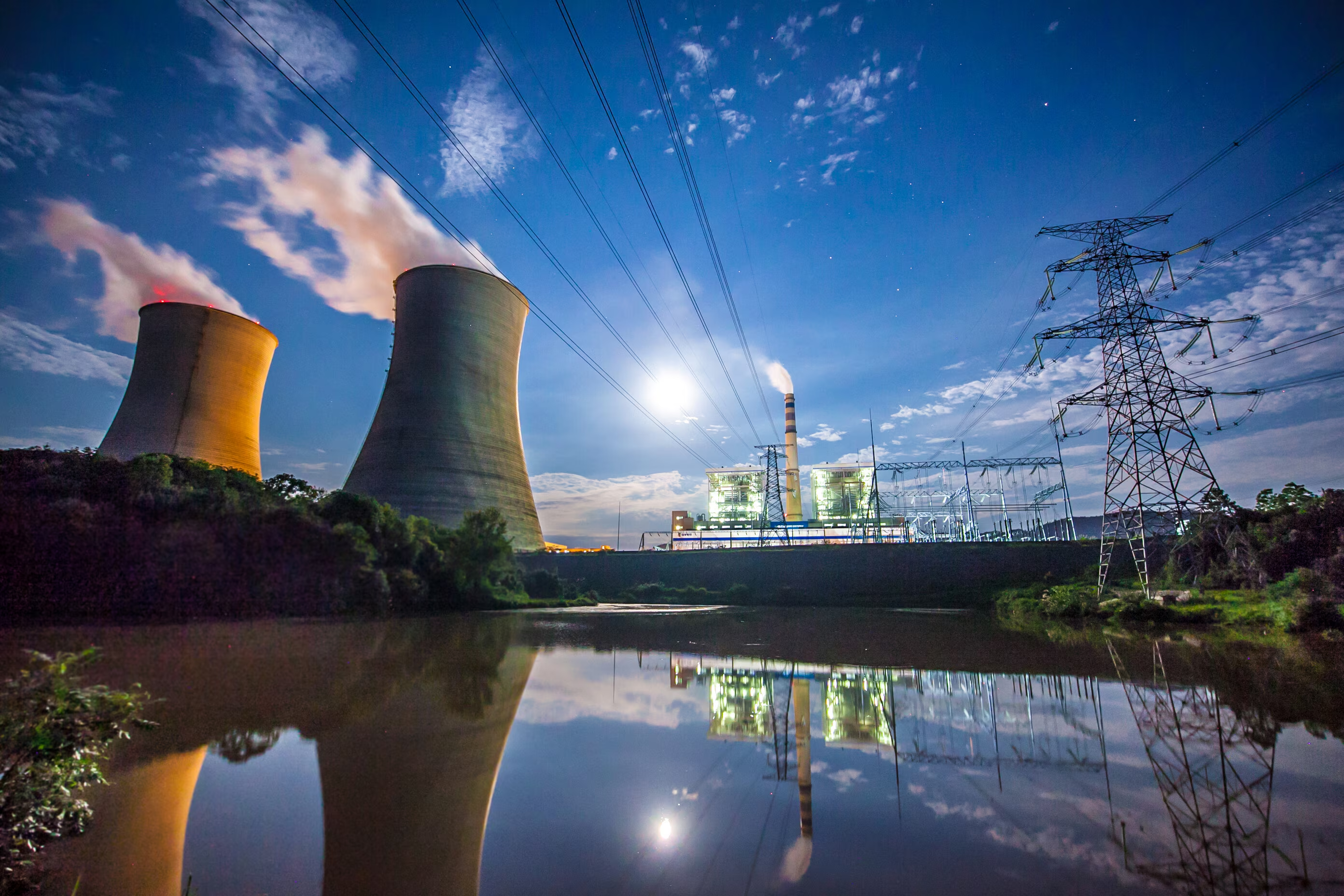
A grid designed for AI from day one is a more resilient one. Image: Getty Images/zhongguo
- Industrial assets operate for decades but AI plans focus on short multi-year budget cycles.
- Designing AI into long-life infrastructure from day one would build resilience and avoid the need for costly retrofits.
- Capturing expert domain knowledge and building multi-company ecosystems could get AI out of testing and into production.
Every plan on the table right now for scaling AI is written to a short clock. National strategies run in cycles of a few years. Corporate investment horizons stop at the end of the decade. For a model, a chip generation or a budget round, that timeframe makes sense. But it is the wrong timeframe for the assets AI is actually being asked to run.
A power plant operates for 40 years. A grid for 50. An aircraft fleet, a rail network, a water system, a port: all built to outlast the people who designed them, and all now being asked to host an AI layer that the world is planning a few years at a time. That mismatch creates a problem for industry. It is why we are calling for a new paradigm for industrial AI, one built through collective action and long-term planning at the scale these systems demand.
The compounding power of long-term planning
We are starting to see a small number of nations become aware of this gap. China’s approach to industrial AI, for example – built on long-range planning and mandated data-sharing across sectors like autonomous vehicles – has moved the country’s manufacturing and supply chain capability forward faster than almost anywhere else. That is not an argument for any single model of planning. It is evidence that planning at the right timescale, with the right level of collaboration, compounds. The lesson is directional, not political: the industries that plan furthest ahead, and share the most, tend to win.
What’s at risk here goes well beyond the technology. A grid designed for AI from day one is a more resilient grid, one that keeps a hospital running through a heatwave instead of failing it. A factory designed for AI from day one is the difference between a nation that builds its own chips, vehicles and medicines, and one that imports them. A power and transport system designed for AI from day one reaches net zero on schedule instead of arriving late and over budget, because the planning that gets it there only happens once and has to be right the first time. An industrial base that captures the expertise of its retiring workforce, instead of losing it, is one with more engineers and inventors on the books in 2050, not fewer.
From components to systems
One shift matters as much as the planning horizon itself: the move from thinking about industrial AI one asset at a time to thinking about it as a system. Energy is the clearest example. The debate has too often been framed as nuclear versus fuel cell versus renewables, as if the answer were a single technology. It never was. The real opportunity sits in how these sources work together, and how data and AI form the connective layer that makes that combination intelligent rather than incidental. The same logic applies across a factory floor, a supply chain or a grid. Individual pieces of equipment generating data in isolation are worth far less than a system that learns as a whole. Getting that right is a design choice, not an afterthought, and it belongs in the plan from day one alongside the AI layer itself.
To future-proof industrial operations against this gap, we recommend four steps that short-term thinking tends to miss:
1. Design AI into the asset, not around it
Every new plant, grid segment, fleet and network commissioned this decade should be specified with the data architecture and AI-readiness it will need across its operating life, the same way it is specified for safety and load.
This is a standard that can be set in procurement and permitting now, not a recommendation to revisit later. Retrofitting intelligence onto 50-year-old infrastructure is possible. Designing it in from day one is cheaper, safer and the only way it compounds.
2. Treat domain knowledge as critical infrastructure
The engineers, technicians and operators who know why a piece of equipment fails the way it does are retiring faster than that knowledge is being captured. A five-year plan can outlast a budget cycle. It cannot outlast a retirement wave that has already started.
Capturing operating knowledge while the people who hold it are still on the floor is a one-time window, not a recurring line item, and it deserves the same urgency as any other capital commitment made this year.
3. Govern for the full asset life, not the next review
Autonomy without long-term governance isn’t a strategy – it’s a delayed liability. Auditability, traceability and human oversight must be specified for an asset’s fourth decade as rigorously as for its first year.
4. Build the ecosystem, not just the transaction
The recent wave of announcements linking silicon to software to hardware on the factory floor is real progress, but a single deal between two companies is not, on its own, an ecosystem. The industries that will move fastest are the ones where hardware providers, data centre operators, power providers, software companies and implementation partners build lasting relationships with each other, not just point-to-point contracts.
The World Economic Forum’s Global Lighthouse Network, which has opened some of the world’s most advanced facilities to unprecedented peer learning, shows what that kind of collaboration can do at scale. Industrial AI needs the same instinct: sharing insight across competitors and partners alike, because a compressor’s maintenance data is worth more to everyone when it stops being treated as a competitive secret.
Scaling industrial AI for the long haul
None of this is a call to slow down. It is the opposite. Three-quarters of companies remain stuck in pilots, and a faster plan will not be what moves them out. The fastest way out of the pilot trap is a plan long enough that scaling once means scaling for good, instead of being redone at every planning cycle for the next half-century.
We are asking the leaders who fund, build and operate 50-year assets to plan on the timescale those assets actually require. Not instead of the work already under way on intelligent infrastructure and responsible scaling. Underneath it, at the timescale the assets themselves are built to. We know that shift doesn’t happen alone, and we’re ready to help build it.
The chatbot economy can iterate in months. The infrastructure underneath it cannot and was never meant to. The industries that get this right won’t just adopt AI faster. They’ll be the ones still standing when the hype cycle moves on. That work must start now, not at the next planning cycle.
Don't miss any update on this topic
Create a free account and access your personalized content collection with our latest publications and analyses.
License and Republishing
World Economic Forum articles may be republished in accordance with the Creative Commons Attribution-NonCommercial-NoDerivatives 4.0 International Public License, and in accordance with our Terms of Use.
The views expressed in this article are those of the author alone and not the World Economic Forum.
Stay up to date:
Industrial Solutions and Manufacturing


Forum Stories newsletter
Bringing you weekly curated insights and analysis on the global issues that matter.
More on Artificial IntelligenceSee all

Rana Dajani and Ahmad Jadallah
October 12, 2026


