What a chip in a football teaches us about governing AI
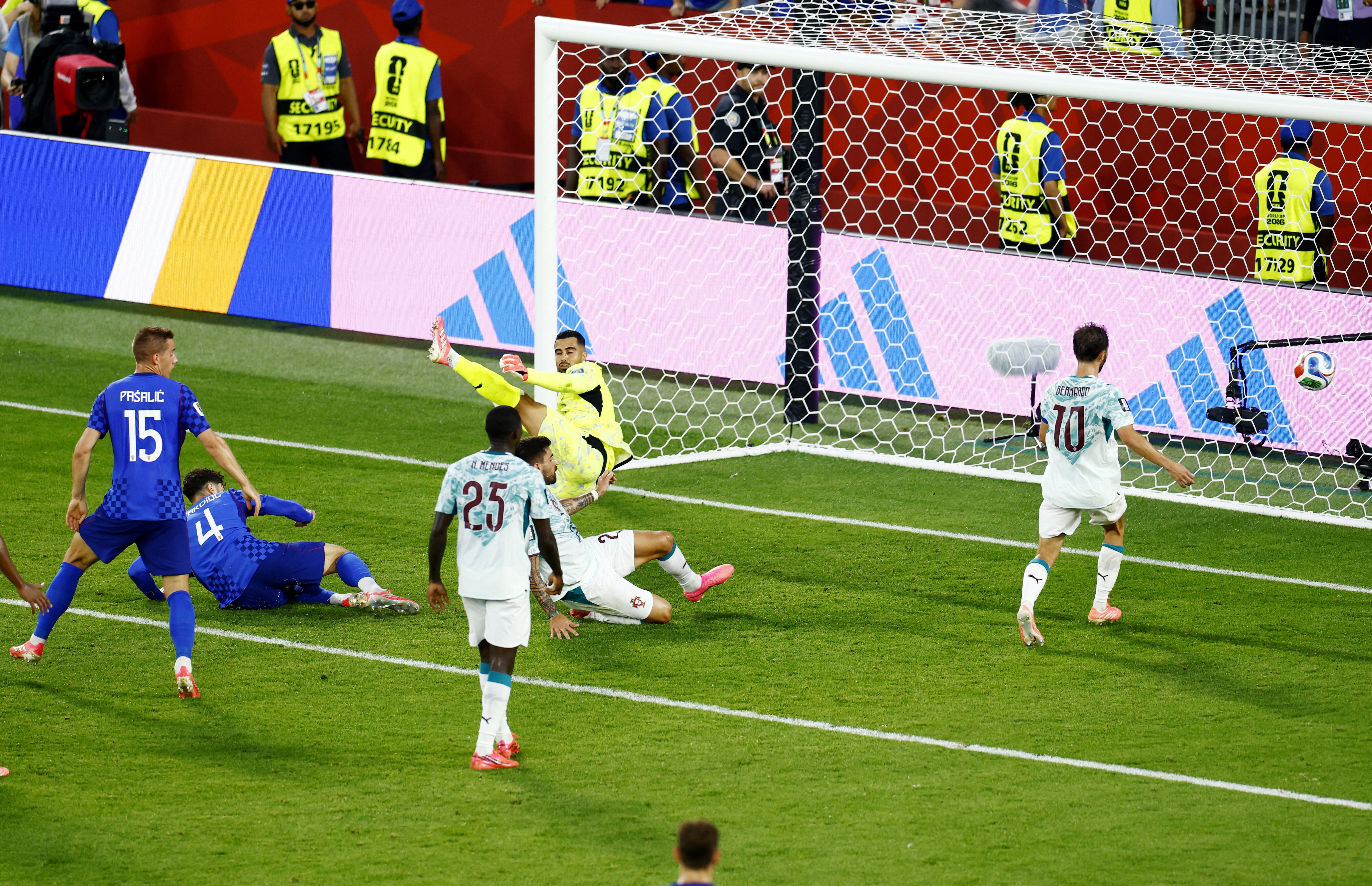
The disallowed goal by Croatia’s Joško Gvardiol against Portugal in the World Cup offers lessons for AI governance. Image: Reuters/Jeenah Moon
- The 2026 World Cup saw a number of highly debated refereeing decisions based on artificial intelligence, automation technology, and VAR.
- This showed how AI technology can perfect detection without repairing the rules, institutions, and power structures in which it operates.
- Instead, it accelerates its defects and highlights why 'human in the loop' is an incomplete governance answer that needs to be addressed.
Toronto, 2 July, the 103rd minute.
Croatia’s Joško Gvardiol bundles the ball over Portugal’s line to level a World Cup knockout tie. Then referee Espen Eskås walks to a pitchside screen, where the match is settled not by a replay but by a waveform: a “heartbeat graphic” from a sensor inside the ball, spiking as it grazed the head – perhaps only the hair – of Igor Matanović. No camera saw the touch. The sensor did.
That phantom touch put a teammate offside. The goal was cancelled, Croatia went home, FIFA pronounced the contact “proven”, and fans threw bottles.
With Spain now crowned as World Cup champions, the tournament’s paradox is clear: the more exactly football measures its contested moments, the more visibly it shows that fairness cannot be engineered through detection alone. A system can be right to the millimetre, and still leave a stadium convinced it was wronged.
This lesson extends well beyond sport. Beginning in August 2026, the EU’s AI Act will impose core obligations on high-risk artificial intelligence (AI) used in hiring, credit, welfare and border security, as governments automate consequential decisions. The World Cup just ran the world’s most-watched pilot of what such systems can and cannot deliver.
What the machines actually do, and don’t do
Not everything called “VAR” – short for video assistant referee – is artificial intelligence.
The World Cup's semi-automated offside technology tracked players’ limbs through camera and computer vision, referenced against 3D scans of all 1,248 players, and flagged clear offsides directly to on-field officials. The adidas Trionda ball used in matches meanwhile carried an inertial sensor that sampled its motion 500 times per second.
These are automated systems. VAR is not; it is humans watching video under the International Football Association Board (IFAB) protocol, permitted to intervene only for a “clear and obvious error”, with the referee taking final decisions.
With body cameras and in-stadium announcements across all 104 matches, the architecture resembled what AI regulation aspires to: automated measurement, human oversight, defined thresholds and public explanation.
The Croatia decision was almost certainly accurate, yet furiously rejected. Measurement accuracy asks whether the sensor detected a real touch, interpretive validity asks whether an imperceptible graze should carry match-ending weight. Procedural fairness asks whether like cases are treated alike.
“Institutional legitimacy” (a concept I have explored in depth in my doctoral research on AI and law in Africa) asks whether the body that runs the system has earned deference. Public trust is the residue of all four. The sensor answered the first question superbly, and left the others untouched.
The 'human in the loop' interpretation never disappears
Days after the Croatia-Portugal game, Egypt was leading Argentina in the round of 16 when Mostafa Zico’s breakaway goal was cancelled for a foul in the build-up, far from the goal. No sensor decided that. A human video official judged the contact an offence, and a human referee agreed at the monitor.
Former elite referees split, and Egypt’s federation filed a formal complaint. Humans decided in advance which conduct counts as an offence, when intervention is warranted, and who receives the reasons.
Offside has been partly converted into measurement, but fouls, intent and recklessness cannot be because they are normative questions. Technology operates inside a rulebook and an institution built by people.
Every disputed decision had at least one "human in the loop," recommending, deciding and sanctioning. Yet distrust persisted, because the well-worn slogan answers none of the questions that determine justice. Which human? Appointed by whom? Under what pressures? Explaining what? Reviewable how?
Compare two red cards, for example. England’s Jarell Quansah was sent off after a VAR-assisted review, and handed a two-match ban with no route of appeal mid-tournament; England were reportedly incensed that the referee was first shown a frozen still of studs on shin, not the moving sequence.
Days earlier, the United States’ Folarin Balogun had received a red card and automatic ban which FIFA suspended after President Donald Trump lobbied FIFA’s president. It was a reversal without published reasoning, which UEFA said “crossed a red line” and is now before Olympic ethics officials.
Same rulebook, same technology, radically different remedies.
A human can correct a machine, but a human can also defer to it, apply rules inconsistently, absorb political pressure, or lend authority to an opaque process. Representation is governance, too. Frozen frames, slow motion and polished 3D avatars project a certainty the underlying judgment may not possess.
The deepest lesson here is structural. Tech is marketed as the ingredient that will inject neutrality into flawed systems. But AI does not arrive before rules, institutions or power. It arrives afterwards, inside arrangements that already distribute authority, error and remedy unevenly. And it can accelerate them, defects included. Football upgraded its eyes; it did not upgrade its constitution. No sensor malfunctioned. A phone call did the work.
This pattern holds when a highly accurate model that scores welfare claimants for fraud risk says nothing about whether the eligibility rules are just, or whether a wrongly flagged family can contest the decision. A border-surveillance system of exquisite precision does not make the policy it enforces, whether lawful or humane.
Govern the decision system, not the model
None of this argues against the tech. Semi-automated offside calls eliminated a class of clear errors, and the transparency tools mark real progress. But technological innovation must be matched by institutional innovation on five fronts:
- Review the rules before automating them, because automation enforces them relentlessly.
- Separate measurement from judgement.
- Design meaningful contestability: accessible reasons and consistent remedies (not appeals that appear or vanish with political convenience).
- Make accountability visible so responsibility does not dissolve among the developer, the official, and the institution.
- Evaluate legitimacy, not accuracy alone: consistency, proportionality and disparate impact, measured as carefully as technical performance.
Even the final obeyed the pattern. Argentina’s Enzo Fernández was sent off in the 93rd minute, once his second yellow was checked and cleared by VAR under a rule new for 2026, and a tournament which Spain won 1-0 in extra time still ended amid headlines about officiating controversy.
This champion’s path was measured more precisely than any in history. Whether or not it is remembered as fair depends on none of that machinery. Before societies ask AI to apply their rules more efficiently, they must decide whether those rules, the institutions that administer them, and the processes for challenging them are worthy of acceleration.
Don't miss any update on this topic
Create a free account and access your personalized content collection with our latest publications and analyses.
License and Republishing
World Economic Forum articles may be republished in accordance with the Creative Commons Attribution-NonCommercial-NoDerivatives 4.0 International Public License, and in accordance with our Terms of Use.
The views expressed in this article are those of the author alone and not the World Economic Forum.

Forum Stories newsletter
Bringing you weekly curated insights and analysis on the global issues that matter.
More on Artificial IntelligenceSee all

Greg Hart
September 9, 2026


