Global Lighthouse Network: Transforming advanced manufacturing
The Global Lighthouse Network is inspiring others to scale innovations in advanced manufacturing Image: Unsplash+/Getty Images
- The World Economic Forum’s Global Lighthouse Network is inspiring manufacturers to develop, replicate and scale innovations in manufacturing by creating opportunities for cross-company learning and collaboration.
- Fifteen new manufacturers joined the network in June 2026. The transformations over the last couple of years have driven rapid growth in generative artificial intelligence use cases, which now account for 23% of top solutions in 2025.
- The network has engaged 238 factories, implementing advanced manufacturing technologies to drive productivity, supply chain resilience, customer-centricity, sustainability and talent development.
The impact of scaling advanced manufacturing technologies.
The World Economic Forum’s Global Lighthouse Network is a community of leading manufacturers accelerating the adoption of fourth industrial revolution (4IR) technologies across industries worldwide.
Each Lighthouse represents an industrial site that uniquely integrates new technologies, from artificial intelligence (AI) and robotics to cloud computing and big data. Their methods demonstrate how to increase productivity, engage the workforce, reduce the environmental footprint and build supply chain resilience.
In early 2026, 15 new manufacturers were recognized as Lighthouses, increasing the network to 238 sites worldwide, which together demonstrate significant impact across all five award categories. For example:
- Productivity: A Singapore-based industrial automation company makes over 1,000 different products and changes its production lines more than 20,000 times each year. This made it difficult to stay flexible, maintain consistent quality and rely less on workers' experience. By deploying more than 50 digital and AI solutions, including flexible automation, AI-enabled quality control and intelligent maintenance, the site increased units per person-hour by 43%, reduced defects by 35% and shortened time-to-competency by 67%.
- Supply chain resilience: A smart living and digital transformation company in China created an AI-powered system to optimize its logistics flows, including across order fulfilment, warehouse operations, vehicle scheduling and carrier bidding. AI was deployed in response to customer expectations for faster deliveries. The platform achieved a 48% increase in response time, a 40% improvement in inventory turnover and a 23% reduction in inventory costs.
- Customer-centricity: A major Swiss science and technology company shifted its biologic medicines production from batch to continuous processing while also changing its design process, using digital technology in both instances. It cut design-to-patient time by 50% and increased lab productivity by 67% through advanced automation, robotics and modular environments, enabling scientists to spend more time on high-value-add tasks. This also reduced the investment needed to scale production by 80%.
- Sustainability: A major consumer goods company in India operates in an area with severe groundwater depletion and carbon-intensive energy use, threatening its long-term operational continuity. The company used AI to improve raw materials sourcing, water management and energy systems.. As a result, the site reduced Scope 1 and 2 emissions by 99%, lowered energy consumption by 29%, reduced inbound Scope 3 emissions by 37% and achieved 100 times groundwater recharge while supporting 35% production growth.
- Talent: In China, a nuclear-generated electricity provider improved safety and operational efficiency by building advanced digital capabilities across its workforce. By scaling 45 advanced use cases across talent development, deployment and human-error prevention, the site increased digital talent by more than tenfold, reduced human error by 71% and increased profit per employee by 50%.
They are not alone in their success. All 238 Lighthouses in the network have achieved measurable impact from their implementations of advanced use cases.
The challenge to the widespread adoption of advanced manufacturing technologies
The global manufacturing industry has been lagging in adopting advanced technologies. More than 70% of companies investing in advanced analytics, AI or digital solutions fail to move beyond the pilot phase of development. Most companies struggle to scale up when upgrading technology, given the costs and anticipated return on investment.
Despite recent industry innovations, only a select group of leading organizations can deploy advanced manufacturing at scale, generating new value and customer experiences within the factory or across value chains.
To close this gap and accelerate the inclusive adoption of advanced technologies in manufacturing, the Forum’s Centre for Advanced Manufacturing and Supply Chains identified the need for a learning network to showcase best practices benefiting companies worldwide.
The world's leading manufacturers are no longer optimizing individual processes; they are reimagining entire operating systems. The newest Lighthouse sites show how intelligence is becoming embedded into the fabric of operations, enabling organizations to respond faster, learn continuously and unlock new levels of performance across their value chain.
—Kiva Allgood, Managing Director, World Economic Forum
”Our approach to driving innovation and scaling advanced manufacturing technologies.
The Global Lighthouse Network is inspiring manufacturers to develop, replicate and scale innovations in manufacturing by creating opportunities for cross-company learning and collaboration.
Launched in 2018 with 16 Lighthouses, the network has grown almost 15-fold over eight years. The current 238 Lighthouses provide a roadmap for manufacturers across the globe looking to”‘escape pilot purgatory,” with a library of over 1,200 proven use cases for the implementation of 4IR technologies.
Under an updated classification methodology, analytical AI and machine learning account for approximately 62% of Lighthouse solutions in 2025, while generative AI has grown rapidly to represent 23% of solutions. By integrating these technologies into core processes, companies are achieving measurable gains in productivity, quality, agility and workforce effectiveness.
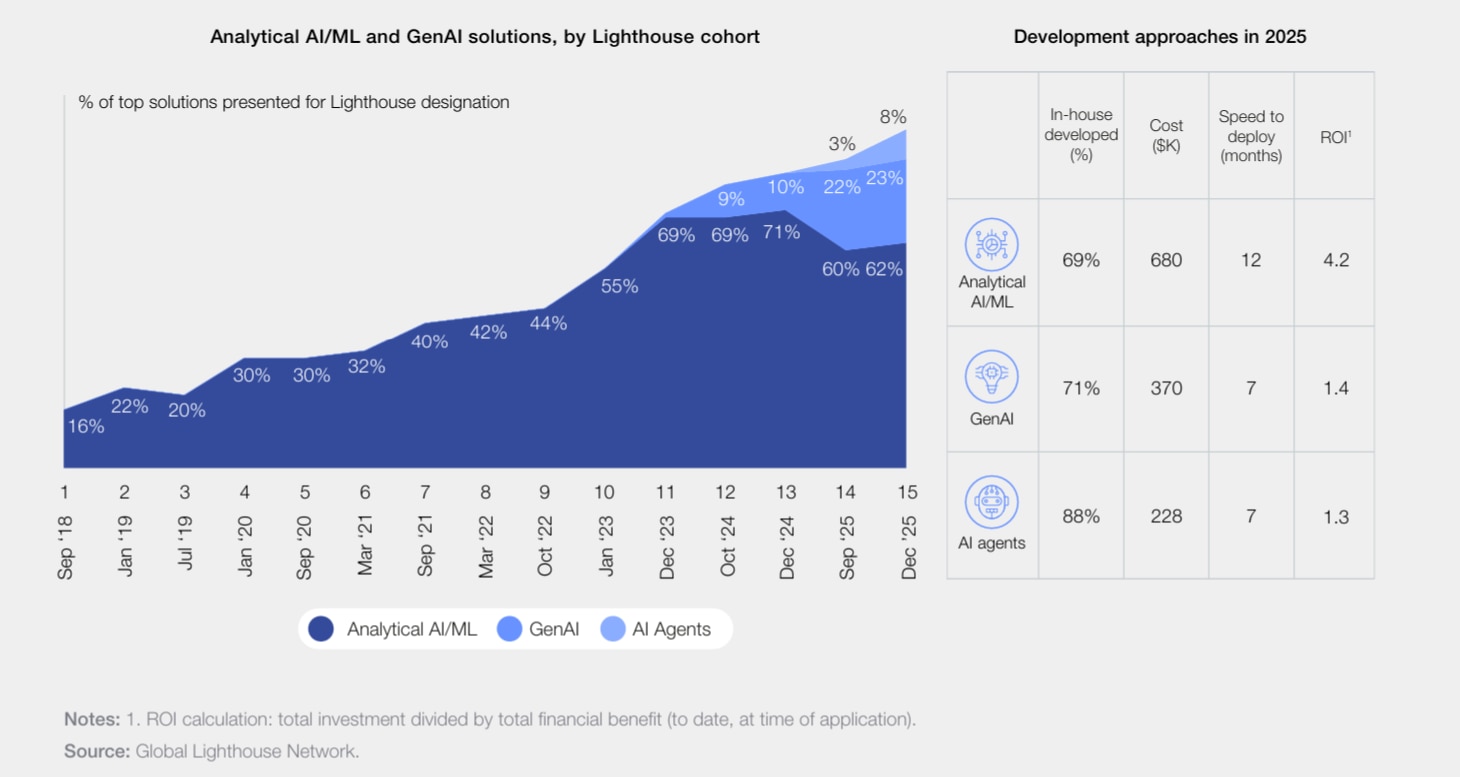
First, AI is becoming a core operating capability rather than a standalone pilot. Second, leading manufacturers are placing people at the centre of transformation and third, sustainability is increasingly embedded in operational strategy, strengthening resilience, reducing costs and supporting long-term competitiveness.
The Global Lighthouse Network today
Today, the 238 lighthouses span more than 30 countries and 40 industries, ranging from pharmaceuticals and steel products to electronics and cosmetics, the full list of which can be found on the Global Lighthouse Network’s site.
Most of the network’s learnings, including its 1,200-plus use cases, supported by an equivalent number of best practices and enablers, are summarized in the Global Lighthouse Network: Rewiring Operations for Resilience and Impact at Scale report, to enable leaders to make tangible positive impacts on people, planet and performance.
How can you get involved?
The Global Lighthouse Network is a World Economic Forum initiative counselled by an advisory board of industry leaders who are working together to shape the future of global manufacturing.
The advisory board includes Aramco, Foxconn Industrial Internet, Koç Holding, McKinsey & Company, Schneider Electric, Siemens and Tata Steel.
Sites and value chains that join the network are designated by an independent panel of experts. To learn about the application process and how to become a lighthouse, visit our webpage.
Don't miss any update on this topic
Create a free account and access your personalized content collection with our latest publications and analyses.
License and Republishing
World Economic Forum articles may be republished in accordance with the Creative Commons Attribution-NonCommercial-NoDerivatives 4.0 International Public License, and in accordance with our Terms of Use.
The views expressed in this article are those of the author alone and not the World Economic Forum.
Stay up to date:
Future of Manufacturing


Forum Stories newsletter
Bringing you weekly curated insights and analysis on the global issues that matter.
More on Manufacturing and Value ChainsSee all

Craig Miller
October 6, 2026


