Why supply chain leaders should learn to stand back and 'see the wave'
Supply chain leaders should consider the broader spectrum of risk beyond their own organization. Image: Getty Images
Melanie Azetmüller
Initiative and Community Specialist, Advanced Manufacturing and Supply Chains, World Economic Forum- Supply chain leaders face the challenge of adapting their businesses amid intensifying geoeconomic, technological and environmental disruption.
- Rather than focusing on single issues, they can learn to read the broader 'wave' of supply chain risks outside their immediate organization.
- Three key capabilities can help supply chain leaders acquire this deeper visibility and resilience.
For decades, supply chains were largely viewed as operational engines of efficiency, designed to minimize costs and maximize scale. Today, that model is in need of reinvention. According to the Global Risks Report 2026, half of all global leaders and experts expect a turbulent outlook over the next two years as geoeconomic confrontation emerges as a leading risk, technological disruption is accelerating and climate volatility intensifies. Supply chain leaders face a new challenge: How do you build the agility to adapt and reconfigure quickly as conditions change?
The Global Value Chains Outlook suggests that an answer lies in moving away from concentrated scale to more decentralized supply chain models. The traditional design of a supply chain, focused on cost optimization and concentration, is now viewed as fragile, while resilience depends on distributed networks, deep visibility into the ecosystem, and the ability to pivot during disruption. In a world of interconnected risks, competitive advantage is likely to depend more on the ability to see beyond one’s organization and adapt as conditions evolve.
A useful metaphor compares this challenge to standing on a beach: Many leaders focus only on the “deck chairs” directly in front of them, reflecting execution, immediate operational issues and short-term performance, while missing the “wave” of disruption, emerging trends and weak signals building in the distance. The challenge is no longer preparing for a single disruption and identifying it once it becomes obvious. Today, the challenge is about operating in an environment where geopolitical, technological, economic and environmental risks overlap and reinforce one another, requiring organizations to anticipate change early and pivot as conditions change.
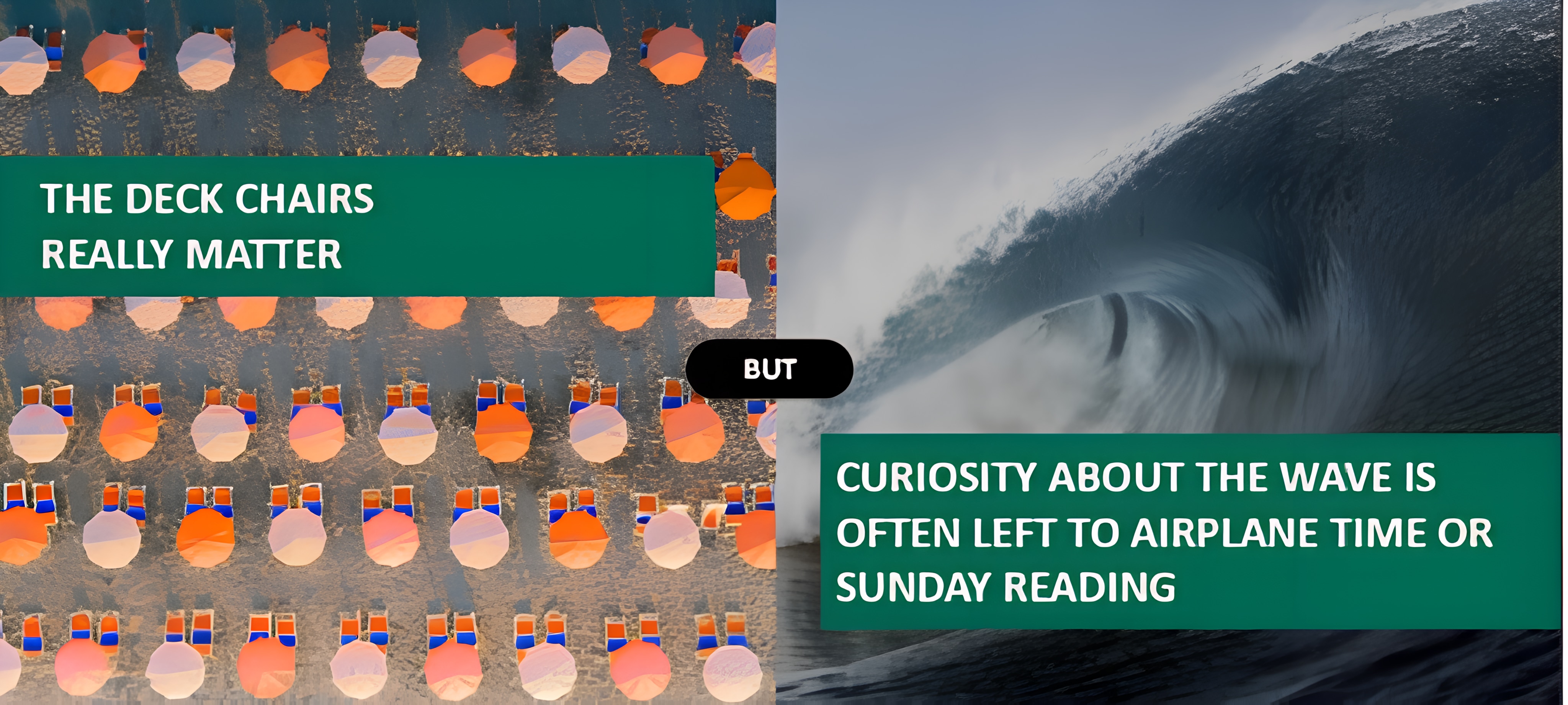
The “wave” is already forming across industries. AI is reshaping supply chain visibility, operational decision-making and customer expectations. Geopolitical fragmentation is changing production and sourcing strategies. Climate pressures are becoming more of an operational volatility. At the same time, customers expect faster, more personalized solutions immediately. Yet organizations often underestimate the pace and scale of structural shifts. For instance, post-pandemic supply chain disruptions exposed the vulnerabilities of overly lean operating models that had previously been celebrated as best practice.
Organizational success will increasingly depend on being relevant for consumers who are ever more demanding, being resilient as well as adaptable, and thriving on uncertainty in the world. To do so, leaders will need to develop capabilities that extend beyond operational excellence to “see the wave”.
1. Lead beyond the supply chain function
Effective leadership starts with a deep understanding of how the business creates value. This means understanding how operational decisions translate into financial and strategic outcomes, particularly as external complexity reshapes the operating landscape. While supply chain executives have long worked across organizational boundaries, today's interconnected ecosystems require a broader perspective. Rather than optimizing individual relationships or functions, they must understand how value is created, shared and sustained across supplier, partner and customer networks.
This shift is already visible across industries. The number of supply chain executives shaping early product and market strategy decisions is now more than double what it was five years ago, reflecting how supply chains are gradually advancing to influence growth strategy, customer experience and competitive positioning. At the same time, 74% of leaders now see resilience as a driver of growth rather than simply a risk management mechanism, reinforcing the broader evolution of supply chains from operational cost centres into strategic business assets. In fact, supply chains influence both sides of the value equation. They help drive revenue through service levels, availability, speed and demand responsiveness, while also improving margins through efficiency and COGS (cost of goods sold) optimization.
2. Build agility, resilience and optionality
In a more volatile environment, being able to pivot across multiple sourcing, production and logistics pathways as conditions change is becoming a source of competitive advantage. Industry sentiment has shifted in this direction, with organizations recognizing that building optionality is essential to respond quickly to changing conditions. Today, 60% more leaders see resilience and agility as core to competitive advantage and growth than they did five years ago. In parallel, three in four executives say they would prioritize resilience investments because of the superior long-term returns they can generate. The lesson is becoming clear: Resilience investments should no longer be viewed as insurance costs alone, but as strategic growth enablers that allow organizations to maintain continuity, capture market share during disruption and adapt faster than their competitors.
3. Strengthen visibility, ecosystem coordination and early response
In more and more interconnected supply networks, disruptions rarely occur within one organization. Instead, they emerge across supplier ecosystems and logistics networks and as a result, visibility beyond one’s own organization is becoming more important.
The challenge is not simply recognizing disruptions once they become visible, it is identifying weak signals early enough to inform decisions and modify before they develop into operational crises. Too often, focus remains on the “deckchairs”, while the “wave” of structural change continues to build in the background. Organizations are embedding intelligence into their operations; from dental company Invisalign's use of 3D printing to deliver truly personalized treatment, to supply-chain optimization specialists Osapiens' real-time ecosystem monitoring and early-warning platform, to Ethon's AI that autonomously optimizes operational variables in real time in the manufacturing sector, these technologies are enabling earlier detection and faster responses.
Competitive advantage depends on ecosystem visibility and coordinated action rather than optimizing isolated functions. In fact, one in three leaders now say digital visibility and coordination are defining supply-chain competitiveness, overtaking traditional priorities such as cost and efficiency.
How the Forum helps leaders strengthen manufacturing and supply chain resilience
As organizations continue navigating industrial transformation, the ability to “see the wave” and adapt as it unfolds may become one of the defining leadership capabilities. The next generation of leaders will not be defined solely by how efficiently they manage predictable systems, but by how effectively they design for where the consumer will be in five to 10 years’ time. That means thriving on structural uncertainty, navigating ambiguity and making decisions amid geopolitical fragmentation and continuously changing rules.
This article draws on discussions within the World Economic Forum’s New Generation of Industry Leaders programme as well as findings from the Global Value Chains Outlook 2026.
Don't miss any update on this topic
Create a free account and access your personalized content collection with our latest publications and analyses.
License and Republishing
World Economic Forum articles may be republished in accordance with the Creative Commons Attribution-NonCommercial-NoDerivatives 4.0 International Public License, and in accordance with our Terms of Use.
The views expressed in this article are those of the author alone and not the World Economic Forum.
Stay up to date:
Supply Chain, Logistics and Transport
Related topics:


Forum Stories newsletter
Bringing you weekly curated insights and analysis on the global issues that matter.
More on Supply Chains and TransportationSee all

Dominik Metzger and Benedikt Gieger
September 30, 2026


