20 emerging leaders to watch at the Annual Meeting of Global Future Leaders
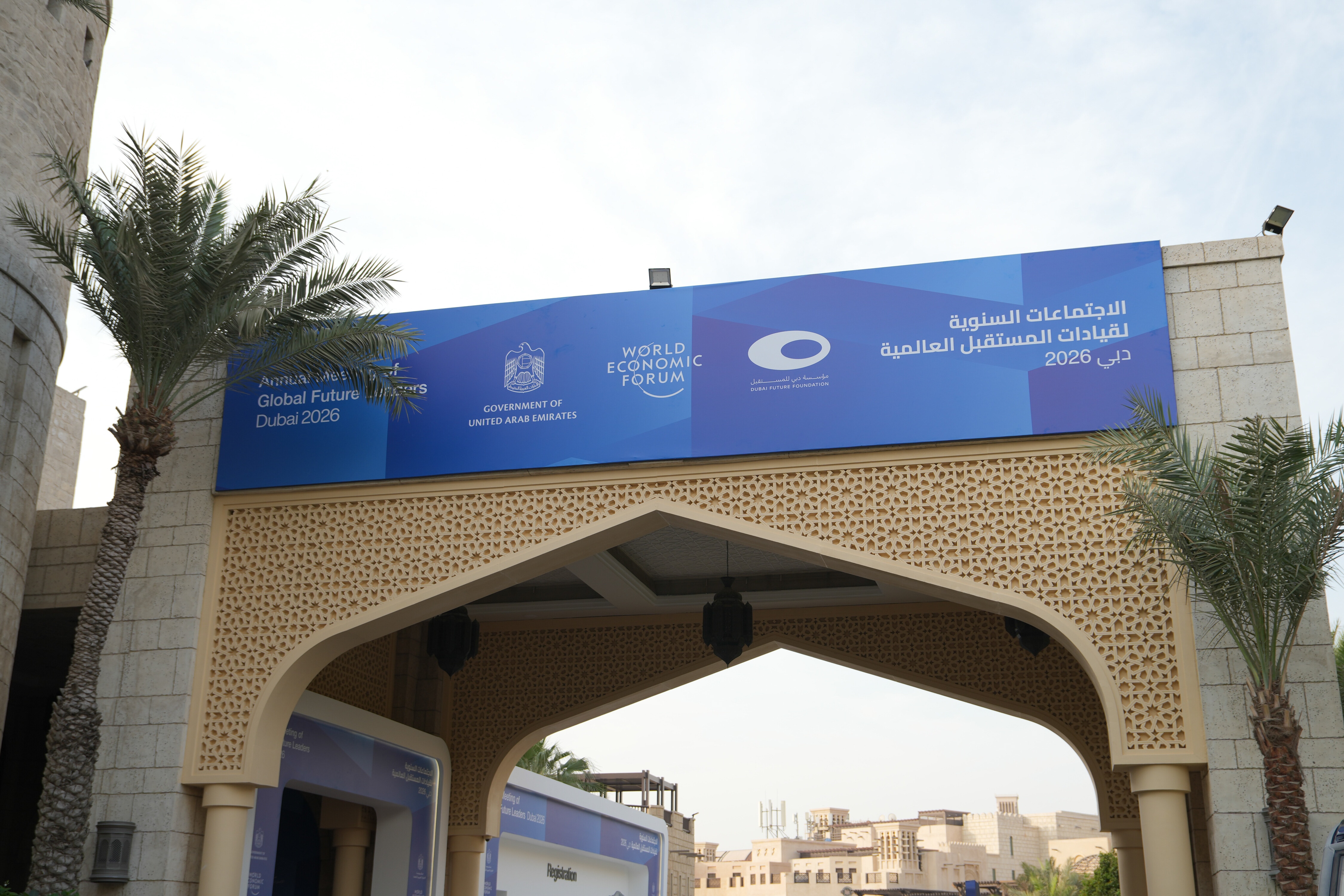
The Annual Meeting of Global Future Leaders 2026 is taking place in Dubai, UAE. Image: World Economic Forum
- Twenty emerging leaders working across science, technology, business and social impact are among those attending the inaugural Annual Meeting of Global Future Leaders in Dubai.
- Their work offers a glimpse of what could shape the next two decades.
- They are joining CEOs, ministers, scientists and entrepreneurs, and bringing the priorities of the next generation into the room.
This week at the World Economic Forum’s Annual Meeting of Global Future Leaders in Dubai, United Arab Emirates, emerging leaders join CEOs, ministers, scientists, entrepreneurs, policymakers and civil society leaders, bringing perspectives rooted in lived experiences across geographies and sectors.
Among those attending are 20 emerging leaders working across issues, from forest management to microgrants for youth innovators. They are building companies, advancing science and shaping policy.
Their presence at the meeting marks an important shift in the future of leadership, where intergenerational perspectives become increasingly critical for solving the complex challenges of our times.
A decade of unprecedented technological progress has given rise to a new wave of leaders asking the harder questions...
”Fixing the system, not just the symptom
Some of these leaders start where a problem actually lands: a failing clinic, a degraded forest, a service that doesn’t reach people. From there, they work back to the system behind it, drawing on evidence and local knowledge while working alongside the people on the front lines.
Ecologist Dana Shukirbayeva, for instance, uses AI-enabled predictive analytics to support forest health, reforestation, and carbon management in Kazakhstan, applying technology to intervene before environmental damage becomes irreversible.
Kacha “Shogun” Mahadumrongkul helps repurpose more than $50 million in medical equipment across 20 countries through Penta Medical Recycling. His work has helped bring a prosthetic ankle designed at the MIT Media Lab to market at 95% lower cost.
Hayfa Sdiri’s RIVET has distributed more than 1,200 microgrants to nearly 3,000 young innovators across 80 countries. Similarly, Georgina Mondino is supporting young entrepreneurs and early-stage startups in Argentina through her consulting firm, Ekos Lab. Both are expanding access to opportunity.
Monal Bhattarai has co-founded Bhandinchu, a civic-technology platform that gathers anonymous citizen feedback on public services, helping create continuous feedback loops between Nepal’s institutions and the people they serve. She also serves as managing director at Canopy Nepal, creating educational opportunities for underserved children.
Physician Adriana Viola Miranda works to improve primary healthcare delivery in Indonesia. She is part of the team at 1000 Days Fund, working to equip 1.5 million community health workers to prevent childhood stunting.
From growth to stewardship
The WEF’s Youth Pulse research ranks climate change and environmental degradation among the threats the younger generation worries about most. These leaders are responding by tying ecological value to commercial value.
They are treating waste, biodiversity and resilience as things that can also make economic sense.
Biologist Luiz Serigheli studies how invasive plants disrupt honeybee pollination networks, linking ecological science to food security. His research shows how changes in biodiversity can affect the ecosystems that underpin food production, providing evidence to inform climate adaptation and more resilient agricultural systems.
Kiara Winona Sweeney, the programme director at the Yunus Environment Hub, supports social entrepreneurs and leads the Circular Impact Procurement Initiative, helping create the demand needed for circular solutions to scale.
Others are innovating on the supply side, turning waste into input for low-carbon materials and affordable energy. Karime Guillen Libien's company Rearvora, for instance, turns agricultural and food waste into commercial bioingredients and materials. Carlos Ayvazian is leading Wasted Treasures in Lebanon to turn organic waste into biomass heating units, reducing energy poverty and reliance on imports.
Many also began their leadership journeys early, volunteering alongside their peers to address challenges in their local communities.
”Technology with responsibility
A decade of unprecedented technological progress has given rise to a new wave of leaders asking the harder questions: is it reliable? Does it work for everyone? Does it reach the people who need it most?
Through his initiative Masar Tech, software developer Mahmood Alwatani is bringing AI-enabled tools to small businesses and non-profits, ensuring that the benefits of emerging technology are not limited to large and well-resourced organizations. An IT solutions architect at Hewlett Packard Enterprise, Aida AlAwadhi works on AI-enabled infrastructure that allows organizations to connect and manage data across distributed environments securely.
Edwin Lai works with governments across Asia-Pacific on electric, autonomous and AI-enabled mobility, from low-carbon transport networks to smart mobility hubs. He has also contributed to Smart Cities Council standards for integrated transport infrastructure. His work shows how emerging technologies can expand connectivity and economic opportunity through smarter urban systems.
Others, like Nada Saadi, recognize that technology is also only as effective as the perspectives built into it. As a doctoral researcher in medical AI who co-developed MEDIC, she argues for addressing safety and bias concerns with a framework that evaluates clinical large-language models for medical reasoning.
At Meridian AI, Benjamin Pfeffer works on AI-powered decision-making in finance. He develops tools that help investors research large volumes of market and company data while maintaining transparency and human oversight.
Francisco Javier Suazo Castro works at the intersection of risk, technology and financial integrity at Remitly, a cross-border payments platform. As digital finance expands and fraud becomes more sophisticated, his work focuses on a defining challenge for the next financial system: scaling access without compromising trust and security.
Closing the last-mile gap
The challenge also extends to ensuring the technologies we create reach the people and places historically left out.
Through GramIN, Sakshi Sharma is helping bridge the rural technology gap by introducing technology adoption centres in rural India, supporting women and farmers with practical applications of AI. Mariam Nourya Koné is expanding pathways into the digital economy for young women in West Africa. Through Hackily, she is building digital literacy, software development, cybersecurity and skills programmes to widen participation in the region’s growing technology ecosystem.
Aerospace engineer and founder of Vora Robotics, Shamsuddeen Jibril is developing locally engineered drones for precision agriculture in Africa. His systems can monitor crops, detect disease and target pesticide applications, reducing chemical exposure while automating labour-intensive fieldwork.
Theodoric Chew is applying technology to another area of urgent need: mental healthcare. Through Intellect’s AI-powered support, his initiative reaches more than four million members across more than 100 countries and 120 languages, combining digital tools, coaching and clinical care.
A different model of leadership
In their own ways, these leaders represent a new generation of innovators, researchers, and entrepreneurs, all seeking to address stubborn social problems that existing systems have struggled to resolve.
Many also began their leadership journeys early, volunteering alongside their peers to address challenges in their local communities.
At the Annual Meeting of Global Future Leaders, these emerging voices present the priorities of the next generation and offer a unique opportunity for established leaders to engage in intergenerational dialogue and partnerships.
Don't miss any update on this topic
Create a free account and access your personalized content collection with our latest publications and analyses.
License and Republishing
World Economic Forum articles may be republished in accordance with the Creative Commons Attribution-NonCommercial-NoDerivatives 4.0 International Public License, and in accordance with our Terms of Use.
The views expressed in this article are those of the author alone and not the World Economic Forum.
Stay up to date:
Youth Perspectives
Related topics:


Forum Stories newsletter
Bringing you weekly curated insights and analysis on the global issues that matter.
More on YouthSee all

Tobias Lindström Battle and Isabela Bartczak
October 13, 2026


