World Food Day: What it is and why it's more important than ever

World Food Day 2025 serves as an annual reminder that food insecurity and malnutrition remain ever-present, with 1 in 12 people still facing hunger, according to the UN FAO. Image: Unsplash/ Dan Gold
Listen to the article
This article has been updated.
- World Food Day, marked annually on 16 October, raises awareness of global food insecurity and malnutrition.
- One in twelve people globally still face hunger; achieving food security demands coordinated global action and targeted local investments, says the UN Food and Agriculture Organization.
- The World Economic Forum is convening global leadership via the Food Innovation Hubs Global Initiative to advance food systems through innovation and market-based solutions.
World Food Day, held this year on 16 October, has been an annual reminder that food insecurity and malnutrition remain ever-present.
As the United Nations Food and Agriculture Organization (UN FAO) celebrates its 80th anniversary, an estimated 1 in 12 people globally still face hunger. And with climate change, geopolitical conflicts and continued food price inflation, we could see food insecurity become more precarious rather than decline.
What is World Food Day and how did it get started?
The UN FAO established World Food Day in 1979, with 16 October marking the day of the FAO's foundation in 1945.
Its goal is to raise awareness and mobilize action for the large share of the global population that still suffers from hunger and malnutrition. Activities and initiatives surrounding World Food Day contribute to the FAO’s mission to develop sustainable solutions that address these challenges and promote global food security for everyone.
The main focus is on making food and agriculture systems resilient against the multiple challenges they face. From extreme weather to economic shocks, agrifood systems experience mounting pressure, whether it’s farm land, water or biodiversity. The FAO’s mission is about increasing food production sustainably, improving supply chains, reducing food waste and losses, and improving diets.
Why is World Food Day important?
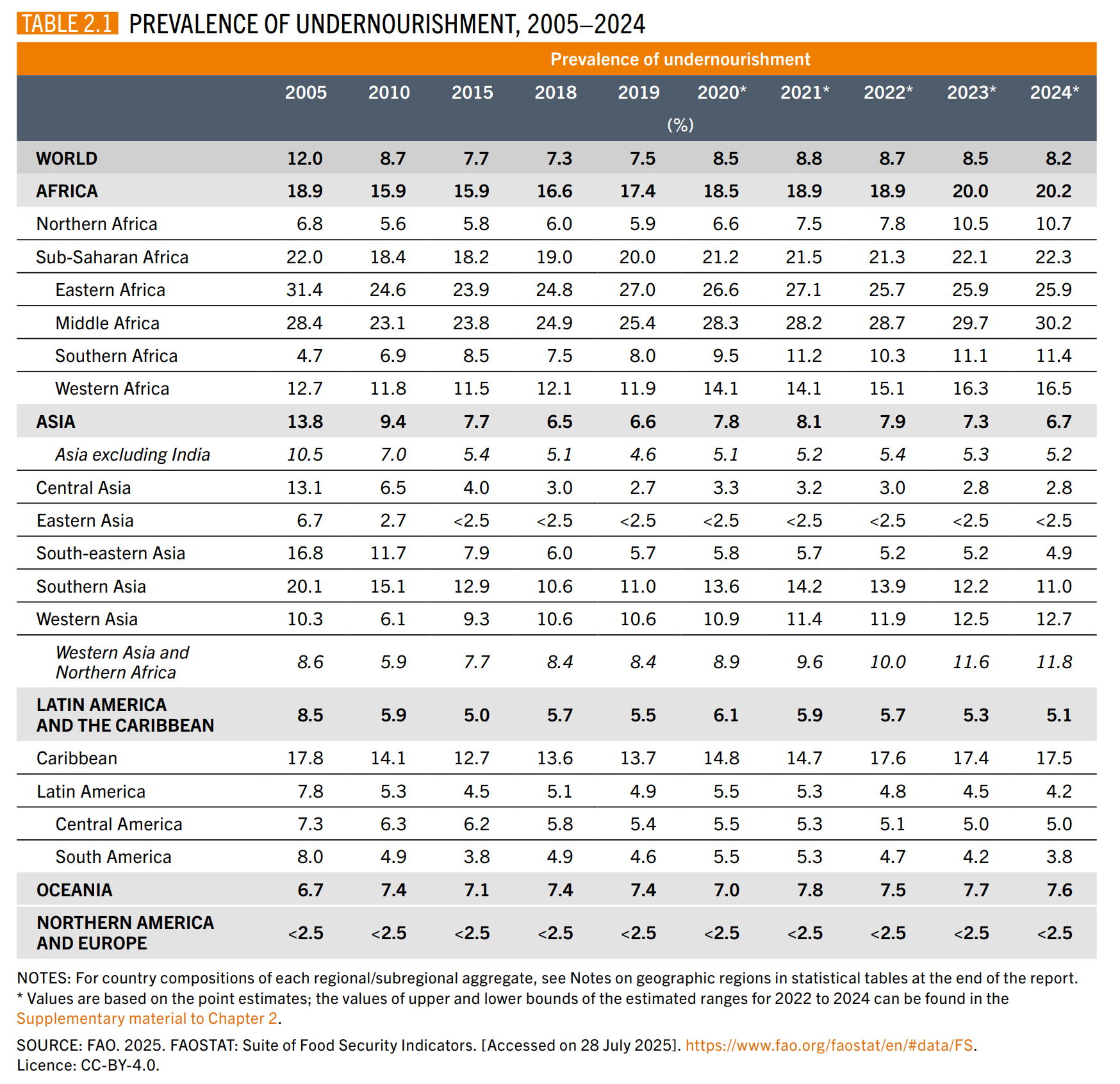
Since the pandemic, world hunger has declined gradually again, from 8.7% of the world population in 2022 to 8.2% in 2024 – equivalent to 1 in 12 people – the UN FAO states in its 2025 annual report on food security. This still leaves around 700 million people experiencing hunger. In addition, more than a quarter – or nearly 2.3 billion – experienced moderate or severe food insecurity last year, and only 34% of babies between 6 and 23 months meet the minimum dietary standards in terms of vitamins and minerals.
Food systems are also weighing heavily on the climate, with the sector accounting for roughly 30% of total greenhouse gas emissions globally, making it the largest contributor to the transgression of five planetary boundaries, according to the latest EAT-Lancet Commission.
Worldwide, five years after the pandemic, food prices are still three times higher than before COVID-19. Food and agricultural production are also directly affected by climate change threatening a 35% drop in crop yields by 2050, according to Boston Consulting Group. In turn, this could further increase malnutrition in vulnerable communities by 20%. Geopolitical tensions and continued inflation could exacerbate this downward spiral.
Amid these trends, low-income economies carry a disproportionate burden, the UN FAO says. While there has been marked progress in South-East Asia, Southern Asia and South America, hunger is on the rise elsewhere on the planet. Undernourishment rose by more than 20% in Africa in 2024 and by 12.7% in Western Asia.
What is this year's World Food Day theme?
This year’s theme for World Food Day is 'Hand in Hand for Better Foods and a Better Future'. The UN FAO stresses that achieving the goal of eradicating hunger and malnutrition can only be achieved by global action across sectors and generations. The mission aims to address the imbalance between hunger in some parts of the world and rising levels of obesity and food waste in others.
The UN FAO anticipates collective action across 150 countries worldwide. Events and outreach will bring together actors as diverse as governments, businesses, civil society organizations and the global public to promote action for a safer future of food. The FAO calls World Food Day one of the most celebrated days of the UN calendar.
The actions we take today will directly impact the future. We must produce more with less. Let’s work towards a future that is more inclusive and more equitable.
—Qu Dongyu, FAO Director-General
”What is food insecurity and why is it growing?
Achieving food security means that people have enough safe, nutritious food to develop normally and lead a healthy life. Food insecurity reflects the opposite. Chronic food insecurity describes a state in which people don’t have enough food over extended periods to maintain a healthy and active lifestyle. Taken to the extreme, acute food insecurity is a lack of appropriate food that threatens lives.
Current food systems feed the majority of the global population. Since the 1960s, food supply per capita has increased more than 30%, supported by the use of fertilizers and irrigation. But our food systems are under pressure, as highlighted by the Intergovernmental Panel on Climate Change (IPCC) in a recent report.
The expanding world population needs more food than ever before. However, conflicts and inflation continue to drive up the cost of food. Climate change has started to affect food security as temperatures increase, extreme weather events become more frequent and rainfall patterns are changing.
The IPCC has warned that all of these factors already affect crop health and potential yields. Food security faces especially tough challenges in drylands across Africa and in high mountain regions of Asia and South America.
Agriculture is at the heart of achieving food security for all. The UN’s latest Sustainable Development Goals update finds that global public expenditures on agriculture reached a record high of more than $700 billion in 2023, a 2% average annual growth since 2015. However, in the less and least developed countries, the share of expenditure is only 4% for a sector that generates around 18% of GDP.
And it’s not only agriculture: fisheries and aquaculture are also under increasing pressure, both from climate change, pollution and overfishing.
What is being done to tackle food insecurity and poor nutrition?
The UN FAO calls for global, coordinated action alongside targeted country-specific initiatives to address the interconnected challenges linked to ensuring worldwide food security.
In response to the challenges our food system face, the FAO appeals to governments to:
- Support access to food for the most vulnerable groups, focus on stabilizing markets through strategic public spending to create market transparency.
- Focus trade policy on removing export bans and similar restrictive measures to ensure the global food markets can continue to function.
- Invest in data and information flows to support more effective decision-making.
- Address high food prices by investing in resilient agriculture, research, development and infrastructure to smooth supply chain efficiency.
The World Economic Forum has been advancing equitable food security through the Food Innovation Hubs Global Initiative, promoting meaningful, inclusive and relevant technology adoption to make food systems positive for people and planet. The initiative focuses on breakthrough solutions in three priority areas: Inclusive AI for Food, Diversified Ingredients, and Water-Smart Food Systems, guided by the Food Innovators Network (FIN), a global community of more than 250 leaders driving food innovation, thought leadership and scalable impact.
Have you read?
How emerging technologies can advance food quality traceability and prevent waste
Transforming food systems: How climate strategy can feed economic growth
Food security is a collective effort — here's what we need to do
How public-private partnerships are fuelling food innovation and supply in the UAE
Mainstreaming food innovation – what will it take?
Don't miss any update on this topic
Create a free account and access your personalized content collection with our latest publications and analyses.
License and Republishing
World Economic Forum articles may be republished in accordance with the Creative Commons Attribution-NonCommercial-NoDerivatives 4.0 International Public License, and in accordance with our Terms of Use.
The views expressed in this article are those of the author alone and not the World Economic Forum.
Stay up to date:
Global Health
Related topics:


Forum Stories newsletter
Bringing you weekly curated insights and analysis on the global issues that matter.
More on Food, Water and Clean AirSee all

Sundar Mahalingam
February 9, 2026


