What can we learn from the top performers and fastest risers in the global energy transition?
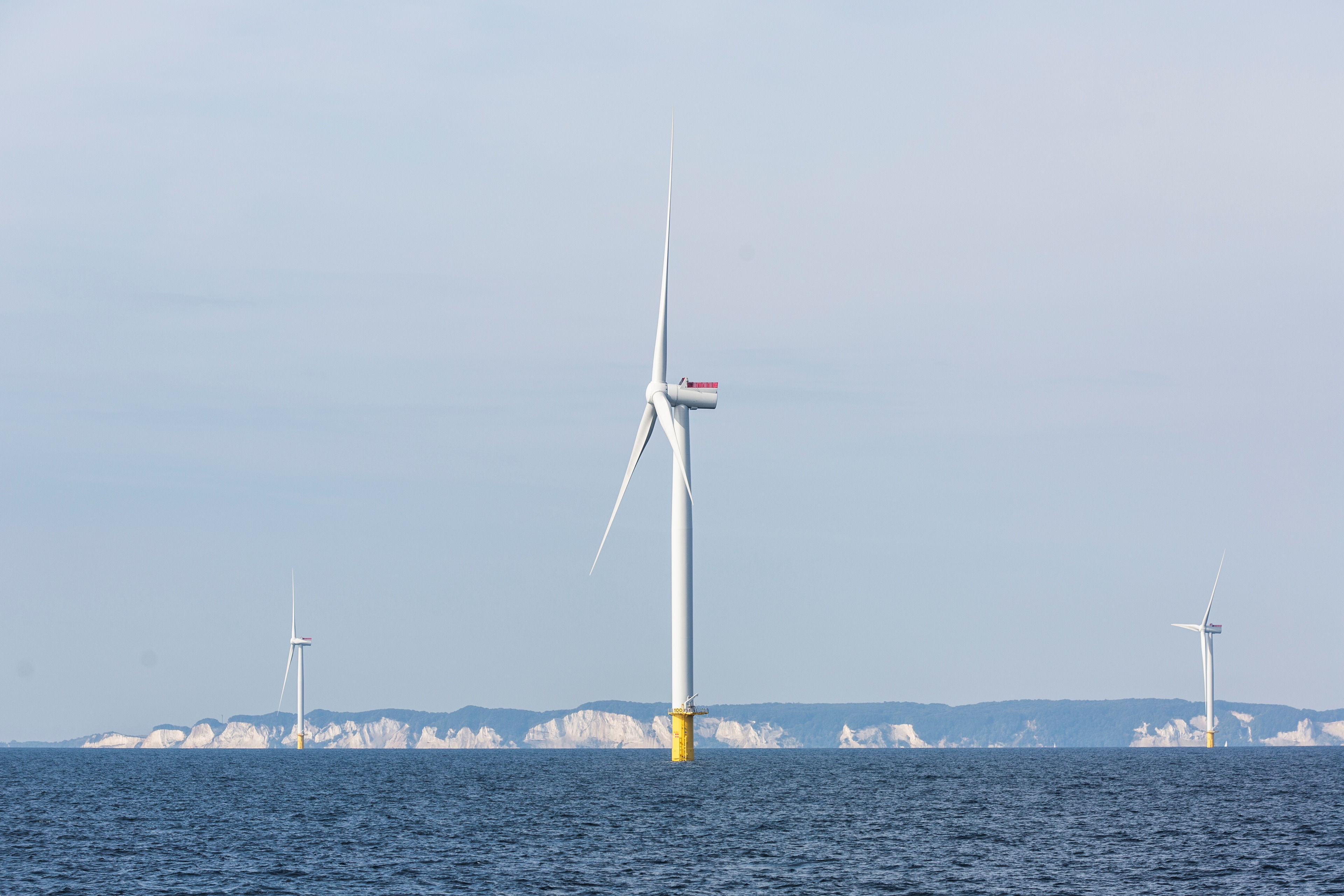
Sweden tops the Energy Transition Index as one of the global pioneers of decarbonization. Image: REUTERS
- The Forum’s 2025 Energy Transition Index (ETI) indicates a modest but broad improvement in the shift toward sustainable energy, although progress varies significantly globally.
- The top performers in the ETI are mainly the Nordic countries, while Latvia and the UAE stand out for their notable year-on-year enhancements.
- Well-funded, effective strategies, guided by global goals yet customized per country, emerge as the way forward, backed by global cooperation that yields tangible results.
Momentum for the energy transition has recorded its strongest improvement since 2021, which marked the beginning of the energy crisis.
The 2025 Energy Transition Index (ETI) recorded a 1.1% year-on-year increase in global scores – over twice the average pace of the past three years. The ETI framework evaluates 118 countries across three system performance dimensions—security, equity, and sustainability—and five enabling dimensions that reflect transition readiness.
Clean energy is now a crucial engine for economic growth, attracting more than $2 trillion in 2024 – double the 2020 levels – and supporting over 16 million jobs.
Even so, the report also finds that investments are still below the $5.6 trillion that is needed annually through 2030, including $2.2 trillion in emerging markets alone, to align with a net-zero pathway. Progress across the world is also uneven, with varying speeds and approaches taken by different countries.
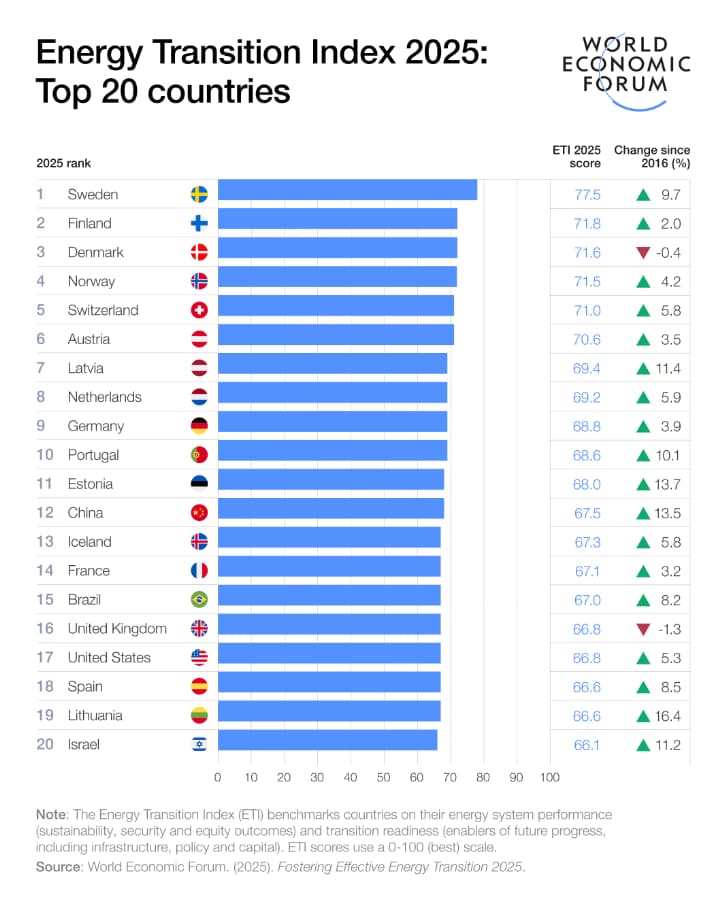
While there may be many paths to net zero, the report highlights that knowledge sharing is one of the biggest priorities for accelerating the energy transition at a time of geopolitical tensions, economic volatility and supply chain disruptions.
With this in mind, what can we learn from the Index’s top performers and fastest risers?
The top five: the Nordics continue to lead the global energy transition
The top ETI performers have maintained a relatively stable performance since 2024, led by European countries, which have emerged as the global spearheads of decarbonization. The Nordic countries were firmly at the forefront of Europe's energy transition: Sweden (ETI 77.5), Finland (71.8), Denmark (71.6) and Norway (71.5). Switzerland (71.0) followed in fifth place.
The top performers share five common enablers. They have a highly diversified clean energy mix, with a large percentage of renewable and nuclear energy compared to fossil fuels. For example, renewables make up 83% in Switzerland and 80% in Sweden.
Adding to this, governments are providing long-term certainty through clear climate targets and supporting policies for both low-carbon electricity and energy efficiency. They are also upgrading and expanding grids to accommodate renewables and decentralized energy generation.
Green industrial policies in the ETI's leading markets aim to generate public and private investments into scaling technologies such as hydrogen, energy storage and smart grids to decarbonize energy production and usage. A case in point: Sweden has the highest number of heat pumps per capita in the world and is one of the first countries to establish a green steel production facility.
Finally, the top performers have succeeded in maintaining public support by backing up environmental taxes with fair access to green energy and strong welfare systems to cushion the impact of the energy transition, the ETI 2025 report finds.
However, despite stable performances from the stalwarts of the energy transition, the greatest momentum is building elsewhere in the world.
The fastest risers: setting the pace for the world
Latvia (69.4)
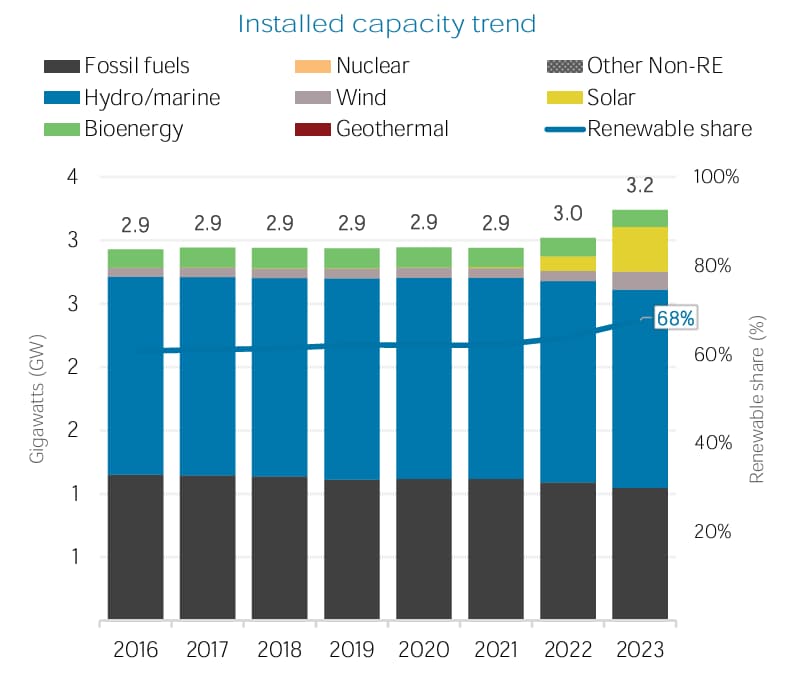
With a year-on-year change of 7.9%, Latvia entered the ETI top ten for the first time this year. Its score was supported by gains in equitable access to energy as well as new investments. Major contributors to this were a 59% drop in electricity prices and a growing share of renewables in its energy mix, enabling greater energy independence and underscoring the impact of the country’s focused policies.
While its significant share of hydroelectric in the energy mix has come down slightly, along with fossil fuels, Latvia has benefitted from growth in renewable sources such as wind, solar and bioenergy, Irena reports.
United Arab Emirates (58.4)
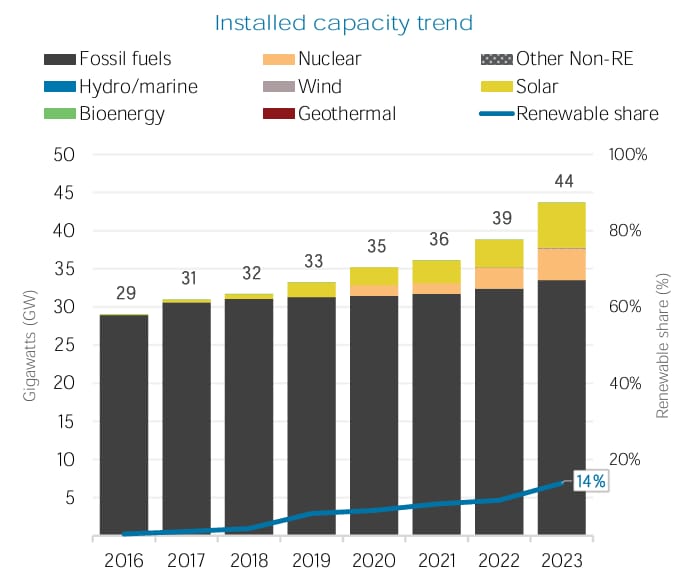
With a 7.85% year-on-year score change, the UAE recorded the highest improvement across the Middle East, thanks to accelerated investments in the country’s buildout of renewable capacity. The majority of the energy produced is from natural gas and oil. However, the UAE has been investing in its high solar potential since 2014, and most of the capacity added in recent years has been solar power.
The ETI report also attributes the UAE’s progress to targeted subsidy reforms and greater energy efficiency, underscoring how focused policies can help speed decarbonization.
China (67.5)
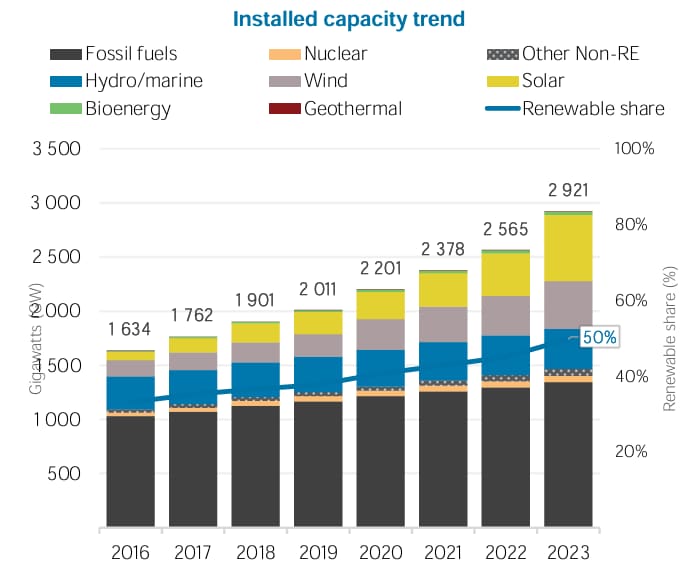
In 12th place globally on the ETI, China remains a key player in the energy transition. With a 2.2 percentage point increase, China led the emerging Asia region, also delivering the fifth-highest transition readiness score globally. The ETI report attributes China’s continued leadership in renewable energy to its well-developed innovation ecosystems and financial strength.
In May 2025, Carbon Brief reported that CO2 emissions had been stable or decreasing for over a year, despite growing power demand. Fast growth in renewable power generation has overtaken average demand growth, cutting the use of fossil fuels. Renewables now make up 50% of China’s energy mix.
Fragmentation demands greater collaboration
Learning from the experiences of these trailblazing economies will be vital for accelerating the transition in other markets. Effective, well-funded strategies, guided by global goals but tailored to each country’s circumstances and resources, emerge as the path forward. This includes updating infrastructure to better accommodate renewables, developing a transition-ready workforce, and fostering energy innovation.
Achieving these goals cannot just rely on single-market initiatives, the ETI report concludes, but a new type of global and regional alliances needs to be forged. Cooperation must now shift from broader strategic alliances to delivery-focused initiatives that can achieve tangible results for speeding the transition to a more sustainable, equitable and secure energy future.
Don't miss any update on this topic
Create a free account and access your personalized content collection with our latest publications and analyses.
License and Republishing
World Economic Forum articles may be republished in accordance with the Creative Commons Attribution-NonCommercial-NoDerivatives 4.0 International Public License, and in accordance with our Terms of Use.
The views expressed in this article are those of the author alone and not the World Economic Forum.
Stay up to date:
SDG 07: Affordable and Clean Energy


Forum Stories newsletter
Bringing you weekly curated insights and analysis on the global issues that matter.
More on Energy TransitionSee all

Shantanu Srivastava and Tanya Rana
March 5, 2026


