European competitiveness - what will it take? 'Everything, everywhere, all at once' - say top leaders
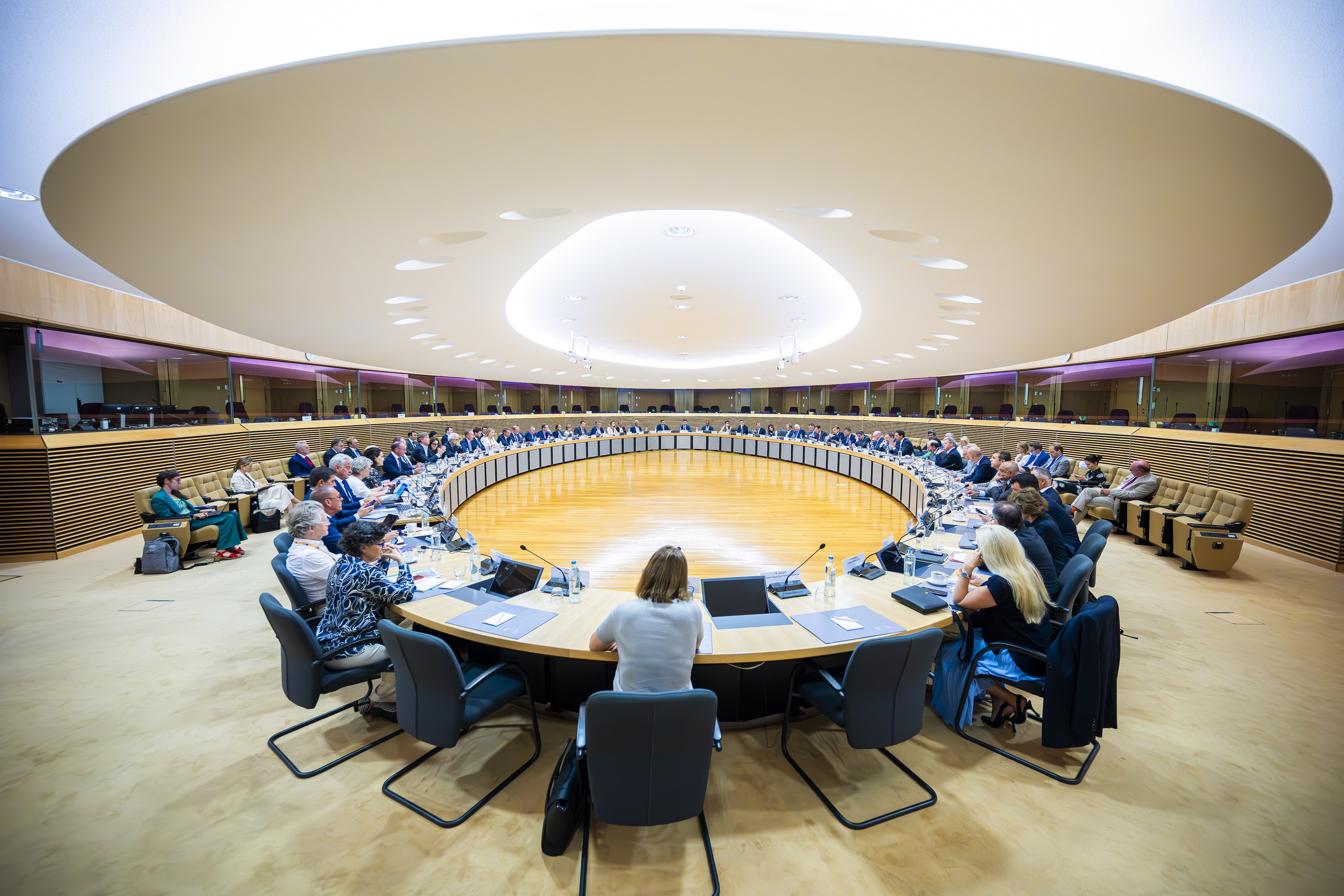
Brussels hosted the first ever meeting of the Leaders for European Growth and Competitiveness on 1 July. Image: Getty Images
- The World Economic Forum convened the inaugural meeting of Leaders for European Growth and Competitiveness in Brussels on 1 July.
- Its purpose is to accelerate action across clean energy, financial markets, strategic alliances and technology.
- Here are some of the key quotes from politicians and business leaders on how to boost European competitiveness and growth.
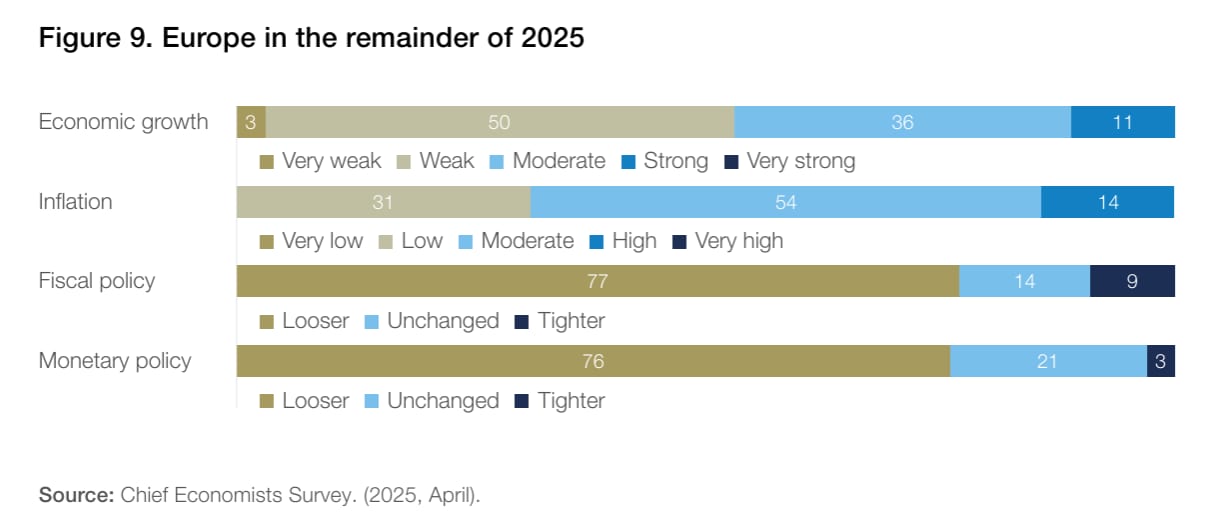
Economic growth in the eurozone is expected to remain at a “subdued” 0.8% this year, amid the ongoing talks around US tariffs and the ripple effect of geopolitical unease.
But there’s a “brightening” around Europe’s economic prospects, the World Economic Forum’s mid-year Chief Economists Outlook finds, as US policy has “galvanized” European policy-makers into action to bolster their economies, security and societies.
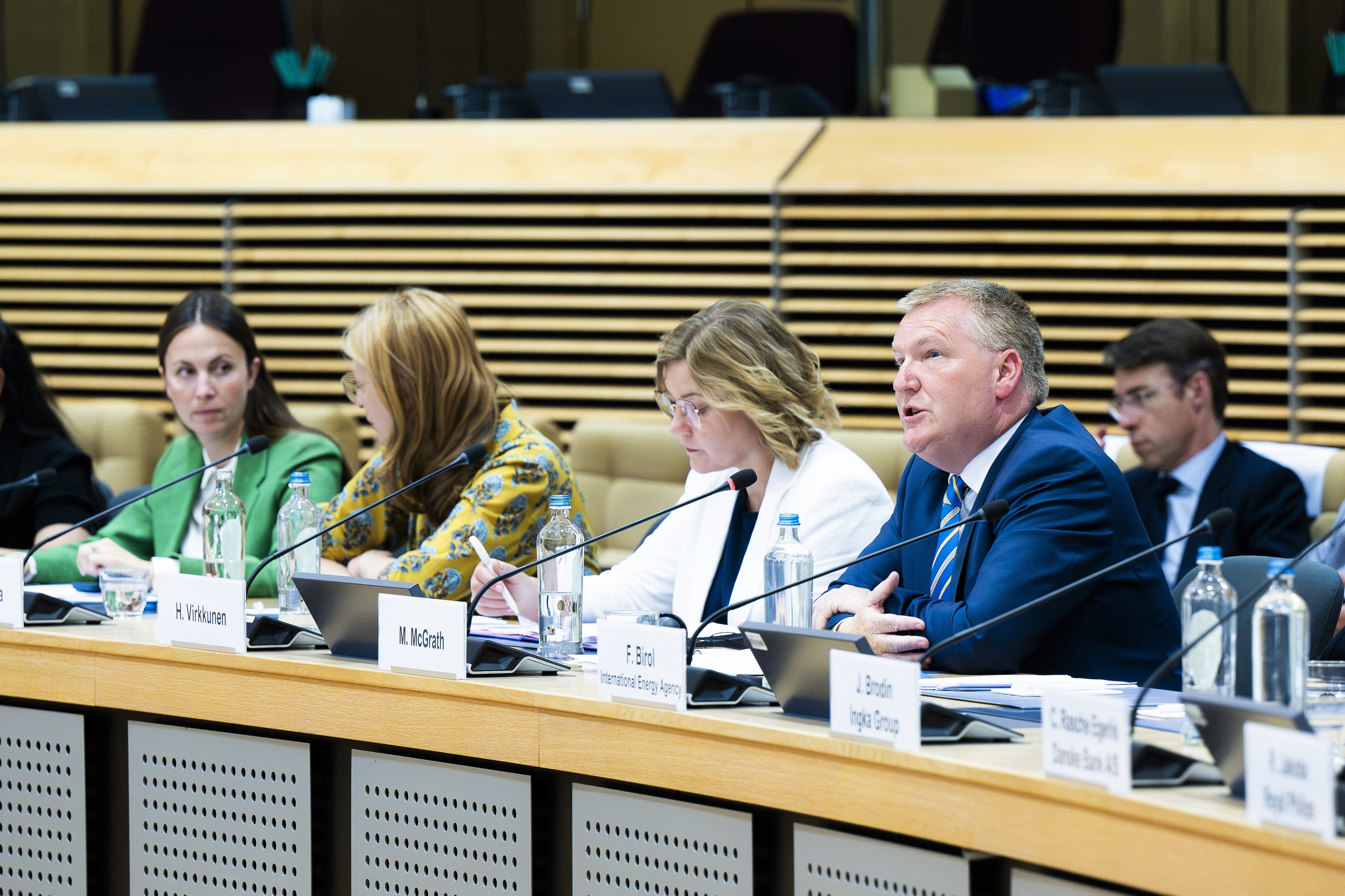
“Europe can provide a pole of stability in a more fragile world,” President of the European Commission, Ursula von der Leyen, told the inaugural meeting of Leaders for European Growth and Competitiveness in Brussels on 1 July.
The Forum has convened the group to shore up Europe’s economic trajectory and accelerate action around four core pillars:
1. Clean and competitive energy infrastructure
2. Leveraging financial markets
3. Enabling strategic alliances
4. Shaping the intelligent age
The launch event brought together European commissioners with CEOs and founders of up-and-coming deep tech companies to discuss a path forward.
‘Everything, everywhere, all at once’
It’s not a zero-sum game: if growth is strong in Europe, cooperation between European countries and with other blocs can lead to mutual benefit and overall growth.
And Europe is playing catch-up with other regions, especially Asia, which accounted for 60% of global growth in 2024.
In the global race to net zero, Europe has electrified just 23% of its economy, with a target of 30% by 2030, while China has already exceeded that level.
When it comes to innovation, Europe is underfunding its growth stage companies by $375 billion - which limits them from reaching their full potential or forces them to seek funding elsewhere, impacting the bloc’s technological leadership and economic growth.
As speakers pointed out throughout the event, in order to be more competitive, Europe needs to tackle “everything, everywhere, all at once”.
Here are some of the key takeaways from leaders who attended the meeting:
'Europe needs its own playbook' - Kat Borlongan
The French entrepreneur and Board Member of the European Innovation Council believes Europe can't use "the same playbooks as China and the US".
"It's about being smarter and about taking a completely different approach. Europe can shift from a more tactical approach into what I call a market-making approach.
"It is not about just fixing things that are broken. It's about making some very deliberate ... choices that would engender a kind of quantum leap."
It's about having an ecosystem that can systematically produce European champions and trillion-dollar companies that can go toe-to-toe with their counterparts in the US or in China.
”'There is huge potential' - Maria Luís Albuquerque
The meeting took place a week before the EU's Economic and Financial Affairs Council was due to meet on 8 July.
Among other items on the council's agenda were enabling Bulgaria to join the eurozone and a package of measures to make the EU Securitization Framework simpler and more fit for purpose, to help channel more investment into the economy - supporting economic growth, innovation and job creation.
'Securitization' is the process of pooling financial assets (such as loans, mortgages and consumer credit) and turning them into tradable securities. Reviewing the framework is the first legislative initiative proposed under the Savings and Investments Union Strategy.
Maria Luís Albuquerque is the European Commissioner for Financial Services and the Savings and Investments Union.
She was upbeat about Europe's prospects: "We have the financial resources, the level of savings, the talent, the innovators. And we do have tremendous opportunity now by linking the dots and eliminating the barriers that keep our markets fragmented to put these assets to the best possible use.
"There's actually a significant advantage in developing the Savings and Investments Union Strategy for all citizens all across Europe, and also for all the companies."
'Decarbonization can make Europe more competitive' - Wopke Hoekstra and Anna Borg
By 2030 the EU is aiming to produce at least 40% of its own green technologies, under the new Net Zero Industry Act, part of the European Green Deal.
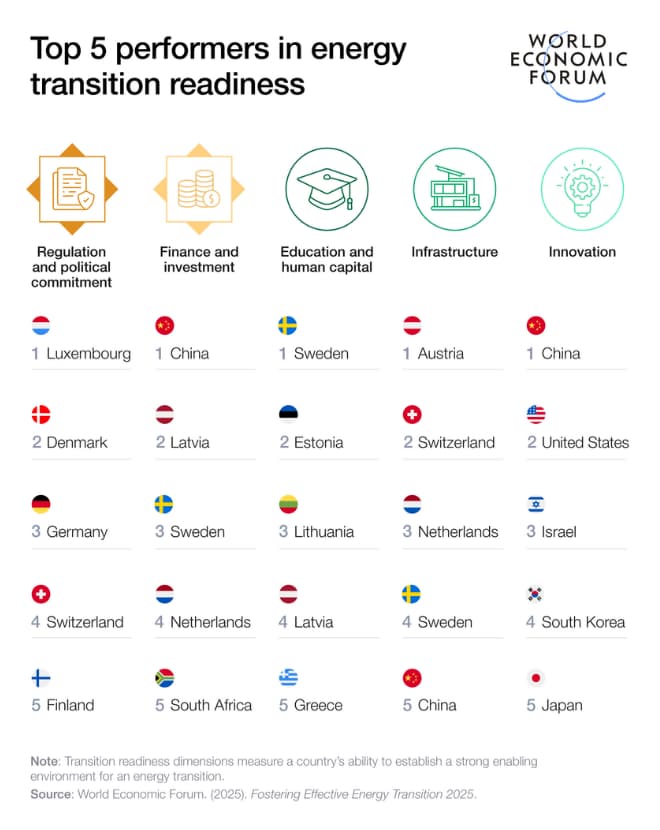
China and the Asia-Pacific region account for around 90% of mass-manufacturing capacity for several key clean energy technologies, according to the International Energy Agency (IEA), with Europe a large importer of electric vehicles, batteries, fuel cells and almost all its solar panels.
Although European countries dominate the top 10 of the Forum's latest Energy Transition Index, China comes top for energy transition readiness in the Innovation and Finance and investment dimensions.
Wopke Hoekstra, the Commissioner for Climate, Net Zero and Clean Growth, believes Europe needs to become "way less one-dimensional about what decarbonization is all about" - and it should tackle three problems at once:
1. Make sure that Europe becomes more competitive.
2. Enhance the continent's independence.
3. Be a force for good in the domain of climate action.
"All these things come together right now. We do have an issue with competitiveness. Clearly, the world has a huge issue in terms of climate change and the horrible effects it is causing, particularly in Europe.
"And if you look at the last couple of years, there is no illusion anymore that we also have a problem with independence. And we never want to be dependent again on rogue actors like Russia for something as important as gas."
Hoekstra's view was echoed by Anna Borg, President and CEO of energy company Vattenfall: "A decarbonized Europe is a competitive Europe because the price of fossil fuels is four to five times higher in Europe today compared to US or China. We need to make sure that we invest in our own energy supply, not only from a security perspective, but from a competitiveness perspective."
She emphasized the need for "cross-value chain collaboration" between the energy industry and other industry in Europe.
"Co-investing and making sure that the supply of energy is there at the time of demand is going to be absolutely critical. New value chains will emerge from collaboration across value chains."
'Europe can no longer work in siloes' - Jesper Brodin
The CEO of Ingka Group, which operates the retail chain IKEA, said it's no longer OK for government and the corporate sector to work in siloes.
"Today we have a polycrisis: climate change, geopolitics, economics, war and much more. In such an environment it's no longer OK to work in silos," said Jesper Brodin.
We need to provide opportunities for dialogue, to listen to each other, to learn from each other and work faster together in real time.
”Achieving growth in Europe requires collaboration, speed and simplicity, he added.
"But most of all, as always, if you want to create something in the future, [we need] a good dose of optimism."
Jozef Síkela, Commissioner for International Partnerships, said cooperation would be key:
“In a world of rising uncertainty, Europe has a strategic opportunity to build credible, value-driven partnerships that deliver mutual benefit.
"As a reliable and transparent partner, the EU can strengthen its competitiveness and security through international cooperation, turning development into an engine of stability and progress.”
'Europe must embrace AI'
At the end of June, the EU's tech chief Henna Virkkunen announced 76 companies had bid to construct four AI gigafactories across the bloc, for which the European Commission has allocated $23 billion in funding.
However, just days after the Forum convened the meeting of leaders in Brussels, CEOs from European countries urged the EU to stop its AI Act, in a letter saying the complex regulation put “Europe’s AI ambitions at risk".
Speaking at the meeting, Virkkunen, the European Commission's Executive Vice President for Tech Sovereignty, Security and Democracy, said:
"Europe must embrace the AI and digital revolutions, enhance investment in critical technologies and supercomputing infrastructure, and improve the conditions for innovation and businesses in Europe.
"It will be critical to empower our best researchers and innovative companies to forge a future where innovation serves as the bedrock of our shared prosperity and global competitiveness."
Meanwhile SAP CEO Christian Klein urged Europe to focus on AI software, not just infrastructure, by scaling talent pipelines and embedding AI into universities, aligning regulatory frameworks across EU member states and shaping a sovereignty narrative around open, scalable standards.
"Europe can win this race," he said, “but only if we stop fragmenting and start executing.”
License and Republishing
World Economic Forum articles may be republished in accordance with the Creative Commons Attribution-NonCommercial-NoDerivatives 4.0 International Public License, and in accordance with our Terms of Use.
The views expressed in this article are those of the author alone and not the World Economic Forum.
Related topics:
Contents
‘Everything, everywhere, all at once’'Europe needs its own playbook' - Kat Borlongan'There is huge potential' - Maria Luís Albuquerque'Decarbonization can make Europe more competitive' - Wopke Hoekstra and Anna Borg'Europe can no longer work in siloes' - Jesper Brodin'Europe must embrace AI'
Forum Stories newsletter
Bringing you weekly curated insights and analysis on the global issues that matter.
More on Economic GrowthSee all

Larry Fitzgerald Jr and Kelvin Beachum Jr
April 6, 2026