Opinion
Why unlocking finance is essential for Bangladesh’s green energy transition
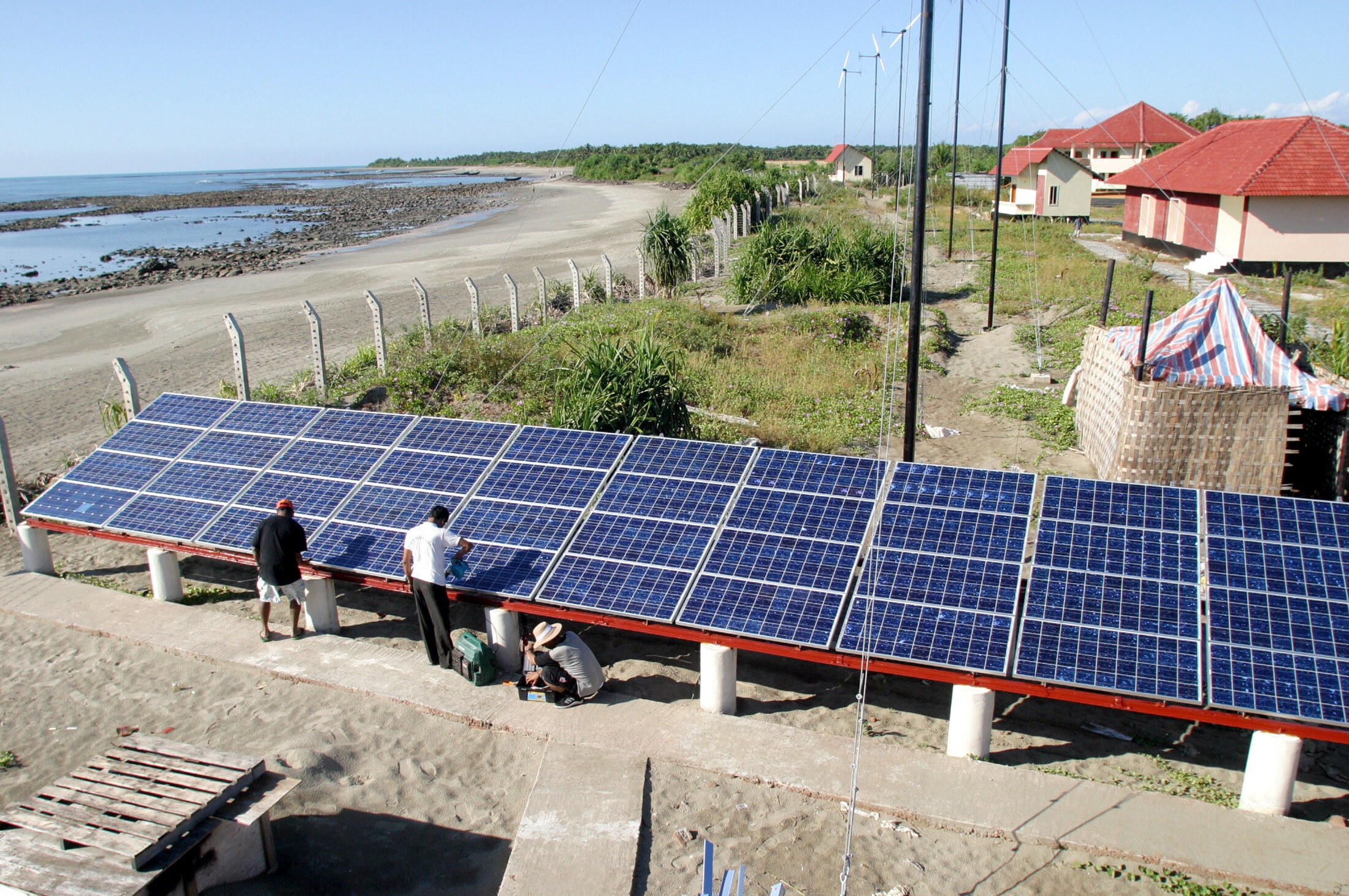
Powering up Bangladesh's green energy transition. Image: REUTERS/Rafiqur Rahman RR/CN
Labanya Prakash Jena
Sustainable Finance Consultant, Institute for Energy Economics and Financial Analysis (IEEFA)- Bangladesh’s new Renewable Energy Policy is pivotal to its green energy transition.
- Due to the high capital intensity of the energy sector, meeting this green transition goal requires a substantial amount of upfront capital.
- Bangladesh should work on developing a conducive financing ecosystem that will foster this transition.
Bangladesh, once a fast-growing developing economy, is going through a transition, one that needs further economic reforms to restore the nation’s growth trajectory. The energy sector, the backbone of the economy, can provide the necessary impetus to this economic revival, while supporting its green transition and energy independence aspirations. The Bangladesh government’s new Renewable Energy Policy is pivotal to the country’s energy transition: it aims for 20% of its electricity supply to come from renewable sources by 2030 and 30% by 2040.
Due to the high capital intensity of the energy sector, meeting this green transition goal requires a substantial amount of upfront capital. The Institute for Energy Economics and Financial Analysis’s (IEEFA) assessment shows that Bangladesh will need up to $980 million annually to meet its renewable energy goal of 2030. During the next decade, the country will require up to $1.46 billion a year. Bangladesh will need to ramp up the current annual investment flow of $238 million by four to six times in the next five to 15 years to meet its goals.
There are, however, several barriers to green energy financing in Bangladesh, including rapid policy changes, offtaker risk, a complex loan disbursement process and land acquisition challenges. Plus, Bangladesh’s recent sharp currency devaluation and downgraded credit ratings hinder capital flows into the country’s renewable energy sector.
The clean energy sector needs policy and regulatory interventions and financial support from international public financial institutions. Policy certainty, risk-mitigation instruments, regulatory tweaking and collaboration from government and international organizations can support mobilizing the large-scale capital necessary for Bangladesh’s green energy transition.
Policy certainty and reform
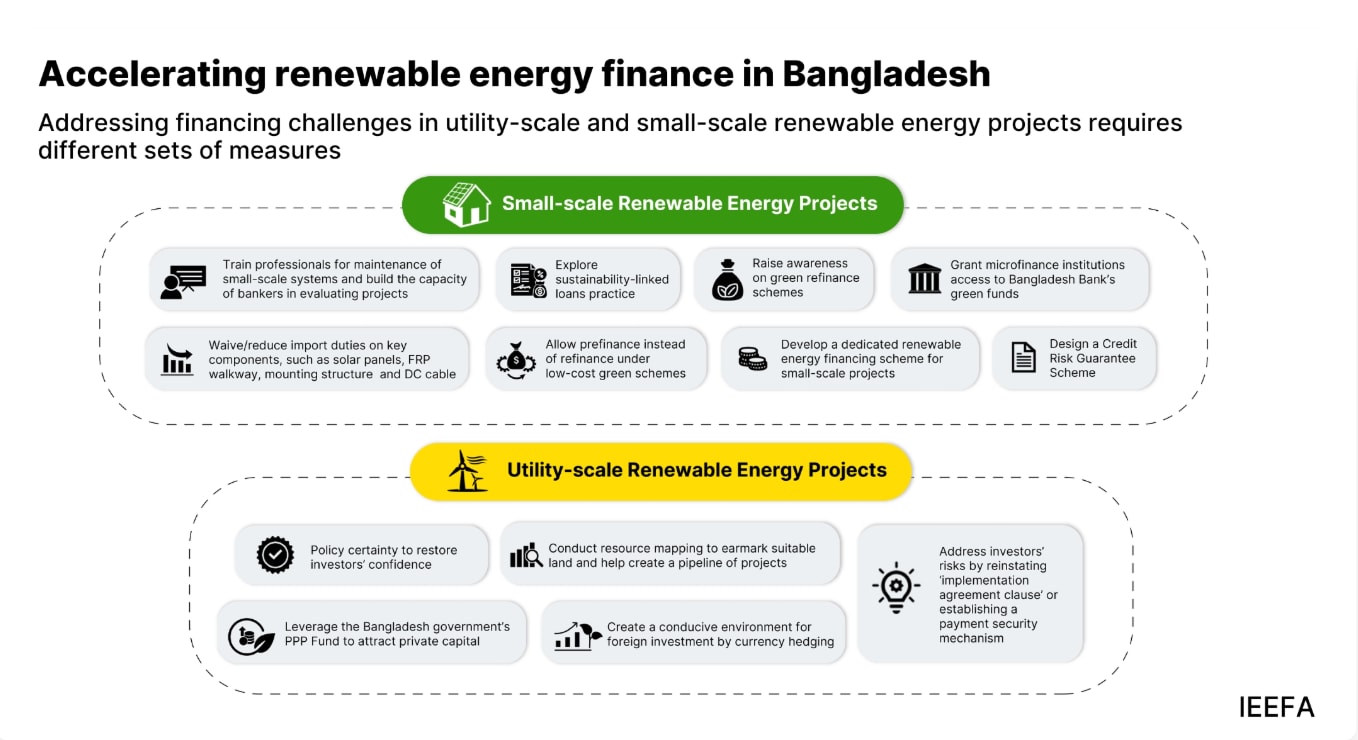
The government should ensure a stable energy policy that enables investors and renewable energy project developers to gain a better visibility of their projects’ profitability. Gaining investor confidence in renewable energy projects is also critical. Instead of abrupt changes, for example, a gradual transition from unsolicited project awards to a competitive bidding process can help address this challenge.
Further, the government should rationalize its trade policies to create a level playing field for large and small renewable energy players. While the government reduced customs duty on imported inverters in the budget for 2026, it should consider doing the same for other key components of small-scale solar projects to accelerate their implementation.
Payment security mechanism
The Bangladesh government can consider reinstating the 'implementation agreement' clause, which provides a sovereign guarantee to renewable energy producers to mitigate offtaker risk, defaults or delay of payment. Alternatively, like the Solar Energy Corporation of India, the government can set up a funding mechanism to provide payment assurance to renewable energy producers. Multilateral Development Banks (MDBs) and bilateral financial institutions can support the government in setting up this kind of payment security mechanism.
Addressing currency risk
The Bangladesh government, supported by MDBs, international climate finance institutions and bilateral financial institutions, can develop a currency hedging facility to reduce currency risk. The facility can subsidize foreign currency swap costs to allow renewable energy companies to borrow foreign debt capital at a reasonable cost. As domestic capital will not be enough, foreign capital will be necessary to fund Bangladesh’s energy transition.
How the Forum helps leaders navigate the transition of energy and materials systems
Tweaking an existing financing scheme for small-scale renewable energy projects
The refinance scheme for small-scale renewable energy projects is lengthy and cumbersome, which prevents many borrowers from accessing it.
Pre-finance, instead of refinance, can incentivize borrowers to avail of Bangladesh Bank’s green funds. Traditional banks are less interested in lending to small-scale renewable energy projects in rural areas. As such, the central bank may allow microfinance institutions (MFIs) to utilize low-cost green funds to lend to small-scale renewable energy projects in rural areas. This regulatory change can help accelerate rooftop solar, solar irrigation and biogas projects in rural areas.
Public-private-partnerships (PPP)
PPPs can also play a key role in mobilizing private capital for renewable energy projects that face policy and administrative challenges. The government can help with land acquisition, energy transmission and signing power purchase agreements, encouraging the private sector to raise capital and develop the project. This power purchase agreement model would suit private sector participation in renewable energy projects in special economic zones designed for the country’s industrialization. As the government has already allocated land for special economic zones, it can allow private project developers to implement and operate renewable energy projects in designated areas, avoiding land acquisition delays.
Credit guarantee can leverage private capital
The government, with support from MDBs and bilateral agencies, can set up a credit guarantee facility to partially cover credit risk that can attract private debt capital to the utility-scale renewable energy sector. This facility can also help small-scale renewable energy projects access debt finance at better terms – low interest rates, long-term debt and no collateral requirements.
The Bangladesh Bank, for example, can offer a portfolio credit guarantee to MFIs interested in lending to small-scale projects in rural areas. This will encourage MFIs to provide loans for small-scale renewable energy projects in rural areas at a lower interest rate, which will propel the green energy transition in those areas. A credit guarantee is a better way of using public capital as it has greater leveraging power to attract private capital compared with concessional loans.
Funding Bangladesh’s green energy transition warrants energy sector reforms, enhanced use of financing risk-mitigation instruments, financial regulatory tweaks and smoothing implementing measures. As the green energy transition will help the country reduce energy costs, enhance energy security and improve its fiscal position – all key to its growth revival and sustainable development ambitions – Bangladesh should work on developing a conducive financing ecosystem that will foster this transition.
Don't miss any update on this topic
Create a free account and access your personalized content collection with our latest publications and analyses.
License and Republishing
World Economic Forum articles may be republished in accordance with the Creative Commons Attribution-NonCommercial-NoDerivatives 4.0 International Public License, and in accordance with our Terms of Use.
The views expressed in this article are those of the author alone and not the World Economic Forum.
Stay up to date:
Renewable Energy


Forum Stories newsletter
Bringing you weekly curated insights and analysis on the global issues that matter.
More on Energy TransitionSee all

Shantanu Srivastava and Tanya Rana
March 5, 2026


