Direct green power connections: How to navigate new carbon rules

Direct green power connections offer a reliable way for exporters to meet carbon border adjustment rules Image: Getty Images/iStockphoto
- Direct green power connections (DGPCs) offer a reliable way for exporters to meet carbon border adjustment rules by providing traceable, real-time clean energy use.
- Competitive advantage is shifting from cost-cutting to verifiable decarbonization, with companies investing in green industrial clusters, smart grids and digital certification tools.
- Global coordination is essential to achieve the harmonized standards, financing and aligned certification needed to scale DGPCs and reduce compliance costs.
With rising cross-border carbon tariffs, companies that can prove clean energy use through direct green power connections (DGPCs) gain a competitive edge in cost and compliance.
The expansion of carbon pricing systems and the emergence of border carbon adjustment policies have reshaped business competition, with decarbonization featuring more prominently in strategy.
Replacing energy sources in supply chains with green power in a transparently measurable way is now critical to gaining a cost advantage over competitors.
Border carbon adjustment policies – which involve applying a carbon price to imports – emphasize the need for traceability so that the origin, production process and environmental energy sources can be tracked and verified. Such additional needs create significant operational burdens as conventional methods generally cannot meet the regulations.
To do so, companies must overhaul existing data collection and validation processes to demonstrate the exact time and location of renewable generation relative to production.
Industries with high energy intensity, such as metals and chemicals, therefore, face steep cost increases when reconfiguring energy infrastructure to comply with regulations.
Addressing traceability bottlenecks
The European Union’s Carbon Border Adjustment Mechanism (CBAM) is currently the only BCA mechanism that explicitly sets concrete compliance requirements for "traceable green electricity."
Still, many other countries are in the process of designing their own BCA frameworks. It is highly likely that the traceability of green electricity will be taken into account in the future.
As more countries adopt border carbon adjustment policies, DGPCs are becoming increasingly important for global exporters. DGPCs use dedicated power lines to deliver renewable energy directly from the source to the user, allowing for a more accurate match between the amount of energy produced and the actual energy needs.
Unlike conventional approaches, which rely on virtual accounting and lack real-time spatial traceability, direct connections create an auditable energy trail from source to consumption.
Because the energy can be physically traced from source to user, DGPCs (especially off-grid types) meet the EU’s requirement for “non-grid supply” under CBAM. This helps exporters accurately track their carbon emissions and meet the growing demand for clean energy.
Globally, regulatory frameworks on DGPCs are rapidly evolving. Some EU countries, such as Germany, Denmark, Latvia and the Netherlands, have led on introducing DGPC-related policies and carried out differentiated practices across various industries.
In China, a landmark policy breakthrough was issued in May 2025 on “the orderly promotion of the development of direct green power connection,” which sets definitions for DGPCs.
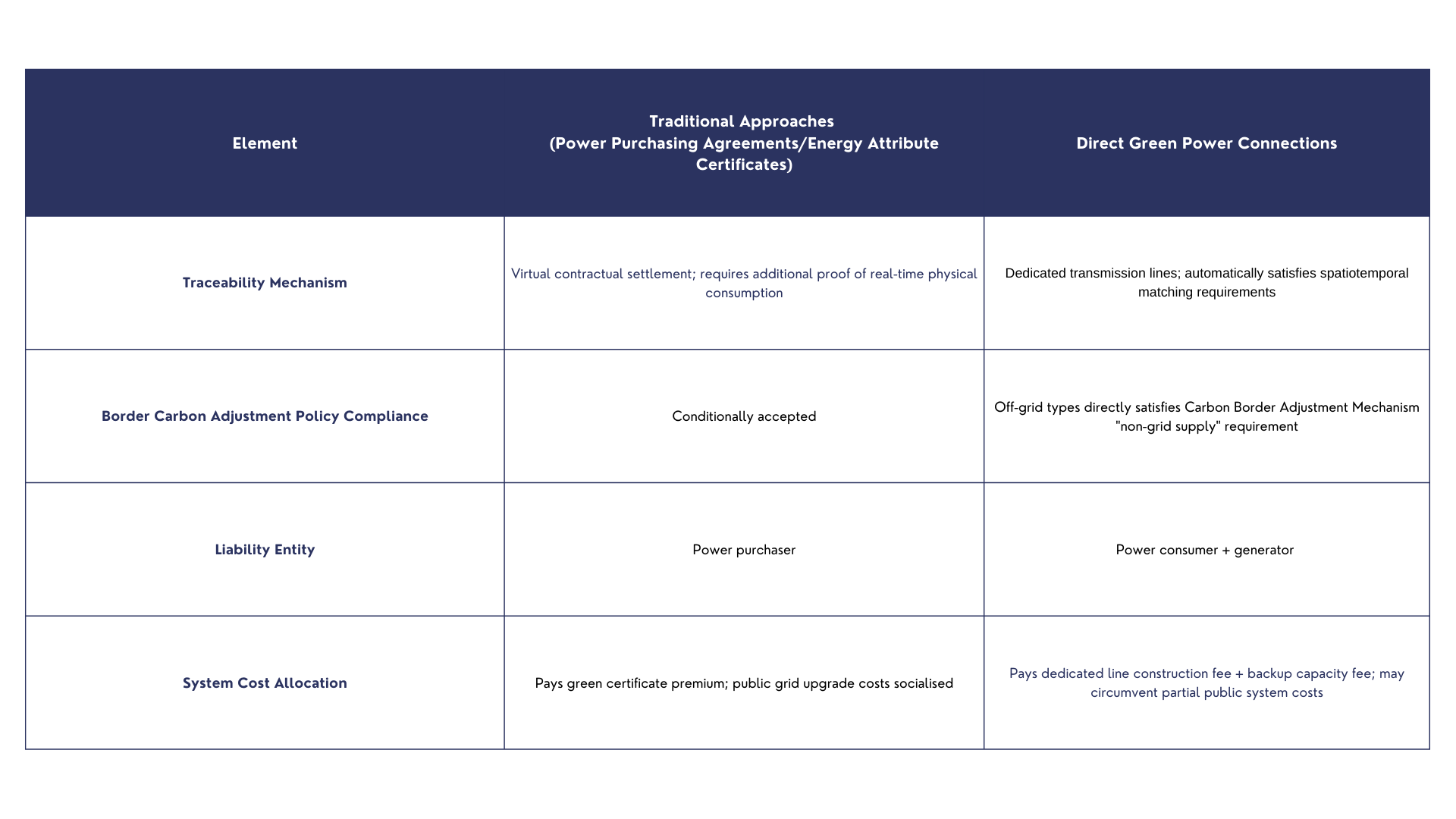
Globally, DGPCs are becoming increasingly common, enabling broader participation by multiple market stakeholders and empowering organizations to navigate emerging regulatory challenges to achieve compliance – and simultaneously a competitive advantage.
Demand is now driving the changing energy supply chain, with green investments increasingly concentrated in industrial clusters where decarbonization benefits are easier to capture and verify.
First movers are already relocating or developing new installations in renewable energy-rich zones, creating clusters of zero-carbon industrial parks and even piloting zero-carbon cities, taking advantage of DGPCs.
Power grids are also evolving, requiring system-level innovation and further technological investment to improve DGPC projects.
Emerging business models are creating new commercial opportunities – e.g. green power aggregators, virtual power plants, services that combine asset management with green financing and digital platforms that track and certify energy use.
These strategies reduce emissions and costs associated with carbon pricing mechanisms. Being able to prove the energy mix used provides multiple benefits, including greater control over power use and helps avoid energy losses during transmission.
As a result, competitiveness is shifting from being about cutting costs to proving real progress on decarbonization, which is transforming electricity consumers into active system architects.
Challenges and synergies towards resolutions
Despite the obvious upsides, DGPCs globally face three major challenges, which can be tackled by finding global synergies:
1. Technical reliability
Stronger protections are needed to ensure reliability. As solar and wind power can be unpredictable, projects often need to add energy storage systems such as batteries, which raise initial costs. At the same time, technical issues such as voltage fluctuations remain unresolved and can affect the stability of operations.
Despite available backups, most installations still depend on traditional grids during extreme weather, exposing self-sufficiency gaps.
To keep systems reliable, it’s important to have clear rules about safety and responsibility between DGPC projects and public power grids. Shared technical standards, tools such as artificial intelligence to match energy supply and demand and hydrogen storage for backup, can help reduce voltage fluctuations and enhance system resilience.
2. Economic viability
Export-focused companies enjoy green benefit premiums, which increase their participation; however, building dedicated transmission lines requires prohibitive investments.
Budgeting is also difficult due to unstable electricity prices – where peak rates can be several times higher than off-peak – and the unclear, inconsistent rules of new carbon border policies across different countries.
In addition, outdated power grids can’t support large-scale direct connection projects, and reconstructing and upgrading both physical infrastructure and digital systems will require significant financial support.
The solution is to promote market-based traceability. Transparent electricity markets benefit from rewarding verified carbon savings through premium pricing and robust physical traceability.
Market rules must also be adapted to regional infrastructure differences, taking into account the interests of multiple stakeholders. Green finance instruments, such as preferential loans and tradable carbon credits, can help manage cost risks and support meaningful decarbonization.
3. Governance fragmentation
Inconsistent standards can fracture certification systems, as was seen in recent disagreements between France and Germany over power purchase agreements.
Meanwhile, regional protectionism can restrict cross-border energy flows.
Without unified carbon accounting or mutual recognition frameworks – such as how the EU’s mechanism accepts physical power connections but not China’s energy certificates – businesses face extra costs from having to meet multiple, overlapping requirements.
One pathway to resolution includes enhancing international regulatory alignment. Wider recognition of green certificates can be advanced through standardized carbon accounting and better integration with databases such as that of the the International Renewable Energy Agency.
Streamlined domestic permitting and trade frameworks, for example, through the World Trade Organization, can further reflect the progress of developing economies.
Bringing market participants together in an impartial setting, including through the World Economic Forum’s Climate Finance Innovation initiative, can play a vital role in resolving each of these challenges, bridging policy gaps by facilitating trust-building, knowledge exchanges, the alignment of methodologies and the development of common traceability frameworks.
Don't miss any update on this topic
Create a free account and access your personalized content collection with our latest publications and analyses.
License and Republishing
World Economic Forum articles may be republished in accordance with the Creative Commons Attribution-NonCommercial-NoDerivatives 4.0 International Public License, and in accordance with our Terms of Use.
The views expressed in this article are those of the author alone and not the World Economic Forum.
Stay up to date:
SDG 07: Affordable and Clean Energy


Forum Stories newsletter
Bringing you weekly curated insights and analysis on the global issues that matter.
More on Climate Action and Waste Reduction See all

Laetitia Gardé and Marc Delobelle
February 26, 2026


