Why shared standards are the missing link to ending plastic pollution
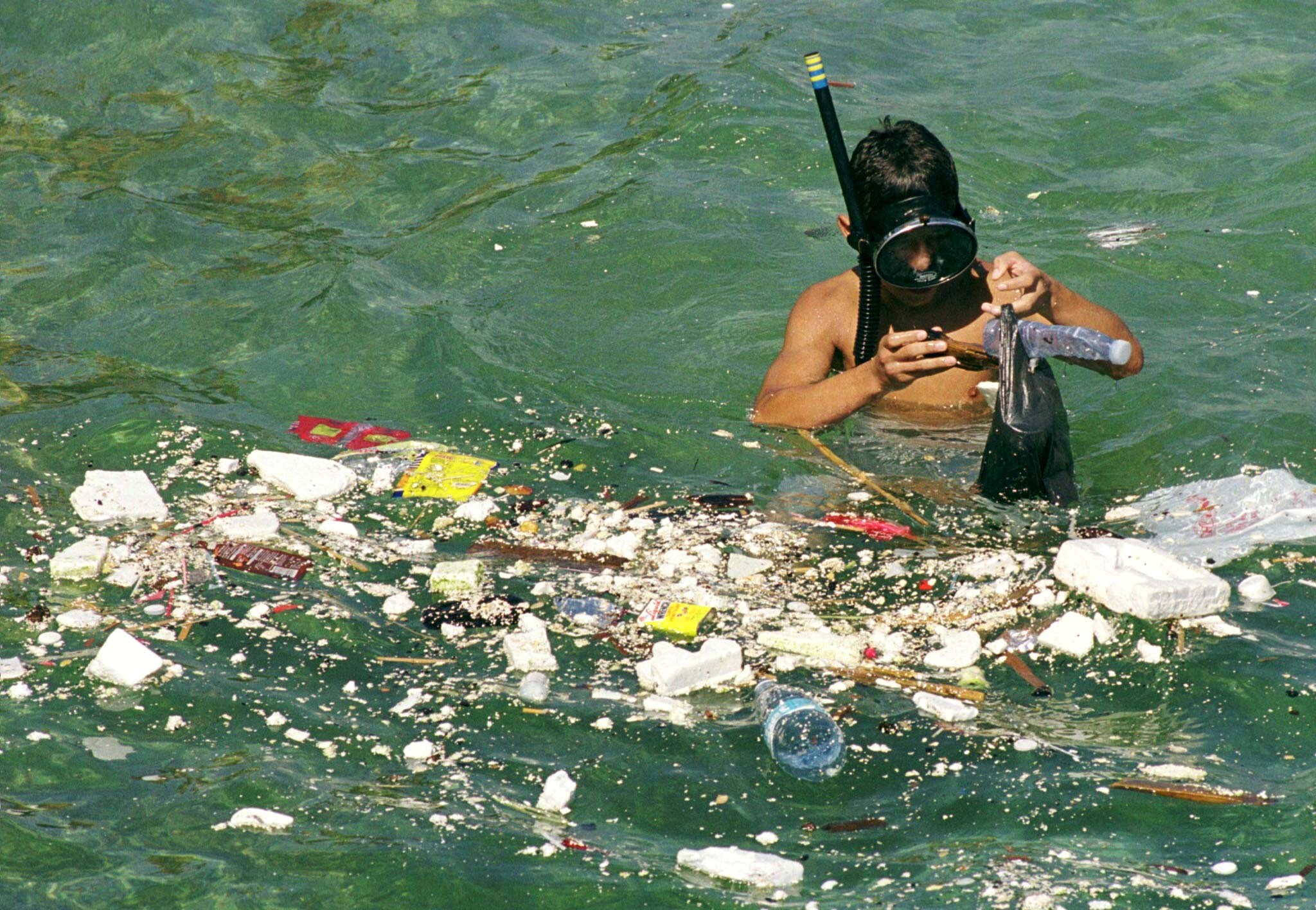
Plastics have infiltrated our seas to such a degree that it is impacting livelihoods and daily life. Image: Reuters
- Plastics have infiltrated our seas to such a degree that it is impacting livelihoods and daily life.
- As global discussions around a plastic treaty take place, world leaders should consider how to enforce it with standardization.
- ISO standards can help enable the transition from linear to circular business models.
In a quiet fishing village off the coast of Brittany, generations have made their livelihoods from the sea. But today, the nets bring in more than just fish.
Tangled within them are fragments of discarded plastic: bottle caps, packaging film and fishing gear. The crisis isn’t far away anymore. It’s everywhere – in the food we eat, the water we drink and even the air we breathe.
In France alone, 2.2 million tonnes of plastic packaging are put on the market each year, according to a report by the French Ministry for Ecological Transition – yet less than 30% of household packaging is currently recycled.
Even with expanded sorting systems, that figure is expected to reach only 40%. However, France’s struggle is part of a much larger picture. According to the United Nations Environment Programme, around 430 million tonnes of plastic are produced globally each year.
Over the next two weeks, as global negotiators gather in Geneva, Switzerland, for the second part of the fifth session of the Intergovernmental Negotiating Committee (INC-5.2), the world will be watching.
After years of mounting pressure, governments are working to finalize a groundbreaking international treaty to end plastic pollution. It’s a historic opportunity but policy alone won’t save our oceans.
If we’re serious about tackling the plastic crisis, we must also equip ourselves with the tools to make real change. That’s where International Standards come in.
The quiet force behind plastic solutions
For decades, ISO, the International Organization for Standardization, has been developing science-based, consensus-driven solutions that support sustainability. Its standards help developing economies and local communities adopt effective, locally-driven approaches to plastic waste, supporting more resilient and sustainable systems worldwide.
Today, ISO’s work is more urgent than ever. From ISO 15270 on plastic recycling to standards for environmental labelling, the organization provides concrete methods to reduce waste and increase circularity.
ISO/TC 323 on standardization of the circular economy – the committee I chair – has been working closely with technical committees on plastics, packaging and waste management to ensure our standards reflect the interconnected nature of these challenges.
By offering practical frameworks for managing plastics across their entire life cycle – from material design and product labelling to recycling performance and environmental claims – ISO standards help prevent and reduce waste at the source, strengthen collection and reuse systems and accelerate the transition to a circular economy.
Crucially, these tools are already in use: guiding industries to embed circularity into business models, improve traceability and track progress using common metrics. We are no longer talking about what might work. These are proven, applicable solutions that countries and companies can use today.
In India, for instance, the national adoption of IS/ISO 17088 has made certification mandatory for compostable plastics, helping eliminate misleading claims and improve end-of-life handling.
Meanwhile, in Kenya, ISO has worked directly with the national standards bureau to integrate international standards into domestic law and develop conformity systems – helping align policy goals with on-the-ground implementation.
The treaty is just the beginning
The success of the global plastic treaty will depend on implementation. Countries will need to translate ambition into law, infrastructure and business practice – and fast.
Here too, standards play a vital role. They turn high-level goals into actionable steps: measurable, verifiable and globally aligned. For instance, if the treaty calls for reduced production, decreased plastic leakage or increased recycled content, standards can define how these are measured, reported and verified, ensuring consistency across borders and industries.
The global plastics treaty will be a milestone; whether it becomes a turning point depends on what happens next.
”That consistency is key. Without it, we risk fragmentation: different countries interpreting the treaty in different ways, leading to inefficiencies and loopholes. Standards offer a common language that connects policy to practice and ambition to accountability.
And because ISO brings together experts from over 170 countries – including governments, civil society, academia and business – our standards reflect a truly global consensus. That makes them uniquely suited to support treaty implementation in ways that are fair, inclusive and effective.
A win for business and the planet
For industry, standards aren’t just about compliance; they’re a catalyst for innovation and competitiveness.
They give businesses confidence that their products, processes and performance claims meet global expectations. They reduce duplication, eliminate market barriers and enable companies to invest in scaleable, interoperable solutions. That’s especially important for small and medium-sized enterprises, which may lack the resources to develop bespoke approaches.
Circular economy standards, for example, help organizations add value to resources through circular design, sustainable sourcing, territorial symbiosis and more. They support the preservation of resource value – through practices such as reducing, reusing and repairing – and facilitate value recovery through end-of-life strategies.
These approaches are grounded in the ISO 59000 series, which outlines the core principles and strategies of a circular economy, from preserving resource value to enabling collaboration across regions and sectors.
ISO’s work is particularly crucial now: the 2025 Circularity Gap Report finds that global circularity has fallen to just 6.9%, highlighting the urgent need for coordinated, standards-based action.
In doing so, they enable the transition from linear to circular business models, unlocking new value networks and job opportunities.
And because ISO standards are based on the latest science and best practices, they help businesses stay ahead of the curve – while saving time, cost and reputational risk.
Shared responsibility, shared opportunity
As negotiators gather at the Palais des Nations in Geneva, I urge them to look beyond the treaty’s wording and consider how we turn global ambition into reality.
That means referencing existing standards where possible and committing to developing new ones where gaps remain, to ensure that treaty goals can be translated into measurable, workable solutions worldwide.
I’ve seen first-hand the transformative power of collaboration across borders and sectors.
Our circular economy standards bring together experts from over 100 countries across sectors to create standards that are globally relevant and shaped by real-world practice. Circularity is not a siloed issue – it is systemic and it must be approached as such.
The global plastics treaty will be a milestone but the question is, will it become a turning point? Let’s ensure it comes with the tools, trust and traction to succeed.
Together, we can build that future – standard by standard.
Don't miss any update on this topic
Create a free account and access your personalized content collection with our latest publications and analyses.
License and Republishing
World Economic Forum articles may be republished in accordance with the Creative Commons Attribution-NonCommercial-NoDerivatives 4.0 International Public License, and in accordance with our Terms of Use.
The views expressed in this article are those of the author alone and not the World Economic Forum.
Related topics:

Forum Stories newsletter
Bringing you weekly curated insights and analysis on the global issues that matter.
More on Climate Action and Waste Reduction See all

Temidayo Akenroye and Hushneara Begum
April 10, 2026


