Chief People Officers Outlook 2025: Talent strategy amid global disruption

Chief people officers are adopting cautious short-termism alongside long-term transformation. Image: REUTERS/Parth Sanyal (INDIA EMPLOYMENT BUSINESS TRANSPORT)
- Chief people officers are pausing hiring and restructuring amid geo-economic uncertainty and rapid technological change.
- Artificial intelligence (AI) adoption, talent scarcity and evolving workforce expectations are defining current talent priorities.
- Chief people officers are preparing long-term transformation by prioritizing structural redesign, company culture and human-centric AI deployment.
Work and talent systems are being reconfigured, as geoeconomic volatility, rapid advances in artificial intelligence (AI) and shifting demographics force organizations to rethink how they attract, develop and retain people.
Amid persistent disruption in global labour markets, organizations are pausing to navigate uncertainty now, even as they lay the groundwork for structural transformation ahead.
Many employers are delaying hiring and restructuring decisions as they grapple with geoeconomic volatility and rapid technological shifts. At the same time, there’s a mounting recognition that long-term organizational resilience demands rethinking job design, talent development and workforce strategies.
Short-term caution, long-term transformation
As continued disruption hits global labour markets, the World Economic Forum has launched its inaugural Chief People Officers Outlook 2025 to map how senior people leaders and organizations are responding and capture the current talent strategy landscape.
The findings reveal a dual reality: short-term caution alongside a longer-term imperative for transformation.
Recent data confirm this caution. Labour markets are showing signs of a freeze, with low hiring and quit rates. According to the Outlook, many organizations are postponing hiring or restructuring decisions as they assess an evolving landscape, navigate geoeconomic uncertainty and rapid advances in technology.
When asked about labour market expectations for the year ahead, chief people officers expressed no clear consensus, underlining current uncertainty.
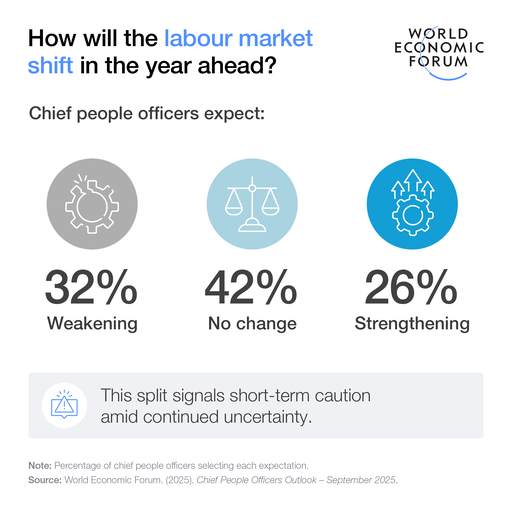
Yet, while caution defines the present, chief people officers emphasize the need to invest in longer-term change to navigate continued disruptions and ensure long-term organizational resilience and success.
Caution is the current setting – but transformation is the long-term opportunity.
”Challenges driving structural change
Beneath this uncertainty are structural challenges influencing organizational priorities. Chief people officers identify three testing factors in particular: AI adoption, talent scarcity and changing workforce expectations.
AI adoption
Technology remains one of the most transformative trends, according to the Forum’s Future of Jobs Report 2025. Despite general optimism, people leaders from Chief People Officers Survey (May-June 2025) also highlight several near-term risks for their workforce.
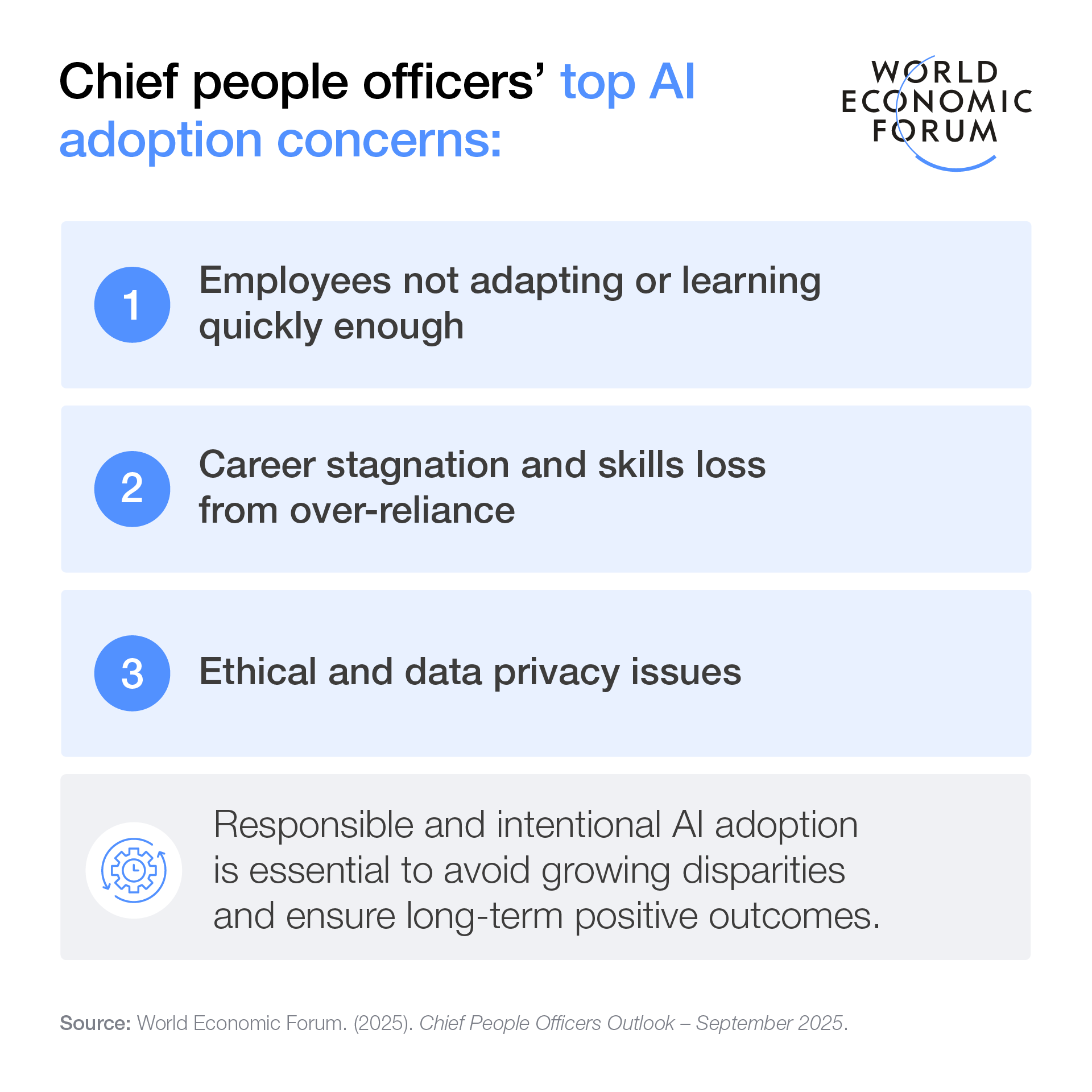
The top three risks in order are:
- Employees may not adapt or upskill quickly enough to keep pace with new technologies.
- Fears of career stagnation and skill atrophy due to the over-reliance on AI.
- Ethical and data privacy concerns.
The top concern is that employees may not adapt or upskill quickly enough to keep pace with new technologies. This is followed by fears of career stagnation and skill atrophy due to over-reliance on AI. Ethical and data privacy concerns rank third.
Chief people officers in the Outlook underline the importance of intentional, human-centric AI strategies to avoid deepening disparities and to deliver positive outcomes.
Talent scarcity
At a global level, talent availability and distribution remain uneven, and demographic shifts and skills gaps are compounding talent scarcity. Governments compete to attract and develop skilled talent through national strategies, while global employers adopt more agile workforce models.
Chief people officers in the Outlook emphasize the importance of forward-looking, global strategies – leveraging distributed teams, remote and hybrid operations and cross-border collaboration – to remain competitive.
In the current environment, workforce resilience stems from global, not just local, talent strategies.
”Changing workforce expectations
People leaders in the outlook point to how changing workforce expectations are shaping talent strategies in mid-2025. Workers, particularly younger generations, are entering the labour market with new priorities, placing greater emphasis on flexibility and purpose.
As one chief people officer observed: “Today’s talent is confident, well-informed and unapologetically selective. They’re clear about what they want and willing to walk away from what doesn’t serve them.”
But while expectations evolve, low vacancy rates in many regions and industries create a paradox marked by both increased agency and choice alongside growing precarity.
Leaders also report deeper social and psychological shifts. Rising mental health concerns and increasing value polarization within organizations are reshaping workplace dynamics. Technology is seen as both accelerating these trends and redefining how employees connect, communicate and identify with their organizations.
Transformation as a strategic imperative
In response to these challenges, chief people officers are prioritizing a fundamental rethinking of organizational structures, job design and company culture. The survey identifies three clear priorities for the year ahead:
- Review organizational structure and job design.
- Focus on workplace culture and articulating business purpose and impact.
- Support workforce deployment of AI and process automation.
Existing structures and workforce models are increasingly inadequate for tomorrow’s economies and labour markets. Current challenges are accelerating the need for transformation. While this transition is complex, it presents an opportunity to build a more resilient, inclusive and agile world of work.
The Chief People Officers Outlook 2025 illustrates that while the present is marked by caution, the future requires bold transformation. Accurate data, aligned strategies, responsible leadership and continued innovation will be essential. This is not just a time for adaptation – it is a time for redesign and chief people officers are emerging as critical to shaping, enabling and leading the transitions ahead.
Have you read?
Don't miss any update on this topic
Create a free account and access your personalized content collection with our latest publications and analyses.
License and Republishing
World Economic Forum articles may be republished in accordance with the Creative Commons Attribution-NonCommercial-NoDerivatives 4.0 International Public License, and in accordance with our Terms of Use.
The views expressed in this article are those of the author alone and not the World Economic Forum.
Stay up to date:
Future of Work


Forum Stories newsletter
Bringing you weekly curated insights and analysis on the global issues that matter.
More on Jobs and the Future of WorkSee all

Keith E. Ferrazzi and Wendy Smith
April 9, 2026


